- Home
- China
- World
- Europe
- Politics
- Business
- Opinions
- Tech & Sci
- Culture
- Sports
- Travel
- Nature
- Picture
- Video
- Live
- TV
- Specials


Share







Copied
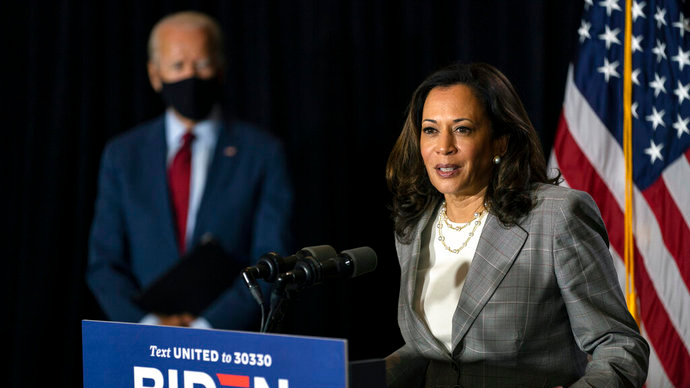
U.S. Democratic presidential candidate and former Vice President Joe Biden stands left as his running mate Sen. Kamala Harris speaks at the Hotel DuPont in Wilmington, Delaware, U.S., August 13, 2020. /AP
Editor's note: Josef Gregory Mahoney is a professor of politics at East China Normal University. The article reflects the author's opinion, and not necessarily the views of CGTN.
Much is being made of Joe Biden's selection of Kamala Harris, the U.S. senator from California, as his running mate for the upcoming presidential election. Many have focused on her gender and race and how she strengthens Biden's campaign. Less is said on other factors and how the selection might impact U.S.-China relations if Biden wins in November.
A multi-ethnic woman against a racist time
Much is being made of her being the first woman and first black person to be chosen as a vice presidential candidate. In fact, while these are surely positives given U.S. racial history, it's more important to note the intersectionality of being a multi-ethnic woman instead of focusing separately on gender and race.
While Barack Obama's presidency marked a vital step forward in America's racial history, Michelle Obama's role as the nation's first African American first lady was in some respects more powerfully symbolic than her husband's.
If Harris is elected as vice president, then this would mark an even more potent achievement for not only African American women, but also a daughter of immigrants from India and Jamaica, and also a woman who got a Chinese name when running as a political candidate in San Francisco as she was required to register one.
This also comes at a time when this type of background is sorely needed after four years of bruising race relations under Trump, and with multi-ethnic women especially vulnerable to COVID-19 morbidity and mortality under Trump's failed containment and control policies.
Will mobilize voters and unify party
While some pundits worry whether Harris will please the progressive and left-oriented wings of the Democratic Party, her gender and race surely appeals to them and will appeal even more when Trump attacks her.
Of all the potential running mates, Harris was the obvious choice to strengthen Biden's campaign. With a candidate like Sanders, one can't seize control of the party apparatus – if one does not have both institutional and voter support to bend the party to one's will – then it is unlikely the candidate would win the election much less be able to govern effectively even if he did.
There is good reason to think that she'll do a better job inspiring and mobilizing both women and multi-ethnic voters to vote than Hillary Clinton did four years ago. While Biden is a deft politician, neither Biden nor Clinton are great campaigners. Harris's earlier campaign for the presidential nomination indicated that she's ready for the national stage.
This will be vital in a closely contested race given an electoral college system that favors Trump, as well as the number of dirty tricks he's already pursuing to suppress minority voters and mail-in-votes.
Stronger than Pence (and maybe even Biden)
Vice President Mike Pence was instrumental to Trump's first campaign insomuch as his place on the ticket warmed the hearts of Evangelicals. Nevertheless, Trump has constantly undercut Pence, given the former's pathological need to always be the center of attention, even in those cases when Trump has delegated responsibility to Pence, as happened during the early days of the COVID-19 outbreak.
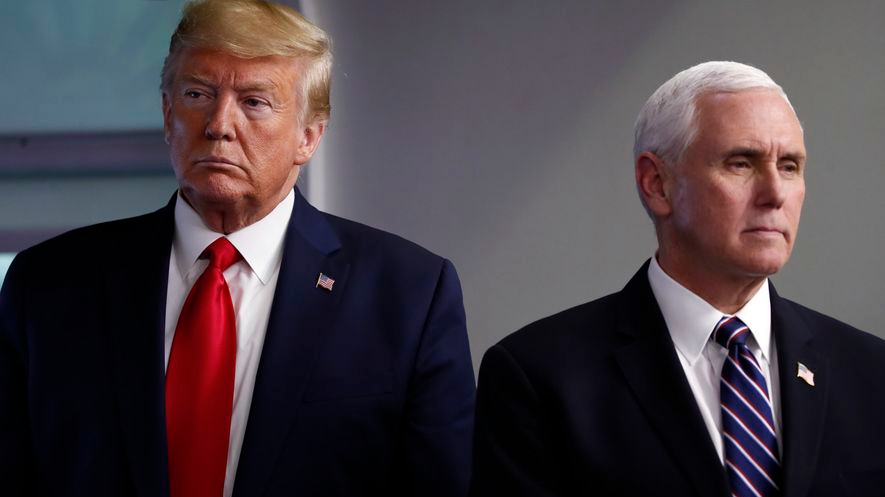
U.S. President Donald Trump and Vice President Mike Pence pictured in the James Brady Press Briefing Room of the White House, Washington, D.C., April 8, 2020. /AP
Further, despite Pence trying to take a stronger role in foreign policy, particularly by getting out in front of Trump by attacking China, he's been outflanked in this respect by Secretary of State Mike Pompeo.
Indeed, Pompeo by many accounts harbors his own ambitions and will likely run four years from now. He may face Pence in a race for the Republican nomination, and likely has already defeated him by building a stronger national brand.
Harris is also strong. This is vital in candidates for vice president in the U.S., insomuch as they are expected to be more assertive or even, dare say, aggressive, than their running mates. Her previous experiences in office as well as her performance when she was running for president indicate she's unlikely to pull punches and can be expected to fare very well in any debate with Pence.
But perhaps most importantly, some are concerned that Biden's age is a weakness. Biden will turn 78 this November. Having a strong vice president like Harris will give voters and markets more confidence.
Implications for foreign policy and Sino-U.S. relations
When Biden announced Harris as his running mate, Trump immediately responded in his typically orientalist, race baiting style, saying that if Biden and Harris win, then Americans will have to learn Chinese.
Well, that would be a good thing, even if Biden loses. When Trump first took office he bragged that his grandkids could sing songs in Chinese – something he's unlikely to mention again. And whatever is good enough for his privileged grandchildren ought to be good enough for anyone. Anyway, with more Chinese studying or having studied English than Americans who speak it, there's really no reason to be proud of U.S. ignorance or cultural chauvinism.
While some in Beijing may worry that Harris's various positions on China are too tough, she's rather typical in this respect for a Democratic candidate for national office. Further, her positions appear principled and reasonable, at least by a liberal calculus, and not racist or wantonly provocative.
While Trump promises to make this a race about China, and likely both Biden and Harris will be forced to take even stronger stands in the campaign, a Democratic win will probably de-escalate tensions in the near future.
That said, in foreign policy Trump is often his own (and the American establishment's) worst enemy. A Biden presidency may be likely to do a better job convincing other countries to choose the U.S. over China. But those developments could be better managed by Beijing, over time, and less prone to crises that can spiral out of control.
(If you want to contribute and have specific expertise, please contact us at opinions@cgtn.com.)