- Home
- China
- World
- Europe
- Politics
- Business
- Opinions
- Tech & Sci
- Culture
- Sports
- Travel
- Nature
- Picture
- Video
- Live
- TV
- Specials


Share






Copied
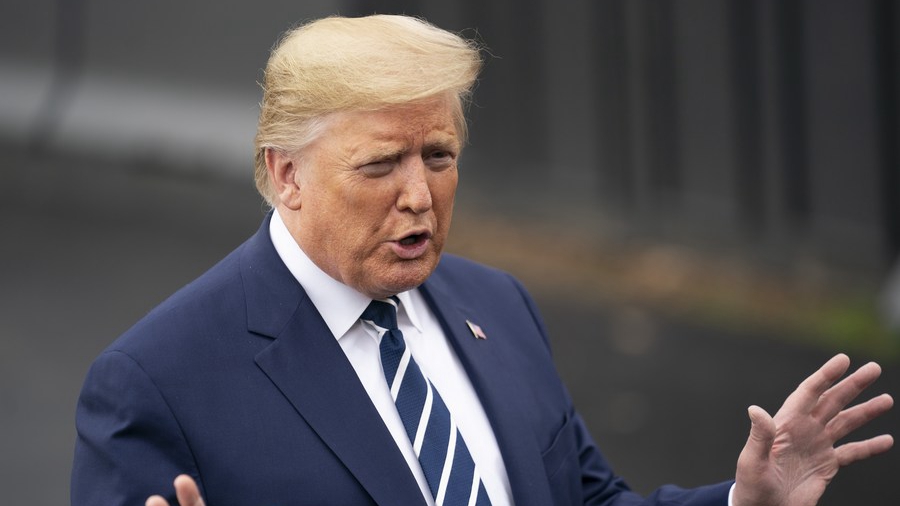
U.S. President Donald Trump speaks to reporters before leaving the White House in Washington, D.C., U.S., March 3, 2020. /Xinhua
Editor's note: Mike Cormack is a writer, editor and reviewer mostly focusing on China, where he lived from 2007 to 2014. He edited Agenda Beijing and is a regular book reviewer for the South China Morning Post. The article reflects the author's opinions, and not necessarily the views of CGTN.
I remember once watching a Wimbledon tennis final – it must have been in the late 1990s – when Bill Clinton was in attendance. Afterwards he gave a short, elegant speech contrasting tennis and politics, saying that it was unfortunate that the sport was a zero-sum game with a winner and a loser, whereas he strived to make governing non-zero-sum, giving the best outcomes for the greatest number of people.
It was a nice illustration of Clinton's progressive approach, as well as his ability to connect with an audience. Clinton might have been a supremely talented politician, highly charismatic and able to give charming little speeches at any event he might be attending, but he was also a serious policy wonk, a man who authors Charles Allen and Jonathan Portis describe in their book The Comeback Kid as "a politician who could spout data and statistics nonstop, a man with a quick answer for every question".
For Clinton, policy was serious stuff, with profound effects. You can agree or disagree with how he governed, but to read his memoir My Life is to hear from someone electrically alive to politics.
His successor but three however is as far from this as is humanly possible. Donald Trump's absolute indifference to governing can be seen whenever he turns to policy. Effects and outcomes are quite beyond him, a man with no understanding of the public sector and how departments achieve their goals.
Trump's legislative achievements are marginal: there was the tax cuts act of 2017, and the First Step Act of 2018, providing modest changes to the federal prison system and unusually passing with overwhelming bipartisan support in Congress.
But few successes spring to mind. He failed to buy Greenland. He has not replaced Obamacare. He has not built a wall between the U.S. and Mexico. He has not won the trade war with China, despite saying "trade wars are easy to win". And he has utterly failed in the handling the coronavirus and the subsequent economic dislocation, with a second wave of infections well and truly underway.
But Trump needs to keep the attention of U.S. voters away from that grimly shambolic effort. His decision to ban transactions between U.S. companies and TikTok and WeChat may not be entirely a distraction strategy, but there's certainly a large component of that at work.
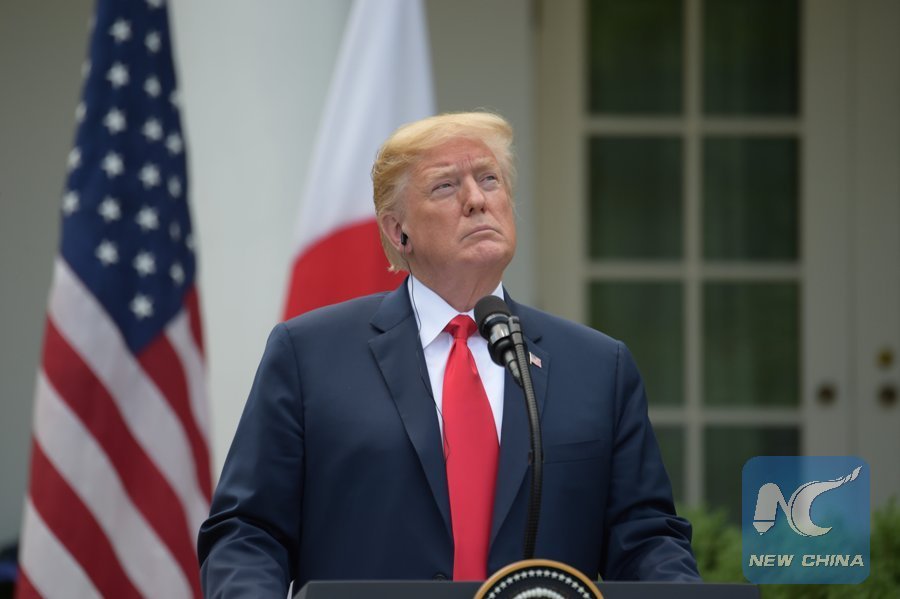
U.S. President Donald Trump attends a joint press briefing at the White House in Washington, D.C., June 7, 2018. /Xinhua
The Trump administration, to paraphrase a masterful quote about the 1930s British prime minister Stanley Baldwin, simply takes one punch in the dark; looks round; and then takes another.
Had Trump therefore looked at the repercussions of his proposal? Had he, as Bill Clinton would have done by breakfast, examined the outcomes, established the winners and losers, considered ways to minimize risks and ameliorate possible negatives? Of course not. Such considerations do not enter policy deliberations in the Trump White House.
And so when Trump was asked about the effect of the ban on WeChat, he seemed almost taken aback to have to consider it. When told, "There's a lot of alarm among American companies about your order on WeChat. Apple, Ford, Disney, they're worried because it's such a big communications platform and payment platform in China, that if you ban U.S. businesses from working with them, that they won't be able to sell iPhones in China or similar markets," Trump's reply – and its bored, slightly peevish tone – was a perfect encapsulation of his approach to governing.
He said: "Whatever."
As a way of signalling his complete disinterest in policy outcomes, it could not be bettered. He might as well have stuck his fingers in his ears. But that's how Trump and his administration operate. They set up targets to clash with, to win headlines, to control the media cycle for a day or two – and then, as stories emerge of incompetence and corruption, the process begins all over again.
That real people and businesses might be affected rarely come into the equation. The "Muslim Ban" - a travel ban affecting people coming to the U.S. from Iran, Iraq, Libya, Somalia, Sudan, Syria, and Yemen, regardless of whether they held valid visas – tore families apart in the name of little more than blind prejudice.
Trump's advocacy of quack cures for the coronavirus (when he finally could be persuaded to take it seriously) meant serious efforts to contain the pandemic were undermined, and more Americans died. The policy of separating migrant families resulted in thousands of children to be treated inhumanely, causing deaths, injuries and traumatic separations from families.
But none of these mean anything to him – in fact, their very ability to agitate the media pleases him. It makes him feel in control. Little else in his presidency does. But what about people who are suffering, losing their jobs, being split from their families, dying in huge numbers? You know what he would say.
"Whatever."
(If you want to contribute and have specific expertise, please contact us at opinions@cgtn.com)