- Home
- China
- World
- Europe
- Politics
- Business
- Opinions
- Tech & Sci
- Culture
- Sports
- Travel
- Nature
- Picture
- Video
- Live
- TV
- Specials


Share







Copied

The al-Aqsa Mosque. /VCG
Editor's note: Hamzah Rifaat Hussain is a former visiting fellow at the Stimson Center in Washington, and currently serves as assistant researcher at the Islamabad Policy Research Institute (IPRI) in Pakistan. The article reflects the author's opinions and not necessarily the views of CGTN.
On Wednesday, Saudi Arabia's Foreign Minister Prince Faisal bin Farhan told reporters in Berlin that his country will not follow the footsteps of the United Arab Emirates in normalizing relations with Israel until an internationally recognized peace agreement with the Palestinians is both signed and secured.
As tensions have festered in the Middle East in the aftermath of the U.S. brokered deal, all eyes were on Riyadh to follow a similar path, approve or denounce the deal. With the Palestinians equating this normalization of ties as a betrayal to their just cause towards self-determination, Saudi Arabia chose to adopt a more nuanced stance by conditioning its normalization of ties with Israel with peace in Palestine.
Nuances instead of binaries in Middle Eastern foreign policy are needed for greater peace and stability in the crisis-struck region, which has unfortunately been ignored by Washington.
The Trump administration has peddled toward serving the interests of one party to the conflict at the expense of the other aggrieved one. This could ignite a tinderbox in the COVID-19 environment, which is detrimental for regional and global stability. Contrasting and as a matter of principle, Saudi Arabia has refrained from openly following their allies, the UAE.
Saudi Arabia's geographical proximity to Israel and similar threat perceptions did not prevent Riyadh from adopting a principled position by ruling out the possibility of forging ties with Israel, with peace in Palestine laid out as a precondition.
Despite being a close ally of the UAE, Saudi Arabia had the strategic foresight which the Trump administration has consistently lacked in conditioning amiable ties with the resolution of the Israeli-Palestinian conflict.
This comes from a kingdom which has closely cooperated with the Emirates on strategic issues such as the Yemen crisis, the Qatar diplomatic quagmire and backing anti-Muslim brotherhood governments across North Africa.
Prince Farhan's statement came in the aftermath of an earlier news conference in Germany with his counterpart Heiko Maas, where he denounced Israel's annexation plans of the West Bank and its illegal settlements.
This diplomatic maturity can be contrasted with American policy blunders which included recognition of Jerusalem as the capital of Israel and silence on annexation plans and settlements.
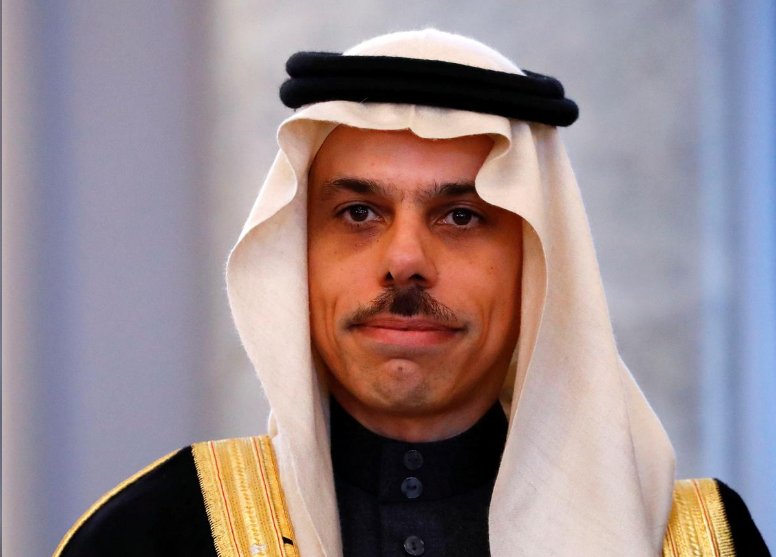
Prince Faisal bin Farhan Al Saud poses for the media after his diplomatic accreditation at Bellevue Palace in Berlin, Germany, March 27, 2019. /Reuters
The rationale behind pursuing binary approaches in the Middle East, however, comes as no surprise. The administration is solely focused on seeking reelection in November 2020, for which heavy handedness with China, troop withdrawals from Afghanistan and implementing the Jared Kushner plan in the Middle East is to be secured to cater to popular constituencies domestically.
The rationale for pursuing quick fixes to intractable conflicts in the Middle East, as the UAE-Israel deal clearly demonstrates, is also obvious. A poor response to curbing the COVID-19 pandemic domestically, rising racial tensions across America and disillusionment from fellow Republicans who are now seen openly endorsing his presidential rival Joe Biden in the presidential race has meant that securing deals on the foreign policy front is imperative.
History shows that there are perils in adopting American binaries in the Middle East which go beyond the Palestinian issue.
The U.S. withdrawal from the Joint Comprehensive Plan of Action (JCPOA) Nuclear Deal in 2018, for example, which was hailed by Washington and some of its allies in the Gulf, eventually resulted in an isolated and embattled Iran which became increasingly emboldened, jeopardizing future peace initiatives in the region and contributing to lingering trust deficits.
At the micro level, U.S. binary approaches towards resolving Middle Eastern conflicts have presented another unique set of challenges.
Sunni's organizations in Palestine, such as Hamas, who often employ violence as a liberation strategy in comparison to the more moderate Fatah, became defiant and called for a third Intifada after U.S. recognition of Jerusalem as the capital of Israel, resulting in an escalation of violence and crossfire with Israel.
Similarly, backing Kurdish rebels in Syria at the expense of forces loyal to the Bashar Al Assad administration has resulted in a fractured country, with the Syrian crisis constituting one of the worst global humanitarian disasters alongside Yemen in the region.
Calls for an inclusive settlement which caters to all the aggrieved parties in different countries for everlasting peace has been missing from the Trump doctrine, resulting in the continuation of protracted conflicts with no solution in sight.
This certainly doesn't entail pursuing anti-Israel policies either. States which share amiable ties with Israel have refrained from adopting binaries for the wider goal of inclusivity and peace.
China is a notable example in this regard, where Beijing's strong economic, military and technological exchanges with Israel have not prevented it from fostering good ties with Palestine and the Muslim world at large. Beijing had even gone on to recognize Hamas as the legitimate governing authority in the Palestinian territories after the organization was elected in 2007.
However, unlike the United States which banks upon securing Israeli interests and antagonizing the Palestinians, China and Saudi Arabia have demonstrated that a balanced approach toward dealing with conflicts and conflicting parties increases the probability of sustainable peace in the region.
Such strategic wisdom continues to elude the United States, with little chance of the decades-long conflict in the Levant being resolved in a way that satisfies all stakeholders including Palestinians.
(If you want to contribute and have specific expertise, please contact us at opinions@cgtn.com.)