- Home
- China
- World
- Europe
- Politics
- Business
- Opinions
- Tech & Sci
- Culture
- Sports
- Travel
- Nature
- Picture
- Video
- Live
- TV
- Specials


Share







Copied
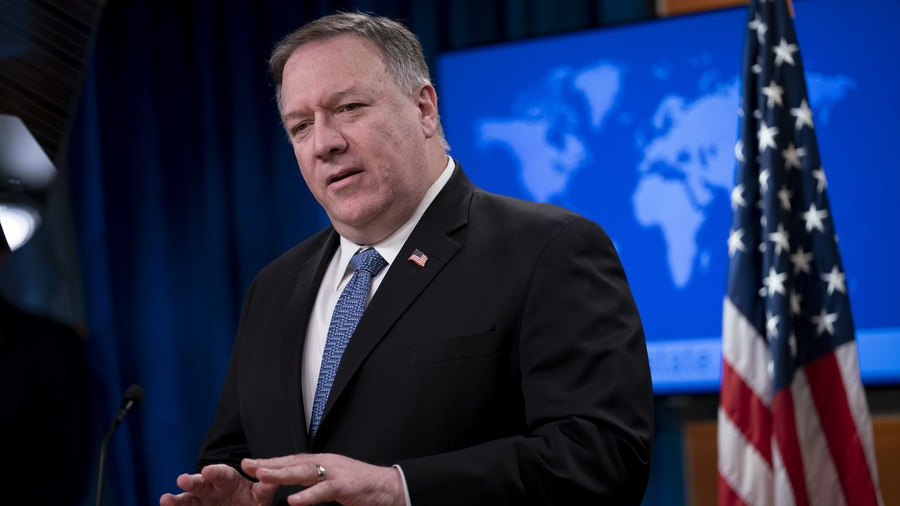
U.S. Secretary of State Mike Pompeo speaks during a press briefing in Washington D.C., U.S., March 5, 2020. /Xinhua
Editor's note: Hamzah Rifaat Hussain is a former visiting fellow at the Stimson Center in Washington, and currently serves as assistant researcher at the Islamabad Policy Research Institute (IPRI) in Pakistan. The article reflects the author's opinions, and not necessarily the views of CGTN.
U.S. Secretary of State Mike Pompeo is all set to visit Israel on August 24 with a follow-up visit to the United Arab Emirates (UAE).
As expected, the visit will focus on the recent normalization deal as per two sources who were briefed on his itinerary. Another item on Pompeo's agenda, however, is to discuss security challenges posed by both Iran and China in the region, which is yet another attempt by the Trump administration to fudge the facts pertaining to the strong relationships which Beijing shares with many prominent states in the region including the UAE and Israel.
Linking China with palpable security challenges in the restive region is both erroneous and fallacious and can only be construed as part of the wider Trump doctrine directed toward isolating China on the international stage with the November elections in sight.
There are quite a few reasons as to why such an agenda item can be contested and may fail to resonate with the UAE and Israel.
Firstly, diplomatic relations between China and the UAE are both currently and historically based on strong economic, political and cultural ties since their establishment in 1984. The relationship also relies on strong bilateral trade which reached 34.7 billion U.S. dollars in the first nine months of 2019.
Furthermore, there has been strategic convergence between the UAE and China on security issues unlike the U.S., where the Emirates was one of the few signatories from the Middle East alongside Bahrain, Qatar and Saudi Arabia to the United Nations Human Rights Council which defended China's treatment of Uygurs in the Xinjiang Uygur Autonomous Region.
In June this year, the UAE also became one of the few states which openly backed the Hong Kong's national security law at the United Nations which is an issue that has been propped by the United States time and again and deals with China's state sovereignty.
Similarly, China shares a strong relationship with Israel, given that Beijing's rising profile has prompted the latter to forge a close economic, political and cultural relationship.
Interestingly enough, the military aspect of the Chinese- Israeli relationship has also flourished despite reservations from the U.S., Japan, Taiwan, India and the Philippines over China's purchases of Israel's sophisticated equipment and technology.
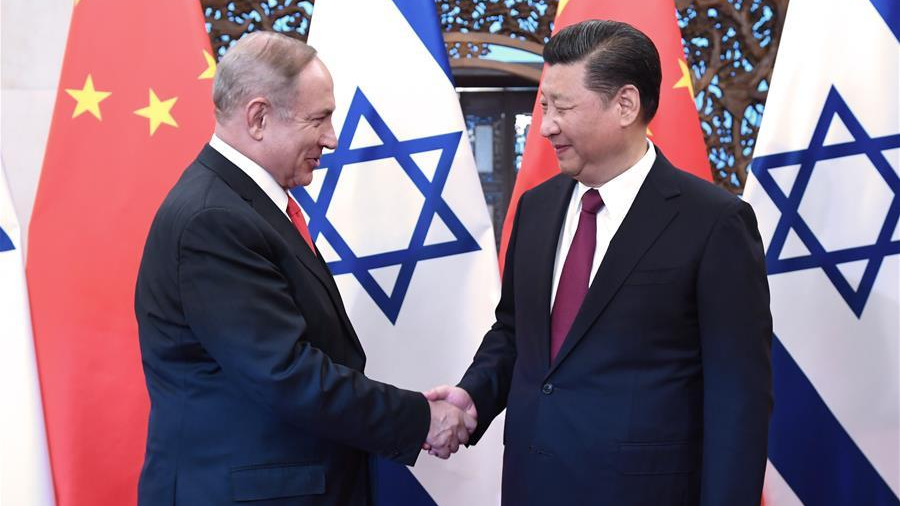
Chinese President Xi Jinping meets with Israeli Prime Minister Benjamin Netanyahu in Beijing, capital of China, March 21, 2017. /Xinhua
Threat perceptions centering on China have been formulated by American allies, but not endorsed by Israel. The only minor skirmish between the two states centered on military deals in 2000, with the cancellation of the Phalcon Airborne Early Warning and Control System to China being a product of U.S. coercion as Washington threatened to cut off 2.8 billion U.S. dollars in yearly aid to Israel if the deal went through. Beyond American concerns and coercion, the Chinese-Israeli military relationship has continued to strengthen.
On the subject of China being a security challenge, both the UAE and Israel consider rising Iranian influence instead of Beijing's influence to be of top concern. China is viewed in both capitals as a benign partner who promotes peaceful coexistence and economic connectivity as evidenced by the UAE and China signing 3.4 billion U.S. dollars worth of economic deals as part of the Belt and Road Initiative. Similarly, Israel is considered to be one of the pillars of Middle Eastern stability by China.
The only flashpoint with Israel has been China simultaneously maintaining close relations with the Palestinian territories and recognizing entities such as Hamas as representing the Palestinian people. Yet this relationship with Palestine is more to do with China adopting a non-binary approach towards conflicts in the Middle East, unlike the United States which has supported one side at the expense of the other. Israeli concerns vis-a-vis China have also not resulted in the suspension of diplomatic ties between the states, with the relationship strengthening over the years.
As far as the Middle East as a region is concerned, there is no evidence to suggest that China has been sponsoring proxies or taken sides in any of the protracted conflicts ranging from Yemen to Syria. Beijing has been against regime change unlike the United States, with a strict a policy of respecting the state sovereignty of states such as Syria. By pursuing a policy of non-interference in matters which are essentially Syrian or Yemeni in nature, China's stance has been supported by numerous scholars who have contested American calls for intervention by citing international law.
There is also no evidence to prove that China has supported Shia or Sunni proxies given its excellent relationship with both Saudi Arabia and Iran. Beijing has mainly been investing in critical infrastructure as well as satisfying its energy demands in the region with a focus on economic cooperation, which is enshrined in two government documents titled "Arab Policy Paper" and "Vision and Actions on Jointly Building Silk Road Economic Belt and the 21st-Century Maritime Silk Road."
It is thus surprising that despite incontrovertible evidence to the contrary, China as a security threat in the Middle East is on the U.S. Secretary of State Mike Pompeo's agenda for his scheduled visit to the UAE and Israel. What's unsurprising though is that this is the Trump administration's agenda after all.
(If you want to contribute and have specific expertise, please contact us at opinions@cgtn.com.)