- Home
- China
- World
- Europe
- Politics
- Business
- Opinions
- Tech & Sci
- Culture
- Sports
- Travel
- Nature
- Picture
- Video
- Live
- TV
- Specials


Share







Copied
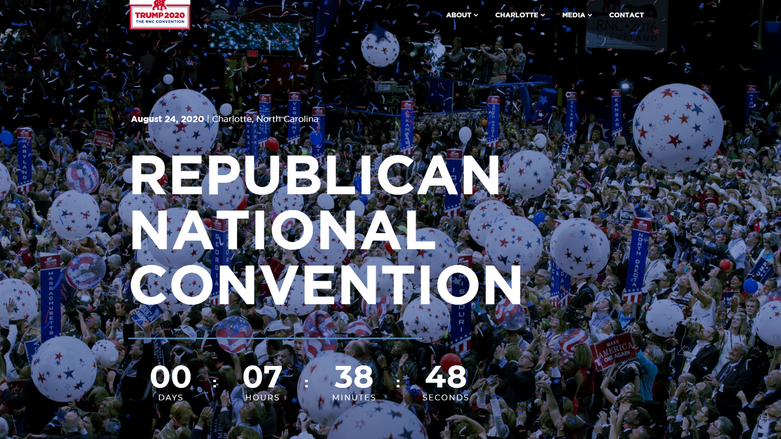
A screenshot taken from the 2020 Republican National Convention's (RNC) official website.
Editor's note: Mike Cormack is a writer, editor and reviewer mostly focusing on China, where he lived from 2007 to 2014. He edited Agenda Beijing and is a regular book reviewer for the South China Morning Post. The article reflects the author's opinions, and not necessarily the views of CGTN.
It's the season for the U.S. party national conventions, those combinations of political jamborees, Machiavellian snakepits and revivalist faith meetings. These quadrennial events are, in theory, to decide upon and then nominate the candidates for the next presidential election, but with modern campaigns requiring stronger narratives, they are nowadays coronations, tightly choreographed multi-day publicity and political messaging opportunities staged with typical American razzmatazz.
The Democrats held theirs last week (the two parties take turns to go first), in a uniquely socially-distanced conference, with many speeches made remotely.
Joe Biden, having kept a fairly low profile since becoming the certainty to win the nomination, ended the convention with a speech that was widely lauded by the press (though, in all honesty, all he had to do was string a few sentences together and utter some basic platitudes about the U.S. for that to happen).
Beforehand, numerous stars in the political firmament gave speeches, all testifying to the range and scope of Joe Biden's greatness: Bill and Hillary Clinton, Barack and Michelle Obama, Colin Powell (a former Republican Secretary of State), former presidential candidate John Kerry and House Speaker Nancy Pelosi.
This is standard practice: candidates seek the widest possible haul of the great and the good to testify on their behalf, and thereby demonstrate the breadth of their political appeal.
The Republican convention will be held from August 24 to 27. It may not surprise you that under the direction of Donald Trump, it will ignore the customs and practices of national conventions. Originally slated to be held in Charlotte, North Carolina, the event was moved after the state government rejected Trump's demands to allow a full crowd without social distancing or face coverings.
Rather than saving himself for a final-day coronation, Trump plans to give speeches on every day of the convention. His campaign senior adviser Jason Miller said that Trump will be "speaking at various parts for each of the nights," though in what form (whether live speeches, pre-recorded segments or something else altogether) remains unclear.
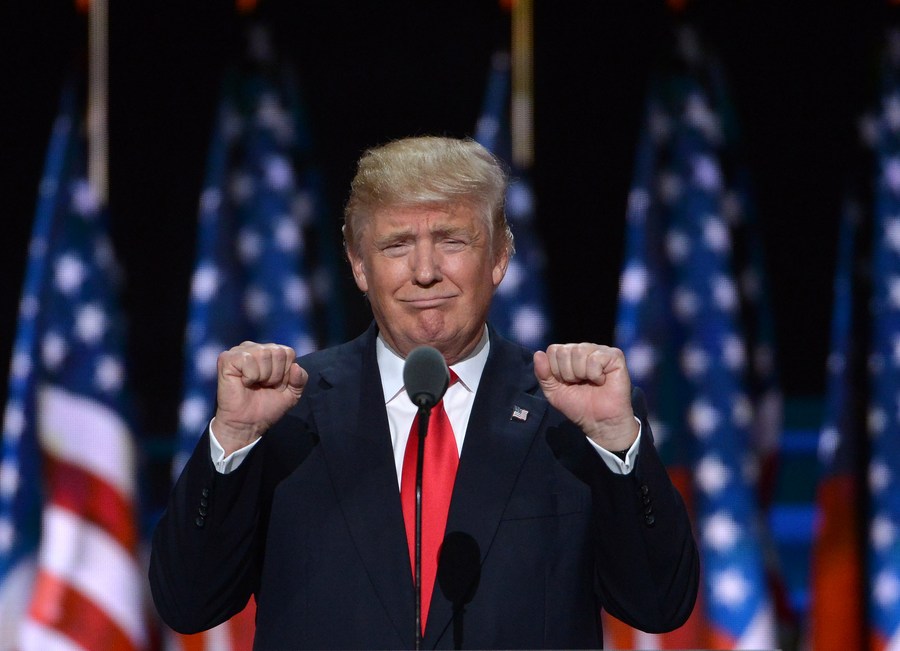
Donald Trump takes the stage on the last day of the Republican National Convention in Cleveland, Ohio, U.S., July 21, 2016. /Xinhua
Trump, who had worked on TV for a decade as the host of "The Apprentice," doubtlessly feels he knows all about putting on a show for the cameras, and will be seeking to have an event in his own image. (Chances are that he doesn't recognize how true this will be, certainly in comparison to the precisely run Democratic convention).
The emphasis on Trump, indeed, extends beyond his own appearances. Many of his family members are listed as speakers at the convention. This is not perhaps surprising, given his reliance on his family when in the White House. It's also worth noting that not one single political heavyweight, not one former president, vice president or cabinet member, will be speaking for Trump.
Trump isn't, of course, the first president to practice a little nepotism. John F. Kennedy made his brother Robert Attorney General, while Bill Clinton put Hillary in charge of a taskforce to overhaul healthcare during his first term.
But the domestication of Republican politics is unprecedented. This is – or was – the party that preached meritocracy, hard work, pulling yourself by your bootstraps, and not relying on government handouts. Now Tiffany Trump – who, according to her Wikipedia page, "is notable for her Instagram account, where she has over 1.2 million followers" – is given the equivalent national platform as former presidents.
The moral collapse of the Republican Party, and its acceptance by a large share of the American public, has been grimly fascinating to observe. Political parties were once vehicles for personal advancement. Their rhetoric of the New World, hard work, progress and achievement has been a clarion call for untold millions. The American Dream was the greatest soft power tool ever invented, because it embraced everyone. Like Coca-Cola, the broader its constituency, the greater it was. The country might have enormous wealth disparities, but if, for example, Marco Rubio, a child of immigrants, could become a senator, then anyone could.
The hard turn from this by Republicans has thus been towards the politics of the royal court, with patronage, nepotism, palace intrigue, courtiers, influence-peddling, and the state as a means for enrichment rather than service. With modern media, U.S. politics (rather than government, which is less of a concern) has become a spectacle, and voters are now not well-informed citizens but viewers of the latest installment of Donald Trump's TV career.
So when we watch the Republican National Convention over the next few days, it isn't for testimonies on the great character of Donald Trump or for any manifesto for a second term. (There aren't any, and there isn't one). It's simply a vehicle for Trump, his family, and their sycophantic attendants to gain national prominence, because fame means power and wealth. It's a four-day extended episode of court intrigues on prime-time TV. The storylines might be jaded, but expect the same old characters to dominate.
(If you want to contribute and have specific expertise, please contact us at opinions@cgtn.com.)