- Home
- China
- World
- Europe
- Politics
- Business
- Opinions
- Tech & Sci
- Culture
- Sports
- Travel
- Nature
- Picture
- Video
- Live
- TV
- Specials


Share







Copied
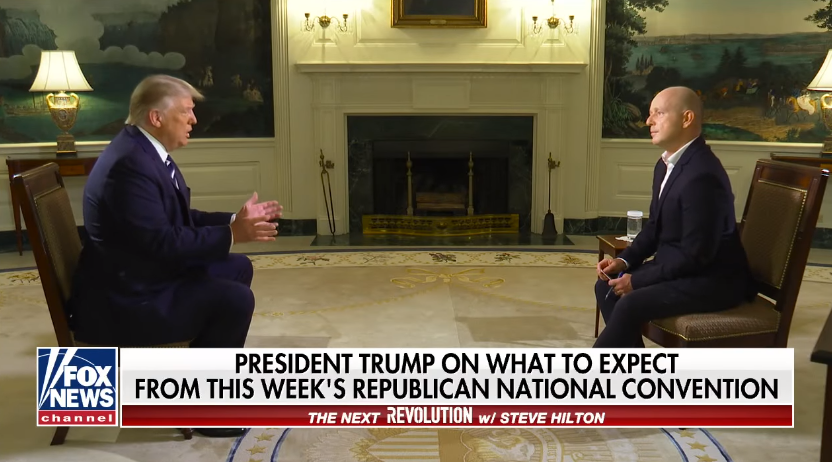
U.S. President Donald Trump on Fox News show "The Next Revolution with Steve Hilton", August 23, 2020. /Screenshot via Fox News
Editor's note: Andrew Korybko is a Moscow-based American political analyst. The article reflects the author's opinion, and not necessarily the views of CGTN.
Donald Trump doubled down on his anti-China fearmongering during his latest interview with Steven Hilton of Fox News. The U.S. president repeated his earlier claims that China wants Biden to be elected, partially because they allegedly "own" him and also due to their intense dislike of Trump's prior trade war, and flirted with the idea of "decoupling" the two countries if he's re-elected. In addition, he also hinted at a military response to Taiwan issue and talked about the "China virus."
Trump touched upon a lot of other topics in his interview as well, but it's his words about China that deserve attention because they amount to his manipulation of Americans' minds ahead of the election. The incumbent wants his people to think that not only is he being victimized by the "deep state," which is admittedly true to an extent considering the Russiagate hoax that was later debunked, but that he's also being targeted by China too.
The innuendo is that a grand coalition between the "deep state," the Democrats, and China has assembled against him, and only the American people can defeat this shadowy threat to their democracy. If Biden wins, according to Trump's logic, then America will basically end up occupied by China considering what he believes to be Beijing's secret control over this conspiracy. In reality, however, China isn't part of any such grand coalition, but pretending otherwise is meant to scare voters into supporting Trump for "patriotic" reasons.
It also serves another purpose too, and that's to concoct a "face-saving" narrative upon which to rely in the event that he handily loses the election like many polls have predicted if it were to be held today. In other words, Trump is doing exactly the same thing that his former challenger Hillary Clinton did four years ago — manufacturing a conspiracy about foreign meddling in order to discredit and subsequently destabilize their opponent's future administration if they win.
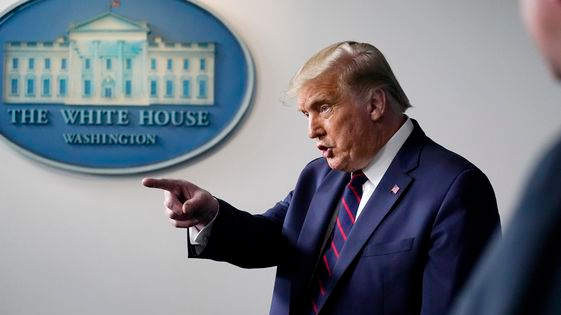
U.S. President Donald Trump speaks during a media briefing in the James Brady Briefing Room of the White House, in Washington, D.C., U.S. August 23, 2020. /AP
Taking a look at the facts, an altogether different reality emerges than the manipulative one that Trump is propagating. Far from being the devious anti-democratic force actively meddling in America's electoral process, China is actually just sitting back and letting the vote play out from afar, passively accepting whatever democratic choice the American people ultimately make and ready to work with the winner. Ironically, it's Trump himself who made China a key election issue, not the Chinese state, and he did so out of political fear.
It's well known that one of the many weaknesses of political systems is the possibility of weaponizing the science of mass psychology for political purposes. This was elaborated upon at length by the famous Austrian-American publicity expert Edward Bernays in his 1928 book about Propaganda and his follow-up publication The Engineering of Consent that he released as an essay in 1947. These texts explicitly talk about how to manipulate people, which is what Hillary Clinton and Donald Trump have done with Russia and China.
Each candidate over-exaggerated the so-called "threat" of what is known as "the other," or put another way, that which one is not. Russia was portrayed by the Democrats as America's foil in the 2016 elections just like the Republicans are doing the same with China in the 2020 elections. The difference between then and now, however, is that the opposition party (Republicans) didn't have a "counter-other" like they (Democrats) do now (with Russia). This wrongly frames the 2020 elections as a proxy battle of influence between China and Russia.
Trump knows how unethical it is to play the Democrats' game, the same one that almost ruined his life after he was accused of colluding with Russia, yet it can also be argued that he learned first-hand just how politically effective it can be too.
That might partially explain why he's doing the same thing to Biden that Clinton did to him in a desperate effort to manipulate Americans into voting for him out for patriotic reasons as well as to concoct a narrative in the event that he loses. Four years ago, who'd have thought that Trump would do this?
(If you want to contribute and have specific expertise, please contact us at opinions@cgtn.com.)