- Home
- China
- World
- Europe
- Politics
- Business
- Opinions
- Tech & Sci
- Culture
- Sports
- Travel
- Nature
- Picture
- Video
- Live
- TV
- Specials


Share







Copied
Editor's note: Bradley Blankenship is a Prague-based American journalist, political analyst and freelance reporter. The article reflects the author's opinions, not necessarily the views of CGTN.
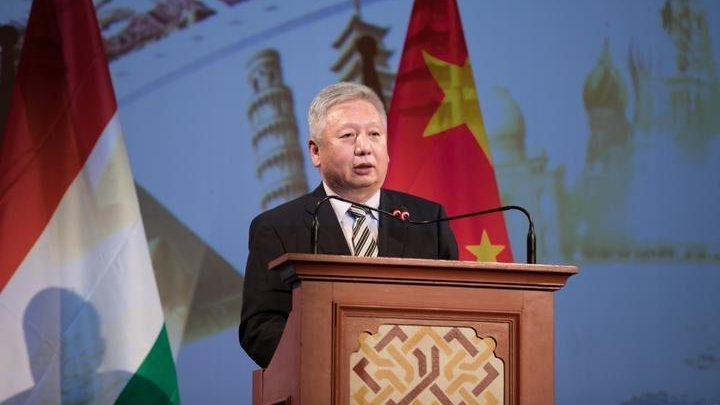
The Chinese ambassador to Hungary, Duan Jielong, was elected on Monday as a member of the International Tribunal for the Law of the Sea (ITLOS) with extensive support, highlighting China's growing leadership in multilateral institutions despite opposition from the United States.
For its part, just like so many other multilateral frameworks and institutions, the U.S. is a non-party to the United Nations Law of the Sea Convention (UNCLOS), which the ITLOS mediates, but still attempts to exercise its waning influence.
"Electing a PRC official to this body is like hiring an arsonist to help run the Fire Department," said David Stillwell, U.S. assistant secretary of state for East Asian and Pacific Affairs, at a Center for Strategic and International Studies (CSIS) online forum in July.
"We urge all countries involved in the upcoming International Tribunal election to carefully assess the credentials of the PRC candidate and consider whether a PRC judge on the Tribunal will help or hinder international maritime law. Given Beijing's record, the answer should be clear," Stillwell added.
Despite this view, by the letter of the law, and indeed as it stands in practice, Washington has no seat at the adult table. Like dozens of other international treaties, the UNCLOS' ratification process has long been stalled in the dysfunctional U.S. Senate over successive administrations and is unlikely to pass anytime soon. As such, Washington is without any serious grounds to comment on the affairs of the ITLOS.
Washington, however, routinely tries to interfere in international maritime disputes despite its lack of proper legal channels to do so. In July, U.S. Secretary of State Mike Pompeo called China's claims in the South China Sea "unlawful" and the Navy carried out military drills in a show of force against Beijing – claiming to defend the sovereignty and integrity of its supposed partners in the region.
In that same month, Washington tried to nudge the Philippines into a possible military conflict with China over disputed claims in the South China Sea, but was rejected by Philippine President Rodrigo Duterte who instead wisely opted for diplomatic routes to resolve the issue.
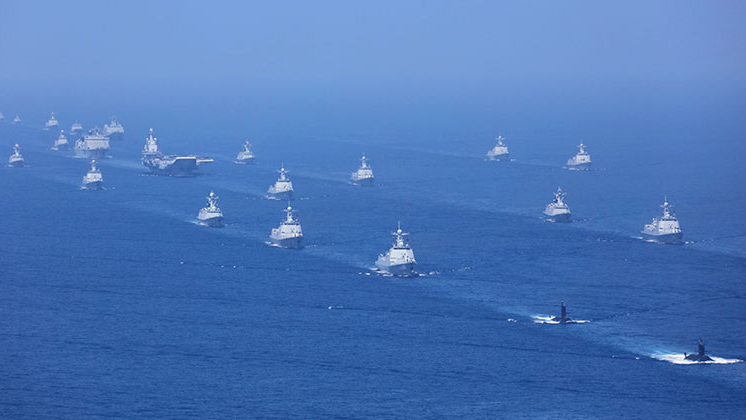
Aircraft carrier Liaoning, submarines, vessels and fighter jets take part in a review in the South China Sea, April 12, 2018. /Xinhua
The U.S. Department of State bizarrely throws around terms such as "unilateral" in regards to China's actions in the region that, by any objective standard, could only apply to Washington. This is evident to anyone with a modicum of understanding of the English language and can read a map – the South China Sea is clearly a territory that Washington has no right to arbitrate on, either directly with its military or indirectly through taking the helm in other states' legal disputes.
Meanwhile, in the vein of diplomacy, China has had three judges on the 21-member ITLOS since its foundation in 1996, Zhao Lihai (1996-2000), Xu Guangjian (2001-07) and Gao Zhiguo (2008-20). The continuation of Chinese representation on the ITLOS with Duan Jielong's successful election, despite Washington's objections, demonstrates that the international community understands China's important role in multilateral bodies, appreciates the country's contributions to the body over the past 24 years and wisely ignores bad actors that see themselves as above international norms.
In contrast to Washington's flagrancy, China has committed itself to the peaceful resolution of disputes in the South China Sea and negotiations surrounding the Code of Conduct on the region. There is every reason to believe that, without U.S. meddling in regional affairs, claimants in the South China Sea can reach a mutually satisfiable conclusion in the near future.
While China leans into multilateral institutions and the U.S. pulls out, it's only natural that China's point of view will gain more respect in the future. This is consequential because the world's most powerful countries – the United States and China being among them – have serious differences not only in interpreting maritime rights, but other elements of international law.
Correspondingly, the international community is noting these stark differences. For example, the president of the United Nations Security Council (UNSC) earlier rejected Washington's demand to "snap back" sanctions against Iran despite the fact that U.S. President Donald Trump withdrew from the 2015 Joint Comprehensive Plan of Action.
"The Trump administration has no fear in standing in limited company in this matter in light of the unmistakable truth in guiding our actions," said U.S. Ambassador Kelly Craft in regards to the decision, echoing Secretary of State Pompeo's complete detachment from reality.
Many have talked for years about the emergence of a multipolar world order and the coronavirus crisis has only accelerated this notion, laying bare the obvious damage over the years to Washington's international reputation exemplified with Trump's administration but certainly not confined to it.
This is no longer an abstraction; Washington's position as the predominant, unipolar world power is a thing of the past. America's depleted diplomatic clout coupled with other countries' rising national consciousness, including China's, demonstrates this very clearly.
(If you want to contribute and have specific expertise, please contact us at opinions@cgtn.com.)