- Home
- China
- World
- Europe
- Politics
- Business
- Opinions
- Tech & Sci
- Culture
- Sports
- Travel
- Nature
- Picture
- Video
- Live
- TV
- Specials


Share






Copied
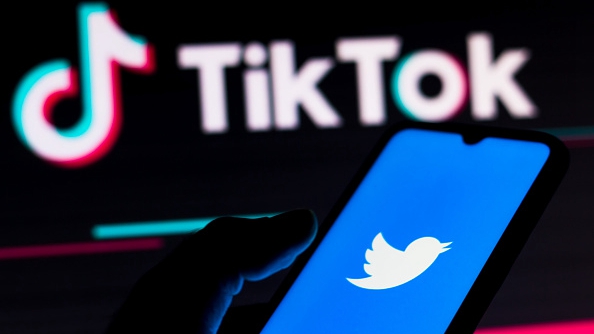
In this photo illustration the Twitter logo seen displayed on a smartphone with the TikTok logo in the background. /Getty
Editor's Note: Huo Zhengxin is a professor of law at the China University of Political Science and Law. The article reflects the author's opinions and not necessarily the views of CGTN.
On August 24, 2020, TikTok and its parent company ByteDance are taking their fight against the Trump administration to a U.S. federal court in Los Angeles, alleging that Trump's executive orders to ban the video-sharing app in the U.S. is unconstitutional and should be blocked from taking effect. The defendants include Donald Trump, the U.S. Department of Commerce and Secretary of Commerce Wilbur Ross.
On August 6, Trump issued an executive order against TikTok, which would ban transactions with the app within 45 days. The order invoked the International Emergency Economic Powers Act(IEEPA). Trump issued a second executive order on August 14 against ByteDance, requiring the company to divest its TikTok U.S. operations within 90 days.
The lawsuit, which has been expected for a couple of weeks, claims that Trump's executive order declaring a national emergency was taken without any opportunity for the company to be heard; thus, it violates the due process protections of the Fifth Amendment of the U.S. Constitution.
In the complaint, Tiktok also argues that Trump is misusing the IEEPA to ban the app, as the Act has important restrictions. Specifically, the IEEPA blocks a U.S. president from using the authority to regulate the "transmission" of any informational materials, including "films, posters, phonograph records, photographs, microfilms" in addition to CD-ROM-based content.
Additionally, TikTok complains that the Trump's executive orders are "not rooted in bona fide national security concerns," as the Trump administration has not provided any concrete evidence that TikTok poses a real threat to the national security of the U.S. In the same complaint, TikTok claims that the executive orders violate the company's free speech rights, arguing that computer code is a type of expression protected under the First Amendment of the U.S. Constitution.
Although it is of great difficulty to predict the outcome of the lawsuit at the current stage, I tentatively evaluate it from the perspective of law.
First of all, it is beyond doubt that the lawsuit is crucially essential regardless of how it shakes out, as it offers a plum opportunity for TikTok to defend itself to the whole world. So far, the Trump Administration has failed to offer evidence supporting the national security grounds for the executive order, nor has it given TikTok any due process to defend itself. In comparison, Tiktok has provided "voluminous documentation to the U.S. government documenting TikTok's security practices and made commitments that were more than sufficient to address any conceivable U.S. government privacy or national security concerns."
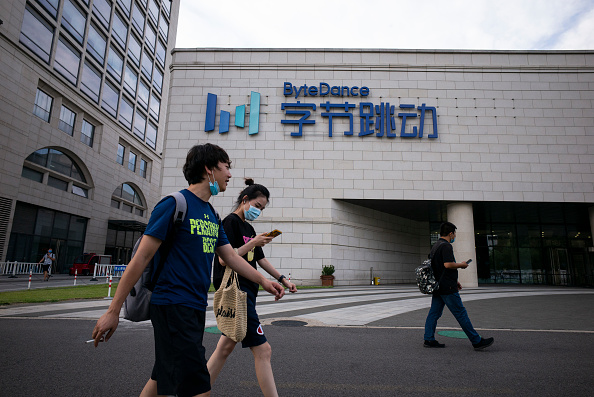
People wear protective masks as they walk past the ByteDance Ltd.'s office on August 04, 2020 in Beijing, China. /Getty
Second, as separation of powers and judicial independence are the most treasured principles of the U.S. Constitution, federal courts do have the power of judicial review to rule executive orders unconstitutional. Therefore, there exists a possibility that the lawsuit could result in a U.S. court invalidating the original executive order.
Hence, it is not surprising that Tiktok chooses to sue the Trump Administration to a U.S. federal court to defend its rights, as the company states that "We do not take suing the government lightly, however we feel we have no choice but to take action to protect our rights, and the rights of our community and employees."
Though as a law professor, I highly appreciate and support Tiktok's decision to challenge the Trump's crackdown by taking legal actions; however, difficulties ahead of the lawsuit cannot be overestimated.
In the first place, national security concern, in principle, is a matter of executive discretion that is not subject to judicial review under the American legal system. Therefore, Tiktok can sue to challenge the process of the executive order but not the merits of the decision when it concerns national security. And in the history of the American Constitution, it has never happened that a court reviews the legitimacy of an executive order invoking the IEEPA.
Moreover, the U.S. federal courts tend to be reluctant to challenge national security decisions made by the executive branch on the ground of process defects. A federal court of appeals rejected a similar lawsuit filed by Russian cybersecurity firm Kaspersky Lab in 2017, challenging a ban on the use of its software in U.S. government networks because of the firm's ties to the Russian government.
Indeed, in my eyes, the principle of separation of powers has been carefully protected and strictly followed by federal courts when they deal with domestic American issues. However, when it comes to international and national security-related problems, the principle has become a matter of secondary importance.
As China is defined as a "strategic competitor" which seeks "to challenge American influence, values and wealth" by the current American government, the anti-China atmosphere is permeating American political circles, the independence and integrity of the U.S. judicial system is even more debatable in this lawsuit. For the above reasons, I am afraid that Tiktok's legal battle against the Trump Administration is an uphill battle.
In spite of the enormous difficulties ahead, I have to emphasize that the lawsuit per se is of historical significance, as it is a gallant endeavor by a Chinese private company to defy a president of the world's sole superpower by taking up legal weapons and showing its confidence, strength and determination in defending its dignity, reputation and legitimate interests in the name of justice and law that this superpower itself claims to enshrine.
(If you want to contribute and have specific expertise, please contact us at opinions@cgtn.com.)