- Home
- China
- World
- Europe
- Politics
- Business
- Opinions
- Tech & Sci
- Culture
- Sports
- Travel
- Nature
- Picture
- Video
- Live
- TV
- Specials


Share







Copied
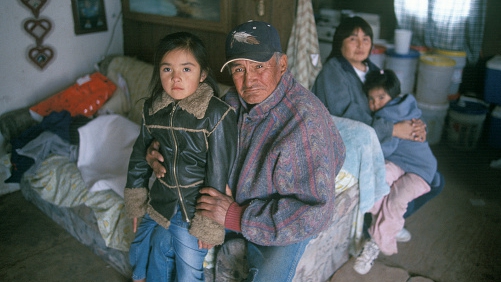
Native American Grandfather and Granddaughter on Reservation. /Getty
Editor's note: Joel Wendland-Liu is an associate professor of the Integrative, Religious and Intercultural Studies Department at Grand Valley State University in the U.S. The article reflects the author's opinions and not necessarily the views of CGTN.
More than 50 million people in the U.S. are out of work, and Donald Trump is on the golf course again. Despite promising swift action to restore economic growth, Trump seems most interested in restoring his golf swing. Indeed, his callous leadership over the pandemic, which has seen the death toll approaching 180,000, has bled into his party's resistance to serious relief for working-class people.
Before the COVID-19 pandemic, the U.S. economy was already headed for disaster. While the unemployment rate was the lowest since the 2008 crash, nearly half of U.S. workers held jobs that paid poverty wages. According to a Brookings Institution report, 56 million workers earned a median wage of just over 10 U.S. dollars per hour.
Most of the people in this category are women, people of color, and people trapped by low education levels.
Indeed, the low-wage workforce proved to be the fastest-growing section of the labor market in the U.S.
Why is this the case? True to discredited "trickle-down" economic theory, Donald Trump believes that his tax cut for the rich stimulated investment in economic activity, creating new jobs.
But why are "new" jobs almost always dead-end and low-pay?
There are two issues here that reveal the weakening structural performance of the U.S. economy that require a new direction, which Trump is unwilling to chart.
First, Trump's plan to re-start the U.S. economy in pandemic conditions shows his cruel, corrupt leadership. He is blocking meaningful relief for tens of millions of unemployed to intensify pressure on them to return to work without proper public health guidelines that could protect them from COVID-19.
His allies in the U.S. Senate refuse to vote on new relief measures for workers. Meanwhile, Trump is making campaign videos that falsely present him as caring about workers.
By contrast to this cold-hearted disregard for workers' well-being, Trump and his allies rapidly passed a massive relief package for millionaires and billionaires through the Paycheck Protection Program. That program has reportedly resulted in massive giveaways to Trump's donors, his family members, powerful politicians, and already successful corporations.
These payments to corporations allowed massive stock buybacks, which kept their share prices up, the appearance of high profits, and protected CEO bonuses, without producing any new economic activity.
These payments should be seen as a massive government down payment to corporations on their employees' future work, now idled by the pandemic.

Elderly people stand in line with carts filled with groceries at the foodbank in McArthur, Ohio. /Getty
The second major weakness is that when the economy re-opens and the mass of workers return to work, most can only count on returning to low-wage, dead-end jobs.
The reason this condition exists in the first place is complicated. It is related to declining educational quality across the country, the labor movement's weakness, and a growing alignment of government with private corporate interests. Observers refer to this combination of policies as the neoliberal consensus.
Perhaps most insidiously, however, the main driver is that U.S.-based capitalism's corporate policies are focused solely on self-interest, unplanned profit-growth rather than long-term, planned activities that are designed to produce positive social benefits. Some will say, "but self-interest is how capitalism works. That's how the U.S. economy grew so strong in the first place."
Despite the distortion of reality behind that claim, the 2008 Great Recession exposed the U.S. economy's underlying weakness due to its dependence on debt, especially for the working class. Total consumer debt in 2008 stood at 13 trillion U.S. dollars, when car loans, mortgages, and credit card debts are added up. In the first quarter of 2019, the total was 14 trillion U.S. dollars. Student loan debt alone has more than doubled in the 11 years since the Great Recession.
Since the 1980s, stagnant profit rates and slow economic growth caused a fundamental shift in economic thinking from demand-driven economics based on real wage growth for the mass of workers to an economic model dependent on consumer debt for growth. This latter model has also seen a downward pressure on real wages to drive higher profits. However, the logic of this model prevents the mass of workers from repaying their debts and periodically forces the economy into crisis.
Trump has no plans to resolve this fundamental structural weakness, the fundamental contradiction within U.S. capitalism. The scramble to demonize China and contain its global economic growth suggests a desperate agenda. But, like those of most of his class allies, his personal goal is to make as much money as he can and get out while the getting is good.
Trump hasn't even tried to pretend that he cares about American workers until this reelection campaign when he needs their votes to reinstall himself as the leader.
(If you want to contribute and have specific expertise, please contact us at opinions@cgtn.com.)