- Home
- China
- World
- Europe
- Politics
- Business
- Opinions
- Tech & Sci
- Culture
- Sports
- Travel
- Nature
- Picture
- Video
- Live
- TV
- Specials


Share







Copied

A worker checks the body temperature of a customer outside Gitano in Hudson Square as the city continues Phase 4 of re-opening following restrictions imposed to slow the spread of coronavirus on August 22, 2020 in New York City. /Getty
Editor's note: Bradley Blankenship is a Prague-based American journalist, political analyst and freelance reporter. The article reflects the author's opinions, not necessarily the views of CGTN.
On Monday, the administration of U.S. President Donald Trump rolled out new testing guidance which states that people who have been exposed to the coronavirus need not get tested if they are asymptomatic, warning that it will lead to "more spikes in coronavirus." This new policy is in line with the false logic that Trump has touted to his supporters – that the U.S. is only seeing a surge in the coronavirus because more people are being tested. The mind-numbing ignorance of this was rightly criticized by the American Medical Association (AMA) and others.
"Months into this pandemic, we know COVID-19 is spread by asymptomatic people," AMA President Susan Bailey said in a statement. "Suggesting that people without symptoms, who have known exposure to COVID-positive individuals, do not need testing is a recipe for community spread and more spikes in coronavirus."
Former Centers for Disease Control and Prevention (CDC) Director Tom Frieden also said, "If an asymptomatic contact tests positive, their contacts can be identified, warned, and quarantined. Not testing asymptomatic contacts allows COVID-19 to spread. The CDC guidance is indefensible. No matter who wrote it and got it posted on the CDC site, it needs to be changed."
Experts around the world, including at the World Health Organization (WHO), have reiterated that young adults – many who are asymptomatic – are likely driving the spread of the disease at its current stage.
The administration has defended the decision, saying that they want more "appropriate" testing, not simply less, and that political pressure was not part of the decision-making process. However, so massive was the backlash that, by Thursday, CDC Director Robert Redfield had to "clarify" this guidance in an apparent walk back, though no formal reverse was made.
Since these recommendations do not line up at all with any foundational knowledge of infectious disease spread, politics is likely the only answer. This was evident by another move on Sunday by the Food and Drug Administration (FDA), on the eve of the Republican National Convention (RNC), approving the use of convalescent plasma as a treatment for COVID-19, which is an unverified treatment option for the disease.
FDA Commissioner Stephen Hahn later responded to criticism for this move, saying on Twitter, "The criticism is entirely justified. What I should have said better is that the data show a relative risk reduction, not an absolute risk reduction."|
There can be no mistake – President Donald Trump, just like his fellow Republican operatives, is trying to make it look like the U.S. has already won its war against the coronavirus and that the situation can be relegated to history. This was indeed the theme that came out of the RNC this week and, as always, government bodies are being used to amplify the president's political messaging.
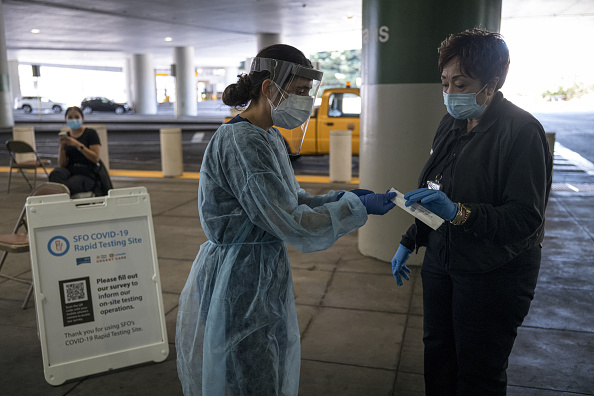
A medical worker wearing personal protective equipment, left, receives a nasal swab from an employee wearing a protective mask and glove prior to a rapid Covid-19 test at San Francisco International Airport (SFO) in San Francisco, California, on Thursday, Aug. 27, 2020. /Getty
But even if bad ideas get through and are later "clarified", the damage can be catastrophic. In the initial phases of the pandemic, the CDC and public health officials advised against the use of masks. While they said at the time that wearing masks was ineffective, they were really trying to protect the small quantity of personal protective equipment the country had at the time. This has been a major breaking point in public trust for some and a major reason for the politicization of mask-wearing.
This hit to public trust – no doubt owed to the president's actions – has already been a key reason for the disease, which has killed over 180,000 Americans and continues to kill over 1,000 per day, spreading uncontrollably.
Public trust is fickle; once lost, it's hard to earn back. It's important in maintaining a healthy society – including consumer confidence, investor confidence, and, of course, public health guidelines, which are all relevant to the present moment. Thus, officials have not only the ability but the obligation, to influence it accordingly because the risks are overwhelming.
There are already a considerable number of Americans who are distrustful over the prospect of taking a rushed vaccine, for example, or even one, in general, considering the growing anti-vaccination (so-called "anti-vaxx") sentiment which has made headlines in recent years.
With these recent episodes, which are the latest in a protracted failure from the administration, the public is likely to be even less trusting of future recommendations at disease mitigation – including receiving a future COVID-19 vaccine.
This would be a catastrophe. Vaccines are one of the cornerstones of public health that emerged in the 20th century and are critical to virus mitigation, but they require a majority of the public to take part in order to achieve herd immunity that could protect even those that don't take them.
The coronavirus is probably going to be in circulation for the long-term, perhaps forever. Everyone has their own responsibility and will have to adopt their own, personal threshold for risk mitigation. But public health guidelines are not a personal issue – they are a collective issue of great importance to every person on the planet – and should be treated as such.
Politics certainly has no place in determining their effectiveness and administration health officials must have the bravery to stand up to Trump, not post-factum, but immediately, because the future of public health is at stake.
(If you want to contribute and have specific expertise, please contact us at opinions@cgtn.com.)