- Home
- China
- World
- Europe
- Politics
- Business
- Opinions
- Tech & Sci
- Culture
- Sports
- Travel
- Nature
- Picture
- Video
- Live
- TV
- Specials


Share







Copied
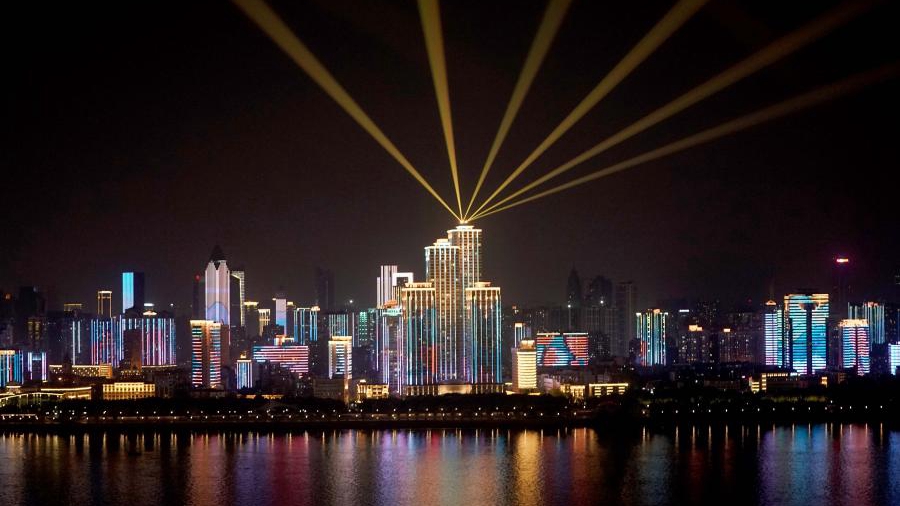
Wuhan, central China's Hubei Province, at night, April 13, 2020. /Xinhua
Editor's note: Ehizuelen Michael M. O. is executive director of the Center for Nigerian Studies under the Institute of African Studies, Zhejiang Normal University. The article reflects the author's opinions, and not necessarily the views of CGTN.
From lockdowns to battles on the front lines to social distancing from friends and loved ones, the coronavirus pandemic has caused an enormous shake-up of our everyday lives. As a result, there is one big question that everyone is probably thinking about: Will life every return to normal again? The answer to this question can be found in China as the country is gradually overcoming the season of darkness.
This is because, while economies in Europe and the United States are still languishing and struggling to contain the COVID-19 pandemic, China is growing once again. Therefore, for anyone looking for some positive headlines to talk about, China's return to normality will be that positive headline.
With that said, a recent International Monetary Foundation (IMF) study upgraded its economic forecast for China and found that the Chinese economy expanded by 3.2 percent from April through June while major economies such as the U.S. contracted by 8 percent, Germany 7.8 percent, the United Kingdom 10.2 percent and Japan 5.8 percent.
Furthermore, according to an article published by BRAmble Newsletter, the Chinese inflation-adjusted economic output was predicted to hit 11.9 trillion U.S. dollars in 2020. The report added that this is approximately 70 percent of the U.S. anticipated output – a seven percentage point surge from 2019. The report concluded that this is the largest advance Beijing has made on Washington in a single year.
All these above-mentioned statistics is an indication that China will be the only major global economy that will bounce back in 2020.
This is because, across China, life in recent weeks has turned out to be normal once again. Different provinces have relaxed social-distancing rules and mask mandates. Also, Chinese folks are beginning to fill tourist sites, gyms, movie theaters, restaurants, bars, public transportation stations and airports after months when such gatherings were banned completely. Students are preparing to go back to school for the fall semester as they did last autumn.
For much of February, millions of workers in China were working from home, which for numerous Chinese folks was a new experience for them. Nowadays, that has changed because the majority of Chinese employees have returned to the office.
Numerous Chinese folks are restarting their old routines, with some changes, confident that the worst is behind them, giving other nations a glimpse of what might await them once the worst of COVID-19 has passed. For example, in Wuhan, night markets are packed shoulder to shoulder, buzzing like before. The public believes that it no longer feels like there is something too frightening or too life-threatening out there any longer.
In the early period of the lockdown when life came to a standstill and the economy cratered, as folks were forced to stay at home and shops largely shut down, except those selling essential goods, numerous nations described the restrictions put in place to combat the virus as "suffocating," but today, after months of travel restrictions and citywide testing drives, locally transmitted cases of the virus in China are near zero.
The Chinese economy has been slowly recuperating in recent months and the nation's factories are humming once again with life returning to normalcy ahead of other nations globally. This is in line with McKinsey's recent report that claims that nations that have restored confidence – or are close to doing so – have seen economic activity return or start to return to pre-crisis levels.
China, hoping to bolster the economy, is eager for the Chinese folk to get back to work and start shopping and journeying again. As a result, the Chinese government has suggested two-five day weekends to induce consumer spending.
Some Chinese provinces such as Gansu, Zhejiang, Hebei and Jiangxi have recommended the strategy, but it is only Jiangxi Province of eastern China that has implemented it recently. Nevertheless, the novel measures are voluntary, and firms can choose how to implement them accordingly.
In addition, Beijing has removed a requirement for their citizens to wear masks outdoors, further relaxing rules targeted at preventing the spread of COVID-19 after the city reported 13 consecutive days without new locally transmitted cases. The Chinese government has done well by showing the world that good leadership is the "master key" to solving all problems.
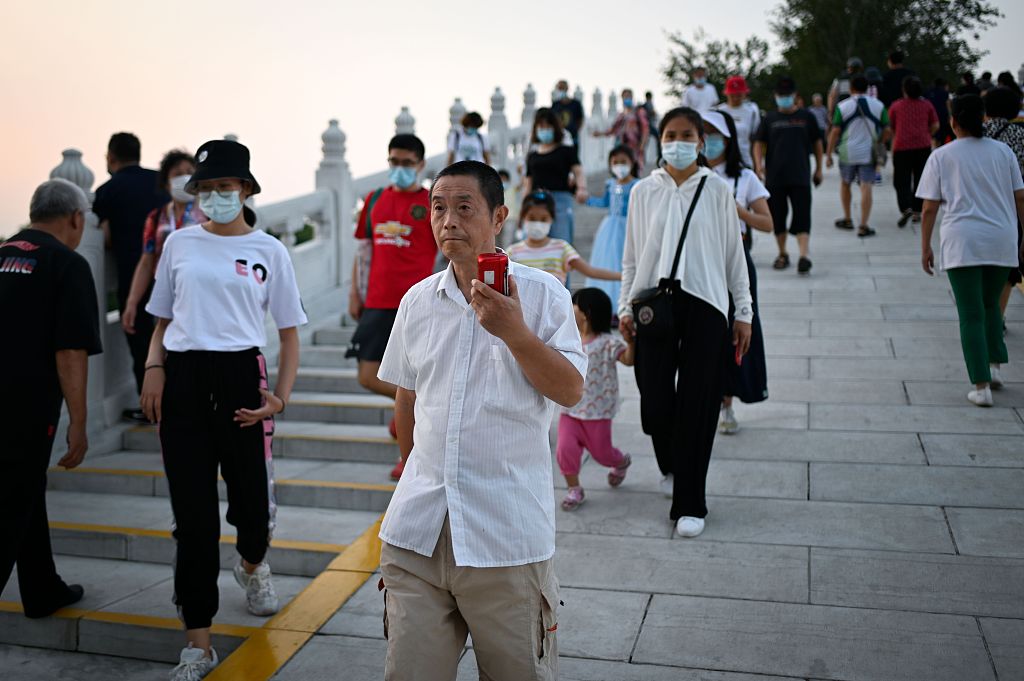
A park in Beijing, August 22, 2020. /VCG
Governments all over the world need to see people as human beings and not as objects or tools. If they see them as human beings, they will be moved to serve them rather than exploit them. This is the philosophy of the Chinese government – serving the people. Likewise, the average Chinese citizen is concerned for others around the world right now.
With that said, even though the Chinese government removed a requirement for wearing masks, it is also taking a cautious method, demanding movie theaters and tourist sites, for instance, to function at half capacity.
On top of that, for anybody to get into any public places such as banks, restaurants and gyms, the person must succumb to temperature checks and display his or her digital codes confirming that they are hale and hearty and have not journeyed lately to places where there have been clusters of COVID-19 cases.
With that said, it is worth noting that being with the people you love, connecting with nature and being free is what I called freedom and that is what the Chinese people are experiencing today. Therefore, returning to normalcy in China is a stark turnaround from the early days of the COVID-19 pandemic, when China was the epicenter of the outbreak.
As such, China's return to normalcy has made the nation standout among other global economies. Chinese economy returning to normalcy recently is in line with McKinsey recent study that found a rebound in growth only in nations that have successfully placed the virus under control. The evidence heavily suggests that a multifaceted public-health response that goes well beyond a simple transient lockdown is the first step to restore confidence and create the conditions for growth.
While that can be said about China, the U.S. and European nations, on the other hand, are facing a potentially long and painful recession. But it is clear that the opportunity cost of waiting is almost surely measured by the unknown thousands of lives and trillions of dollars that might be lost globally.
McKinsey estimates that for every three months' delay in getting the virus under control, we push back the return of GDP to pre-crisis levels by around six months. For that reason, the world needs to realize that we need to act now and fast to find a solution to the health-disaster coronavirus has brought to the global economy because time is the enemy of both saving thousands of lives and trillions in livelihoods.
(If you want to contribute and have specific expertise, please contact us at opinions@cgtn.com.)