- Home
- China
- World
- Europe
- Politics
- Business
- Opinions
- Tech & Sci
- Culture
- Sports
- Travel
- Nature
- Picture
- Video
- Live
- TV
- Specials


Share







Copied

Protesters gather in front of the White House at Washington, U.S., August 27, 2020. /VCG
Editors Note: Stephen Ndegwa is a Nairobi-based communications consultant and international affairs columnist. The article reflects the author's views and not necessarily those of CGTN.
In his acceptance speech at the end of the Republican National Convention on Thursday, U.S. President Donald Trump accused Democratic Party rival Joe Biden of seeking to turn America into a socialist state.
Warning that Biden was a "Trojan horse for socialism," Trump said the Dems candidates, Biden, and running mate Kamala Harris would push a socialist agenda that would destroy the American way of life.
In his typical scaremongering style, Trump said, "If you give power to Joe Biden, the radical left will defund police departments . . . no one will be safe.” He also implied that the Democrats support "anarchists, agitators, rioters, looters and flag-burners.
Apparently, it is a Republican script that had been agreed upon. In mid-July, Vice President Michael Pence cast Biden as a "Trojan horse for a radical agenda” and portrayed the 2020 election as a choice between "freedom and opportunity" or “socialism and decline.”
Trump thinks that many Americans still have the stereotypical view of Communism as a straitjacket system carried over from the Cold War era that pitted the U.S. against the Soviet Union.
In a Gallup poll published by Frank Newport on October 4, 2018, titled "The meaning of 'Socialism' to Americans Today," 23 percent of Americans understood socialism as some form of equality. Most significantly, only 17 percent said socialism meant government control of business and the economy, which was half of those who had the same view in 1949.
Just like democracy has evolved over the years, socialism has also refined itself. Of course, China comes to mind in conversations about progressive socialism, which is why Trump is perennially painting a negative picture of the country to divert Americans’ attention from its viability.
The classical definition of socialism says that it is "a political and economic theory of social organization which advocates that the means of production, distribution and exchange should be owned or regulated by the community as a whole."
But that is the notion of a bygone era. China’s socialism with Chinese characteristics has become the biggest ideological rival to liberal democracy and capitalism in governing the political economy.
Basically, the system is a hybrid of market economics that encourages investment and principles of equity such that no one is left behind as the country prospers. This has not only propelled China to the second-largest economy in the world in a span of 40 years but also lifted almost all its citizens out of poverty.
Therefore, Trump’s associating socialism with unsavory characteristics like crime is totally misplaced and misleading. Instead of deriding such self-evident achievements, Trump should propose an American social market philosophy to forestall the looming disintegration of the U.S. due to the chasm of the current social and economic disparities. It would not be that difficult, as the U.S. already practices aspects of socialism through its welfare system.
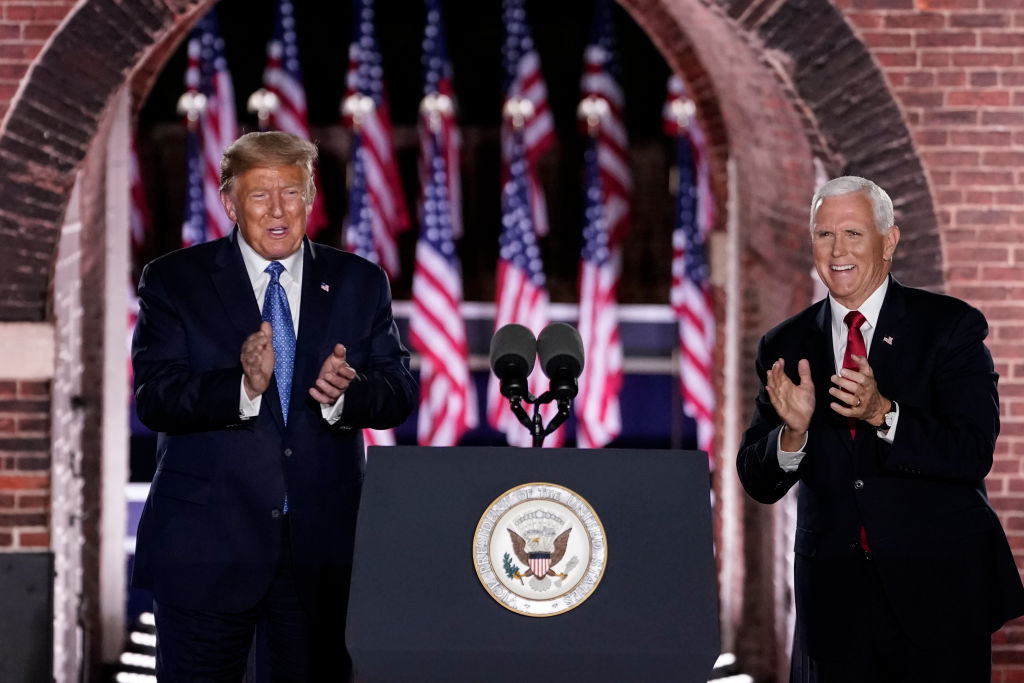
U.S. President Donald Trump attends Mike Pence's acceptance speech for the vice presidential nomination during the Republican National Convention at Fort McHenry National Monument in Baltimore, Maryland, August 26, 2020. /Getty Images
In an interview aired Sunday on CNN’s GPS program with Zareed Zakaria, "How They See Us – A Global View of Trump's America," former United Kingdom Prime Minister John Major said although he does not see China’s socialist political ideology as a threat to Western democracy, China offered a deep sense of "ethicism" widely lacking in Western liberalism.
Major noted that the U.S. had failed to create a moral code to temper the fast changes taking place in the world, particularly the ever-changing technological scenario. He also alluded to the erosion of Christian religious values that have held Western societies together, saying that the latter had become rather rudderless.
Many governments in the developed world also have socialist tendencies in their economic governance and legal systems. A good example is Germany, Europe’s largest economy, which has blended a free market capitalist economic system with social policies that aim at equity at both the market and governance level.
Further, the country’s Social Democratic Party (SDP) has been a major contemporary political player in the country. According to Germany’s public broadcaster, Deutsche Welle, SDP had a membership of 438,000 members in 2017, and gathered 153 out of 709 seats, or 20.5 percent, in the year’s Bundestag elections. It is also part of the ruling coalition led by Chancellor Angela Merkel. In the 2019 European elections, SDP had 15.8 percent of the votes.
Basically, many countries that subscribe to liberal democracy and a market economy based capitalism also have political parties with varying degrees of socialism. It is expected that with the devastating global economic crisis, socialist parties will gradually become mainstream as a way of avoiding future disenfranchisement of large populations and ensure all people live above the poverty line. The U.S. does not have to ape the Chinese model; it can create a system that suits its social, economic and political ideology.
(If you want to contribute and have specific expertise, please contact us at opinions@cgtn.com.)