- Home
- China
- World
- Europe
- Politics
- Business
- Opinions
- Tech & Sci
- Culture
- Sports
- Travel
- Nature
- Picture
- Video
- Live
- TV
- Specials


Share







Copied
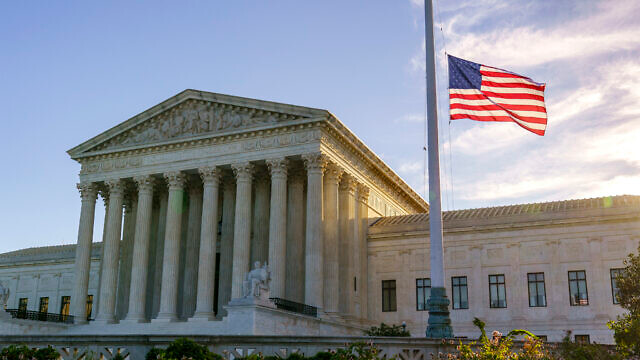
The flag flies at half-staff at the Supreme Court on the morning after the death of Justice Ruth Bader Ginsburg, 87, in Washington D.C., the U.S., September 19, 2020. /AP
Editor's note: Josef Gregory Mahoney is a professor of politics at East China Normal University. The article reflects the author's opinions, and not necessarily the views of CGTN.
Flags are at half-mast in the U.S. for the passing of Supreme Court Justice Ruth Bader Ginsburg, a social justice icon and a feminist role model. Her death sent a shudder through progressive Americans who had hoped she would survive the Trump presidency.
That has not happened, and despite her reported dying wish that an appointment be made after the election, both President Donald Trump and the Senate Majority Leader Mitch McConnell who is a responsible for overseeing confirmation of the president's nomination for the high court, have announced their determination to replace her at speed.
Some have described this as "power over principle," insomuch as McConnell infamously asserted the principle of refusing to hold a confirmation vote for the last justice to die, Antonin Scalia, near the end of Barack Obama's second term in office, and then reserve that privilege instead for the incoming Trump presidency.
This is not surprising because the only principle ever involved was the exercise of raw power itself, and as Bob Woodward's book "Rage" (2020) explains in the voice of Trump himself, McConnell cares most about stacking the federal courts with conservative judges.
Facing the prospect of yet another Trump appointee to the Supreme Court and the possibility it might tilt decisively to the right, a few progressive whispers of resentment have been heard regarding Ginsburg's decision to stay on the bench.
Had she retired when diagnosed with pancreatic cancer in 2009, her second bout with cancer no less, Obama would have been able to appoint a progressive justice to succeed her. Indeed, during his time in power, Obama had appointed and had confirmed two progressive female justices, Sonia Sotomayor and Elena Kagan, and progressives hoped to solidify a long-term voting block with a third appointment given Ginsburg's age and health concerns.
And yet, the Supreme Court functions quite differently from the executive and legislative branches of the government. Appointed for life to make them immune to the very politics that likely put them on the bench in the first place, the eight associate justice and one chief justice tend towards close relationships and even deep friendships with each other in ways that transcend ideological divides.
It may well be that Ginsburg worried less about the future of the court because she knew the hearts and minds of her colleagues. Some of her conservative colleagues have been known to vote more liberal and progressive on some issues, and the opposite is sometimes true of liberal justices as well.
But it is also the case that as progressive as Ginsburg may have seemed, she was by many estimates a moderate and not as radical as some of her admirers imagine. Most legal systems are in many respects inherently conservative and resistant to change, especially when the system is predicated on precedence and case law.
Furthermore, the Supreme Court itself is largely confined to interpreting the constitutionality of legislation and whether the other two branches limit themselves appropriately to the powers granted to them by the Constitution. Additionally, it serves as the nation's highest appellate court, but in this respect its primary role tends towards judicial oversight ensuring due process.
Consequently, while many people worry over an activist court, especially given the tendency of the legislative branch to abdicate responsibility for lawmaking and to essentially defer to the president's capacity for rule-making, the Supreme Court's power never reaches levels wished for or feared by cultural warriors who expend great amounts of energy and angst over its make-up.
Nevertheless, Ginsburg's passing and Trump and McConnell's decision to replace her quickly in the run-up to a close election in a highly polarized society reeling from COVID-19 promises the sort of political theater that Washington insiders adore.
200,000 dead
The flags should be at half-mast for Ginsburg, they should also be at half-mast for the black men and women killed by acts of police brutality nationwide, and they should stay that way for the rest of the year for the now more than 200,000 Americans who have died from COVID-19.

Activists from the COVID Memorial Project mark the deaths of 200,000 lives lost in the U.S. to COVID-19 after placing thousands of small American flags places on the grounds of the National Mall in Washington D.C., the U.S., September 22, 2020. /AP
Ginsburg's passing should be mourned, but the gross negligence of government with respect to containing and controlling the outbreak, as well as the lack of national mourning for so many American's dead, indicates a much greater tragedy has gripped the nation.
Indeed, Ginsburg was a champion for social justice, but the injustices associated with the pandemic in the U.S., especially its disproportional impacts on minority and poor communities, sets out a stark contrast: COVID-19 and failed governance has killed more in the last six months of Ginsburg's life than she helped save over her lifetime.
While some believe the number is inflated, it's more likely a substantial under-count according to many experts, with many accounts in leading publications asserting this dark milestone was achieved months ago.
Furthermore, despite the likelihood that the number of actual deaths is already much greater than 200,000, there is a tendency among some to discount even those deaths officially attributed to COVID-19, asserting that most who died already were facing serious health problems and were likely to have died soon anyway.
This sort of thinking is socially dangerous insomuch as it's a gross falsehood that is deadly, and above all because disrespecting the dead a herald of dehumanization.
This leaves us with two difficult matters to consider:
First, even if the count is accurate, it's still the worst among developed nations globally, and this refusal to acknowledge the tragedy adequately, this refusal to acknowledge responsibility for the tragedy, and this continued failure to prevent further tragedy is the death that becomes "America" today.
Second, if a country like the U.S. can't acknowledge and respect its own fallen, what then should the world expect from it in return except darkness? If America doesn't find a better course, how many of her own will perish, and how many others will she drag down with her?
(If you want to contribute and have specific expertise, please contact us at opinions@cgtn.com.)