- Home
- China
- World
- Europe
- Politics
- Business
- Opinions
- Tech & Sci
- Culture
- Sports
- Travel
- Nature
- Picture
- Video
- Live
- TV
- Specials


Share







Copied
The U.S. Department of Commerce in Washington, DC, August 5, 2020. /Xinhua
Editor's note: Anne O. Krueger, a former World Bank chief economist and former first deputy managing director of the International Monetary Fund, is senior research professor of international economics at the School of Advanced International Studies, Johns Hopkins University, and senior fellow at the Center for International Development, Stanford University. The article reflects the author's opinions, and not necessarily the views of CGTN.
Since World War II, the global economy has performed beyond the wildest dreams of its post-war architects, yielding unprecedented gains in health, education, living standards, poverty reduction, and wealth. Central to this success was the growth and liberalization of international trade, which was made possible with U.S. leadership in the creation and stewardship of an open multilateral trading system.
That system – enshrined first through the General Agreement on Tariffs and Trade (GATT) and then in the World Trade Organization (WTO) – established international rule of law over global commerce, non-discrimination among trading partners, and a forum for negotiating tariff reductions and the removal of other trade barriers.
The WTO succeeded the GATT in January 1995, and by 2000, average tariffs on manufacturers in advanced economies were about two percent, far below the levels of 1948. International trade had grown from around 20 percent of global GDP in the early post-war years to 39 percent in 1990 and 58 percent in 2018.
But the open multilateral trading system has been severely eroded over the past few years.
The dollar value of world trade fell by three percent in 2019, even as world GDP was still rising. This reversal was largely the result of America's shift toward bilateralism and protectionism since the beginning of U.S. President Donald Trump's term in January 2017.
Trump seems to believe that the United States is powerful enough to secure better "deals" by negotiating (read: bullying) with trading partners one on one. But while the U.S. is indeed a large trading country, it actually accounts for only four percent of the world's population and less than one-fifth of global GDP. Those numbers alone justify skepticism about the effectiveness of Trumpian bilateral browbeating.
Moreover, enough time has elapsed that we can now subject Trump's approach to the microscope. His stated aims when he came to office were to reduce U.S. bilateral trade imbalances and remove or reduce trade barriers and tariffs against American goods, thereby increasing U.S. exports. None of these goals has been achieved.
Bilateral and overall trade deficits cannot be remedied through protectionism, and both indicators have actually worsened under Trump. The overall U.S. trade deficit rose from 750 billion U.S. dollars in 2016 to 864 billion U.S. dollars in 2019, and has now reached its highest level since July 2008. And U.S. exports to China, the main target of Trump's "America First" trade policy, have risen by only 1.8 percent in the year to August 2020, while Chinese exports to the U.S. have risen by a whopping 20 percent, thereby increasing the bilateral trade deficit.
As is always the case in trade wars, both countries have lost from the tit-for-tat tariff increases. American consumers now must pay more for many goods from China, and the U.S. has had to pay out some 28 billion U.S. dollars in compensation to American farmers. Numerous U.S. businesses have been forced to pay more for inputs, and have consequently lost market share to foreign competitors who now have a cost advantage. And, predictably, China has raised its own import tariffs on American goods, undermining U.S. exports.
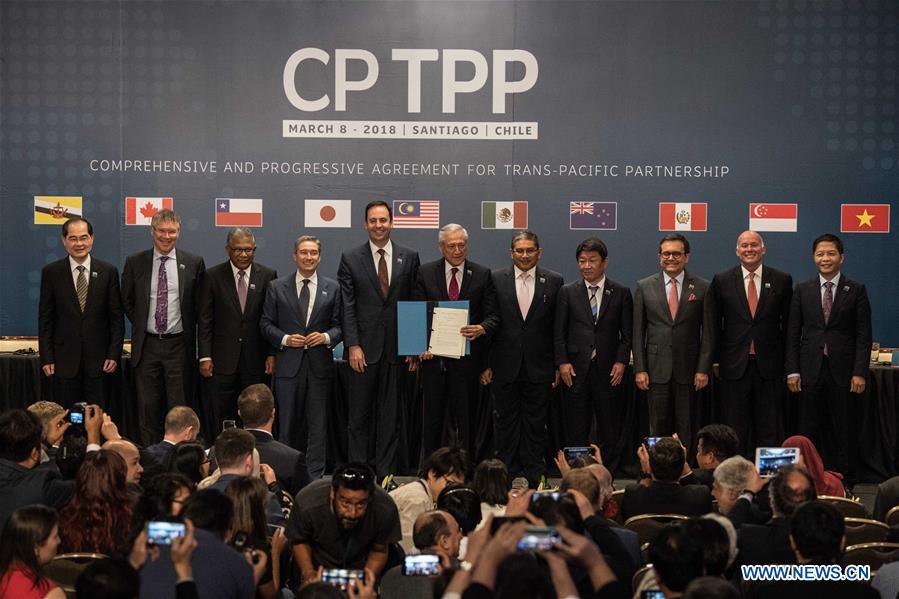
Ministers from 11 countries attend the signing ceremony of the Comprehensive and Progressive Agreement for Trans-Pacific Partnership (CPTPP) in Santiago, Chile, March 8, 2018. /Xinhua
Similarly, the Trump administration's "renegotiation" of the North American Free Trade Agreement (NAFTA) and the U.S.-Korea Free Trade Agreement (KORUS) was supposedly meant to address "new issues" like the rise of the digital economy. And yet, these issues had already been included in the Trans-Pacific Partnership (TPP) negotiated by Barack Obama's administration, which Trump immediately abandoned upon taking office.
Having concluded a similar free-trade agreement without the U.S. – the Comprehensive and Progressive Agreement for Trans-Pacific Partnership (CPTPP) – the remaining members of the original agreement now enjoy duty-free access to one another's markets, while the U.S. is subject to higher tariffs vis-à-vis these countries.
So, far from reducing the barriers faced by U.S. exports, Trump has managed to increase them almost across the board. Under the TPP, American wheat producers would have been spared Japan's 38 percent tariff on all wheat imports. But now that the TPP has been replaced by the CPTPP, Canadian and Australian wheat exporters to Japan are subject to lower tariffs than their U.S. counterparts. Making matters worse for U.S. producers, Japan and the European Union have since concluded a free-trade agreement that eliminates duties on autos and other goods.
The list of Trump's "own goals" goes on. Sweeping tariffs on U.S. steel and aluminum imports (which initially included those from its NAFTA trading partners) have merely disadvantaged American steel-using industries. But iron and steel employment has fallen over the past two years.
Even though almost every U.S. ally has been on the receiving end of U.S. demands for changes in trade relations, very little has been achieved. The primary changes to NAFTA were in automobiles and parts, and the effect was merely to increase protection against imports from Mexico.
Finally, and perhaps most importantly, the Trump administration has severely undermined the WTO by blocking the appointment of new judges to its appeals panel, thus rendering the dispute settlement mechanism non-operational. The WTO is a global institution whose 164 members account for 96.4 percent of world trade and 96.7 percent of world GDP. The world desperately needs it to function properly.
The Trump administration would have had a much greater chance of success if it had addressed outstanding trade issues through the WTO. Forming alliances with like-minded trading countries and amending the WTO's rules multilaterally has long been more effective than pursuing narrow, piecemeal objectives unilaterally. Trump's bilateralism and rejection of the WTO has undermined the entire international trading system and inflicted great harm on U.S. firms and households.
Copyright: Project Syndicate, 2020.
(If you want to contribute and have specific expertise, please contact us at opinions@cgtn.com.)