- Home
- China
- World
- Europe
- Politics
- Business
- Opinions
- Tech & Sci
- Culture
- Sports
- Travel
- Nature
- Picture
- Video
- Live
- TV
- Specials


Share







Copied
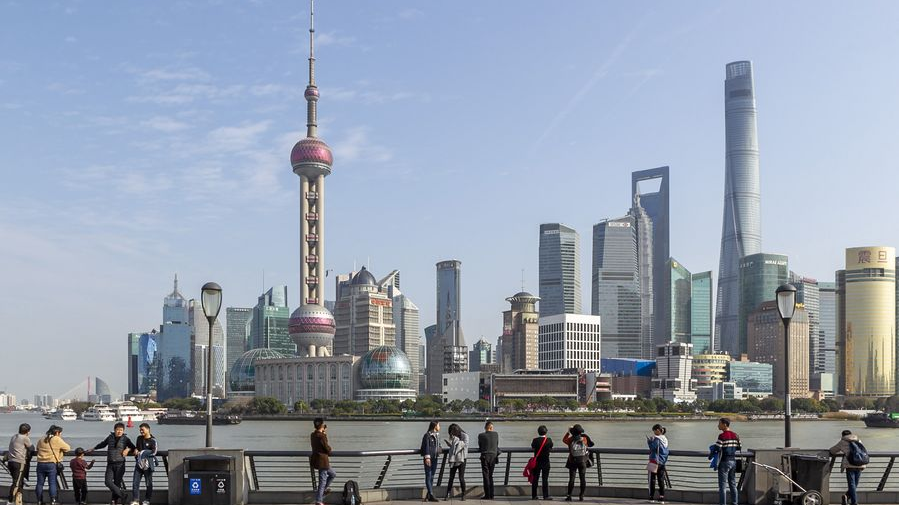
The skyline view of Lujiazui area at the Bund in Shanghai, China, January 6, 2020. /Xinhua
Editor's note: Keith Lamb is a University of Oxford graduate with a MSc degree in Contemporary Chinese Studies. His primary research interests are international relations of China and China's "socialism with Chinese characteristics." The article reflects the author's opinions, and not necessarily the views of CGTN.
In President's Xi Jinping's address to the United Nations General Assembly's General Debate, he advocated for a future world order that few could or should disagree with. His message was that we should work together through multilateral institutions and protect the multilateral trading system; the COVID-19 vaccine should be made a global public good; all states should have the right to follow their own development path; we should develop a community of shared interests where differences are solved through dialogue.
This speech will most likely be cast off as little more than rhetoric and propaganda in the West. However, when "rhetoric" becomes solidified and widely disseminated, it can both reflect the future direction of power and also provide a framework to hold power accountable to.
For example, when the U.S. rhetoric is about war, going it alone and isolationism, the bar is already set low. What ideal is there to hold this sort of power to when it actually does do something outrageous like bomb or invade a developing country or pulls out of the WHO? No one can say they didn't warn us or that it was unexpected.
When I arrived in China in 2004, I heard all sorts of things that the Communist Party of China (CPC) were going to do such as get rid of poverty, construct the towns and countryside, clean up the environment and develop their technology. Coming from a developed country, it seemed impossible to me. However, members that I spoke to in the CPC didn't share the same opinion.
I looked at Shijiazhuang, the city I landed in, and it was hard to see anything that was better, in terms of development, than in the UK where I had come from. Nevertheless, I had not witnessed what China was like in 1994, while my Chinese colleagues had. Consequently, they evidently had a better idea about how rapidly a country can change for the better with the right leadership.
In China, the message of the CPC is ubiquitous; one can't ignore the multifarious slogans that compete with market advertising space promoting what sort of society China would like to transform into. It also reminds its citizens of their common bond and duty for achieving shared prosperity.
My dad, a hardened military man with an "anti-communist prejudice" who visits me regularly has different views. As we once crossed a bridge in China he looked at a banner, which he had no ability to read, and laughed saying, "propaganda." This basically sums up many a typical Western citizen's attitude toward China.
However, as I translated the "propaganda," the banner was simply reminding citizens to be courteous to one another.
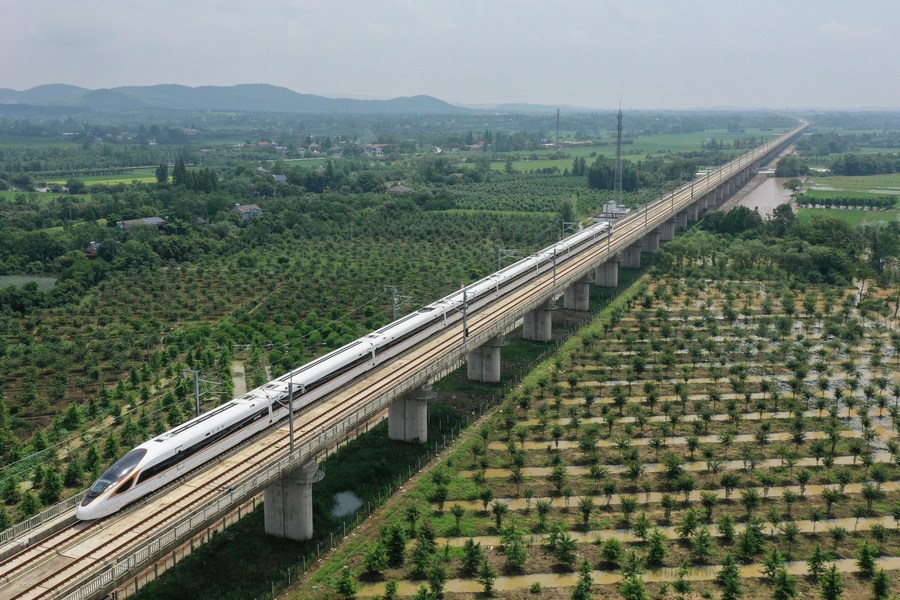
A bullet train runs on the Shangqiu-Hefei-Hangzhou high-speed railway in Anji County, east China's Zhejiang Province, June 28, 2020. /Xinhua
We have plenty of public messages in the West and usually its sole source is from private corporations promoting their goods. The dearth of government messages makes it hard to know where the country is heading. The fact that private enterprise is preponderant when it comes to public communication makes one think that power in fact lies with corporations, not our democratic institutions.
China is not alone in having long-term social developmental problems; many Western countries do too. Therefore it would be valuable if we could also hear more how our liberal democracies' plan to tackle them. But it is only at election times that political slogans become awash, though most will remain unfulfilled promises.
As such, Western countries need to find ways to modify their systems to deal with struggles that last beyond an election cycle. They need to also be able to convey their plans to the public so that we can evaluate our systems over the long term.
There are pressing issues that cannot be solved by any one country in a short amount of time, such as war, pandemics and environmental problems. We need to hear more rhetoric and have this expressed in more public slogans from our Western political elites detailing how our system and we, the people of the West, will join hands with the rest of the world to tackle these problems. Of course, rhetoric and slogans must concur with emerging reality; otherwise they are just propaganda.
The problem is, there isn't even this message of goodwill coming out of the U.S., the "leader" of Western states. The U.S. under Trump seems set for further belligerent policies; the Paris Agreement has been disregarded; in the tragedy of COVID-19 the U.S. has spurned the WTO. The European states will have to unite so that their future isn't hijacked.
Walking around China for those that can read Chinese they will not see any messages about oppressing another state or about climate change denial. Pervasive are messages about peace and building a greener future where recycling and respecting the earth are important. This message was also highlighted in Xi Jinping's speech.
For years naysayers derided China about their pollution problem. The smog in Shijiazhuang and coal cities like Tangshan was so bad that at times one could see a man disappear into it a couple of hundred meters down the road. Not a single Westerner, including myself, believed this situation could be changed any time soon a few years ago.
The CPC said pollution would be a temporary problem that they would solve in the future. And indeed, there has been a marked difference in air quality in Chinese cities.
If all what I was hearing in China in 2004 about alleviating poverty, developing technology, as well as making leaps and bounds to clean up its environment was propaganda, then it was pretty appalling propaganda because so far, the rhetoric, the slogans and the promises are being fulfilled. When China says it wants a world of shared destinies, a multilateral trading system and an ecological civilization, it is earnestly serious.
(If you want to contribute and have specific expertise, please contact us at opinions@cgtn.com.)