- Home
- China
- World
- Europe
- Politics
- Business
- Opinions
- Tech & Sci
- Culture
- Sports
- Travel
- Nature
- Picture
- Video
- Live
- TV
- Specials


Share







Copied
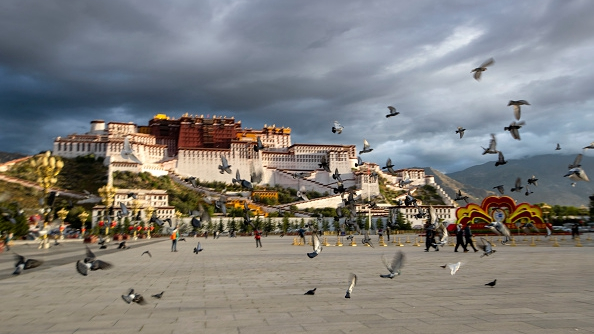
The Potala Palace, Lhasa City, Tibet, China, September 19, 2020. /Getty
Editor's note: Iram Khan is a Pakistan-based commentator on international affairs. The article reflects the author's opinions, and not necessarily the views of CGTN.
In an effort to undermine the growing prosperity in southwest China's Tibet Autonomous Region, a new misleading Orwellian fantasy accusing the Chinese government of a mass labor program has surfaced.
The story comes from the news agency Reuters and forms a part of the latest series of anti-China concoctions. On one hand, U.S. lawmakers have been introducing bills that are tantamount to interfering in China's internal affairs, on the other, rhetoric is being built through shaky media campaigns.
A glance at contemporary events helps understand why these antagonistic overtures are coming to the fore. Within 70 years of its founding, the People's Republic of China has surpassed economic progress of states founded much earlier. At the same time, China's win-win partnerships and the Belt and Road Initiative have brought it immense international goodwill.
As the country's diplomatic clout grows, there appears to be an unfounded feeling in the U.S. that the traditional role of America as a global hegemon is waning.
For the better part of the current and the previous century, the U.S. has tried to retain a unilateral approach toward international affairs, drawn by the one thing it is addicted to the most: global primacy.
When the U.S. was challenged by the Soviet Union, it spent all resources to win the Cold War. And now as the world is seeing a peaceful economic rise of China, the U.S. is perceiving an undue threat that is based on nothing but paranoia.
The recent spike in anti-China narrative is also explained by the upcoming U.S. election. In one of the worst presidencies in U.S. history, Donald Trump has failed to deliver on the promises he made during his 2016 election campaign. Moreover, he is desperately looking for a scapegoat to divert public attention from his economic failures and from arguably the worst response by any country in containing the COVID-19 pandemic.
Trump's 2020 election campaign can be summarized in one sentence: "blame it all on China." But the problem he is facing is that saner minds are unwilling to peddle his accusations. Instead, they are convinced of the interdependency of American and Chinese economies and China's impressive role in global economic growth.
What the anti-China campaign is ultimately left with is a set of organizations that are, in fact, fronts for undermining other countries' interests and dubious individuals who are passed off as experts.
The latest report on the alleged mass labor program is released by the Jamestown Foundation, a Washington-based institute with a history of supporting foreign dissidents.
An interesting fact about this institute is that most of its board members are from the corporate world, naturally bearing commercial interests while churning out their research work. With the report in question, Jamestown Foundation has actually helped Trump who perceives an economic threat from China.
Core findings of the accusations were compiled by Adrian Zenz, a German scholar with significantly questionable credentials. Zenz claims to be on a God-led mission against China and has made several fictitious assertions in the past that are conveniently ignored by his mentoring organizations.
Human Rights Institute of the Southwest University of Political Science and Law in Chongqing recently analyzed the work of Zenz and found massive discrepancies.
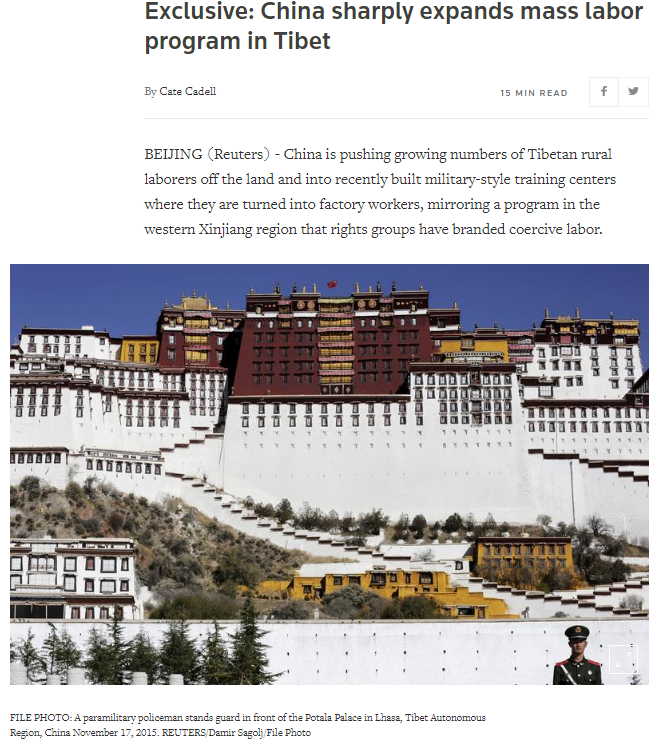
A screenshot of the Reuters report.
It was revealed that he had been using synthetic pictures with fictional figures to prove that a "genocide" is being brought upon the population of Xinjiang Uygur Autonomous Region. In addition, he used photographs from the internet, portrayed them as if taken by him and distorted their context to back his allegations.
It is surprising to see Reuters stooping so low that it had to quote such an individual's "research" and insert his remarks in its story about Tibet. Had the editors at the news agency done a background check on him, this yarn would have probably headed to the bin rather than the website.
Reuters, the Trump administration and other China critics attempt to generate confusion between genuine law enforcement measures and human rights abuses. While it has never been possible to fool all the people all the time, in today's era of smartphones and internet, it is not even possible to fool some of the people all the time. If human rights violations take place in any part of the world, videos and testimonies do get out.
Ever since such claims were first made against China, not a shred of solid evidence has been made public. Meanwhile, if human rights violations under the garb of law enforcement are to be taken up for criticism, then the killings of George Floyd and other young black Americans at the hand of their police force – recorded on video – serve as the starting point.
Reports accusing China of mass labor camps come at a time when the foundations of Western society are under scrutiny for being built on mass exploitation of African people. It must be remembered that human dignity is a prerequisite of building inclusive societies. And while building industries and farms, it was not China that went on an enslavement spree around the world.
(If you want to contribute and have specific expertise, please contact us at opinions@cgtn.com.)