- Home
- China
- World
- Europe
- Politics
- Business
- Opinions
- Tech & Sci
- Culture
- Sports
- Travel
- Nature
- Picture
- Video
- Live
- TV
- Specials


Share







Copied
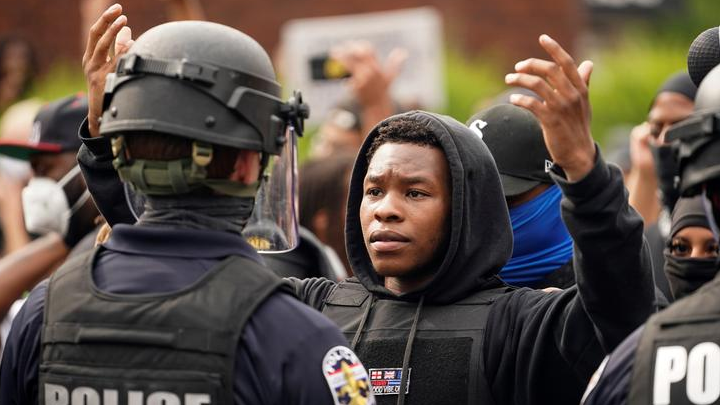
Demonstrators confront police in Louisville, Kentucky, U.S., September 23, 2020. /Reuters
Editor's note: Bradley Blankenship is a Prague-based American journalist, political analyst and freelance reporter. The article reflects the author's opinions, and not necessarily the views of CGTN.
The city of Louisville, Kentucky, has become the next major frontline in the U.S. cultural war, as the nation grapples with its racist past and present. Breonna Taylor, a 26-year-old Black emergency room technician and aspiring nurse, was killed by police who stormed her home on March 13 in a botched narcotics raid. No drugs were found in her home and she was not the target of the warrant.
Of the three officers who were involved in the killing, only Brett Hankison was indicted on September 23 on three counts of first-degree wanton endangerment – a charge that activists say is nowhere near severe enough.
On September 16, Breonna Taylor's family was awarded 12 million U.S. dollars by the city of Louisville in a lawsuit from April – the largest such settlement paid out for a Black woman killed by police, according to one of the family's attorneys, Ben Crump. The lawsuit does not technically admit any wrongdoing by the city or police, but its substantial sum and accompanying police reforms elements suggest otherwise.
"I cannot begin to imagine Ms. Palmer's pain, and I am deeply, deeply sorry for Breonna's death," Louisville Mayor Greg Fischer said alongside Taylor's mother, Tamika Palmer, when announcing the terms of the lawsuit.
To any normal person, it may seem a bit strange that an organization, a city in this case, would pay a fortune in restitution and apologize for something it had apparently no legal culpability for. Strange as it is, the actual developments of the indictment are perhaps more illustrative of the erasure of Breonna Taylor's unjust killing.
Prior to the grand jury's indictment on September 23, Hankinson had been let go by the Louisville Metro Police Department for displaying "an extreme indifference to the value of human life" during the incident in which he "wantonly and blindly fired ten (10) rounds," according to his chief.
"I find your conduct a shock to the conscience," Louisville Police Chief Robert Schroeder told Hankinson. He noted that some of the rounds fired in Taylor's apartment had gone into the neighboring apartment "endangering the three lives in that apartment."
These three lives mentioned by Schroeder were those represented in the three counts of first-degree wanton endangerment. Under the Kentucky statute, someone "is guilty of wanton endangerment in the first degree when, under circumstances manifesting extreme indifference to the value of human life, he wantonly engages in conduct which creates a substantial danger of death or serious physical injury to another person."
The language in the statute matches the assessment of Chief Schroeder pretty much identically, indicating that this case will probably be open and shut based on the charges brought forth. But what's obviously troubling, as anyone aware of the case to this point should know, is that Breonna Taylor's life was not taken into account at all by the grand jury and thus her death will probably never be met with justice.
Hankinson now could see a five-year sentence for each of these counts, but will likely see much less even if found guilty. The other two officers who were involved in the no-knock raid into Tayor's home and also fired rounds now walk away unscathed, any suffering they may incur is likely to be offset by a wave of support from far-right entities.

A woman visits the memorial for Breonna Taylor in Louisville, Kentucky, U.S. /Reuters
While this may seem like a grim analysis, the reality is that racism and injustice are features of the American criminal justice system – they are its "laws of motion," so to speak.
Basketball player, Jaylen Brown, said it quite appropriately in response, "To be honest, I wasn't surprised… This society, the way it was built, and the way intentions was to never protect and serve people of color initially."
Certainly Hankinson, who fired ten shots into Taylor's apartment and, of course, at the victim herself, showed "extreme indifference to the value of human life" if we count Breonna Taylor as a human. But her equally valuable life was discounted by the grand jury and totally omitted. For as long as people have said her name, she has been completely ignored – and that is exactly why protesters have swelled the city streets for days on end.
Predictably, the grand jury decision sparked immediate nationwide protests. Netizens on Twitter noted the absolute show of force by the Louisville police in the wake of the grand jury decision. It was reported by the American news media that two officers were shot and suffered non-life-threatening injuries during the ensuing protests in Louisville.
Kentucky Governor Andy Beshear tried to calm the storm, calling on protesters to go home and urged prosecutors to release the evidence presented to the grand jury to help the public "process" the decision.
But more predictably, U.S. President Donald Trump chimed in with divisive language during a White House news conference by telling reporters "I thought it was really brilliant." There is nothing brilliant about this or the steady stream of police misconduct cases that always amount to no justice and thus result in no peace, as protesters have made their rallying cry.
Though the American criminal justice system apparently follows its own, separate laws of motion – nature has its own set of governing principles that supersede all others, including the fundamental law that every action has an equal and opposite reaction. Policymakers should anticipate the day that an equally powerful yet righteous reaction might head their way.
(If you want to contribute and have specific expertise, please contact us at opinions@cgtn.com.)