- Home
- China
- World
- Europe
- Politics
- Business
- Opinions
- Tech & Sci
- Culture
- Sports
- Travel
- Nature
- Picture
- Video
- Live
- TV
- Specials


Share







Copied
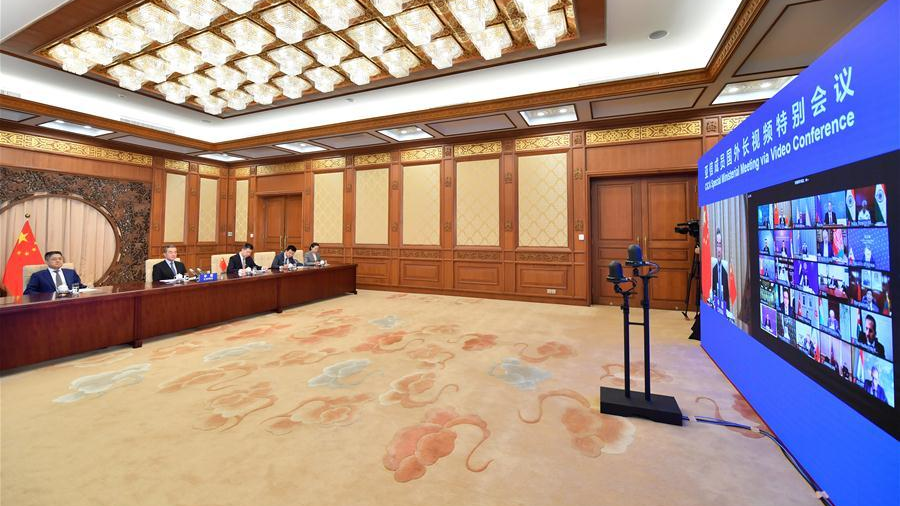
Chinese State Councilor and Foreign Minister Wang Yi attends a video conference of foreign ministers of the member states of the Conference on Interaction and Confidence Building Measures in Asia (CICA) in Beijing, capital of China, September 24, 2020. /Xinhua
Editor's note: Iram Khan is a Pakistan-based commentator on international affairs. The article reflects the author's opinions, and not necessarily the views of CGTN.
As the world progresses into the Asian century, a number of complementing initiatives have been launched by countries in the continent to make the best use of each others' potential. But to accrue maximum benefits, an environment conducive to investment is a prerequisite.
To guarantee such an environment, Conference on Interaction and Confidence Building Measures in Asia (CICA) was formed in 1992 to enhance security-related consultations among participating countries. It has since evolved into a comprehensive platform that promotes regional stability and prosperity through a wide representation.
The menace of terrorism raised its head in the latter part of the previous century and continued to disrupt the development process of Asian countries well into the 21st century. It took a considerable time for the international community to realize that this problem can be tackled only with joint efforts.
The CICA has played its part in combating terrorism by providing a mechanism to share information and experiences among members. The security situation steadily improved in Asia and so did the economic conditions in the Eastern hemisphere.
The threat that the world faces now is from the rising unilateralism. Although this trend is emanating mostly from outside the borders of Asia, it very much impacts the economies and, consequently, security in Asian countries.
The CICA members are of the unanimous view that the multilateral system, with the UN at its core, must be supported. The UN was created after enormous loss of lives and resources in the two world wars. It provides a system of solving conflicts without taking up arms and mitigates global challenges like poverty, illiteracy, disease and climate change.
Such problems are better solved if the system of international relations is democratized. Weaker nations are assured that their voice will be heard and their interests will not be overrun by powerful nations. This is only possible if regional and sub-regional multilateral cooperation is encouraged and practiced.

A Chinese medical expert instructs an Iraqi medical worker on operating a nucleic acid detection machine at a new Polymerase Chain Reaction lab in Baghdad, Iraq, March 26, 2020. /Xinhua
Initiatives like the CICA make sure that the global arena does not turn into a place where the law of the jungle prevails. They help in protecting the international order as a just system of addressing issues that affect every nation. Leaders gather under the banner of the CICA and, through communication, develop and improve mutual trust that translates into a safer and more peaceful region.
Foreign ministers of the CICA held a virtual meeting on September 24 where China presented its vision to bolster the organization's commitment to enhance cooperation.
Mutual respect, fairness and justice are the pillars of building a community of shared future for mankind. Foreign Minister Wang Yi pledged to make China's contributions to peace and development not only in Asia, but also in the world at large.
The Chinese vision also includes openness and inclusiveness in fulfilling the historical mission of the CICA since these values inherently engender trust among member states.
Moreover, China places great emphasis on innovation in all realms to cope with the constantly changing requirements of the modern world. At the CICA too, innovation has to be a priority to make the collaboration a success.
As everybody is focused on containing the COVID-19 pandemic, the need for putting up a multinational front to meet common objectives has increased. Be it the donation of personal protective equipment, dispatching experienced medical experts or participating in vaccine trials, China has taken its partners along in the control efforts.
Until the entire planet's population is cleansed of the virus, everyone remains at risk. Cooperation, therefore, becomes mandatory. Wang Yi asked the CICA members at the meeting to oppose politicization of the pandemic and stigmatizing specific countries. Unless this is done, the plan of defeating COVID-19 will remain illusory.
COVID-19 has thrown the economies of almost all countries backward. Financial situation of individuals, businesses and governments is precarious and developmental activities have taken a huge hit. The CICA presents a possibility to synergize development strategies and the Belt and Road Initiative can accelerate the recovery process.
Just as China shared its experiences of bringing down COVID-19 cases, it is also willing to share its development opportunities. There is a massive domestic market in China open to Asian investors. The upcoming China International Import Expo and the recently promoted "dual circulation" policy are excellent avenues for this purpose.
The CICA has delivered results in the past and holds a promising future. The member countries should keep faith in its multilateral nature and discourage isolationist and protectionist tendencies at the international level. The world is moving in a positive direction and the CICA will continue to foster productive partnerships.
(If you want to contribute and have specific expertise, please contact us at opinions@cgtn.com.)