- Home
- China
- World
- Europe
- Politics
- Business
- Opinions
- Tech & Sci
- Culture
- Sports
- Travel
- Nature
- Picture
- Video
- Live
- TV
- Specials


Share






Copied
Editor's note: Bradley Blankenship is a Prague-based American journalist, political analyst and freelance reporter. The article reflects the author's opinions, and not necessarily the views of CGTN.
U.S. President Donald Trump has repeatedly justified the framing of his administration's COVID-19 response as somehow helping to manage panic, which to him is apparently worse than the pandemic itself that has killed over 200,000 Americans. His statements to Bob Woodward that he likes to "downplay" the virus while actually knowing its danger and contagiousness reflect his point of view very candidly.
Many are of the opinion that Trump wants to avoid a panic in order to quell consumer and investor uneasiness – perhaps a reasonable concern from a certain point of view – but the president's statements and actions on many other accounts reflect that he is much more shallow.
It should be noted that Trump's lackadaisical response to the coronavirus was not just irresponsible rhetoric and a slow-moving mobilization, but actual actions that had consequences. On September 17, Professor Don Moynihan at Georgetown University tweeted out a draft press release from the United States Postal Service (USPS) which stated that they would "distribute 650 million reusable cotton face coverings on behalf of the Department of Health and Human Services (HHS)."
They would have essentially sent out five reusable face masks to "every residential delivery point in America," starting in April, first to the most vulnerable areas at that time and to essential workers. According to the Washington Post, the White House blocked the plan because "households receiving masks might create concern or panic."
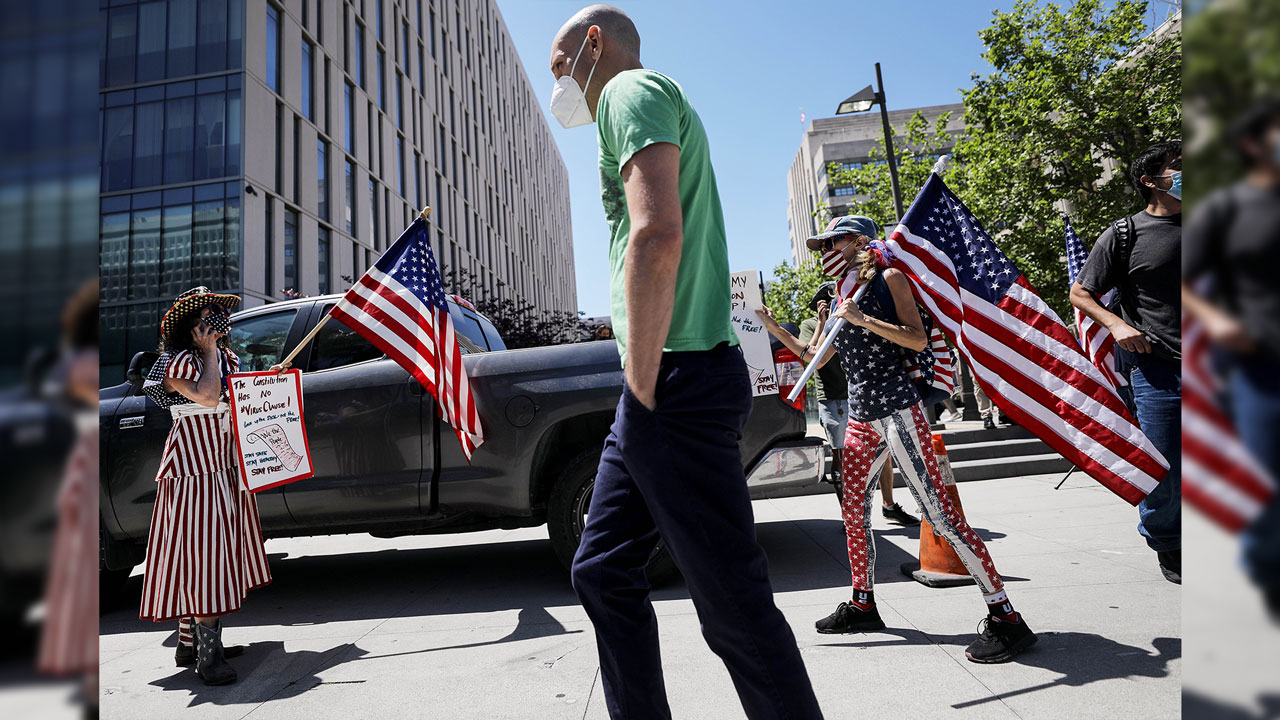
Protesters rally against a shelter-at-home order at Los Angeles City Hall, California. /AFP
To put it simply: Competent agency staff were ready to do what was necessary to help contain the virus, but Trump intervened to stop it. We know that, according to medical research, this would have undoubtedly saved tens of thousands of lives if the administration had let the adults in the room do their job. But they didn't.
And for that sacrifice – more than 200,000 lives – consumer confidence is still down. Similarly, investors are starting to realize the inevitable. Despite a befuddling stock boom this year, it seems things are headed toward a bear market – the Nasdaq is already in correction territory.
The S&P 500 and Dow Jones are likely to follow. Cases of the coronavirus are increasing across the country, and the autumn will huddle people indoors more where the virus is more likely to spread. Cases are already surging again in Europe, spreading fear to American investors of a generalized infection rise. There is also the risk of an influenza-coronavirus "twindemic." And, according to the New York Federal Reserve Bank's Weekly Economic Index, the economic recovery is stalling. The global economy is in a similar position, according to OECD's September forecast.
To really sum it up in one word: uncertainty. And Trump's actions have added more to it by creating turbulence in the international order, sowing racial division and his latest attacks on the peaceful transition of power between each administration. With the sheer volume of voting by mail, which Trump and a slew of right-wing propagandists are concocting conspiracies about, it is more than likely that the election results on the night of November 3 will not be final. Even if Trump loses in the end, as is most likely, he very well could be the perceived winner on that night and get overwhelmed by ballots bit by bit over several days, if not weeks.
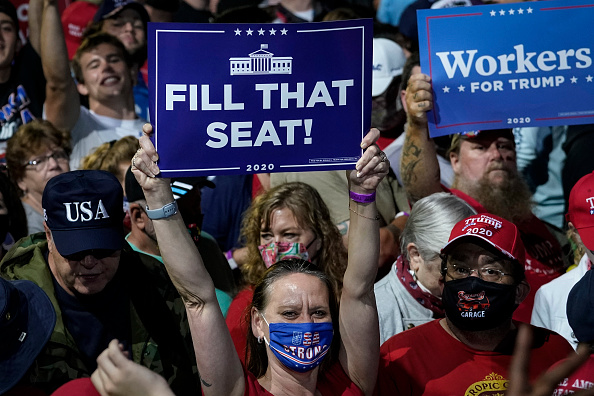
A woman holds up a "Fill That Seat" sign before the arrival of President Donald Trump during a campaign rally at Newport News/Williamsburg International Airport in Newport News, Virginia, September 25, 2020. /Getty Images
This is worrying because he has already signaled that he wouldn't accept these results. In a July interview with Fox News' Chris Wallace, Trump, just as he did in 2016, gave a "let's wait and see" type of response to whether he would accept the results of the election as legitimate. Trump predicted that the election, like in 2000, might end up in the Supreme Court.
"I think this will end up in the Supreme Court. And I think it's very important we have nine justices," Trump said, justifying the need to swiftly fill Justice Ruth Bader Ginsburg's bench ahead of election day.
Let's take it from one man who knows Trump very well – his former attorney Michael Cohen. Speaking again to CNN's Don Lemon on September 25, Cohen said that "he's laying a foundation of an argument that he's going to bring whether it's before the Supreme Court or to the Supreme Court that's going to challenge the validity of these ballots."
"He is the master of chaos and he is going to sow chaos each and every day up and through the election," he said.
Donald Trump says he doesn't want to create a panic – but to what end? Surely it didn't protect the lives of the American people. It also can't be to stabilize the financial market or the economy because every action he's taken (or not taken) this year will leave it in ruin for at least several years. Refusing to peacefully exit office would also torpedo the financial market, and everyone knows that.
The only explanation is that it's all about Trump himself.
(If you want to contribute and have specific expertise, please contact us at opinions@cgtn.com.)