- Home
- China
- World
- Europe
- Politics
- Business
- Opinions
- Tech & Sci
- Culture
- Sports
- Travel
- Nature
- Picture
- Video
- Live
- TV
- Specials


Share







Copied
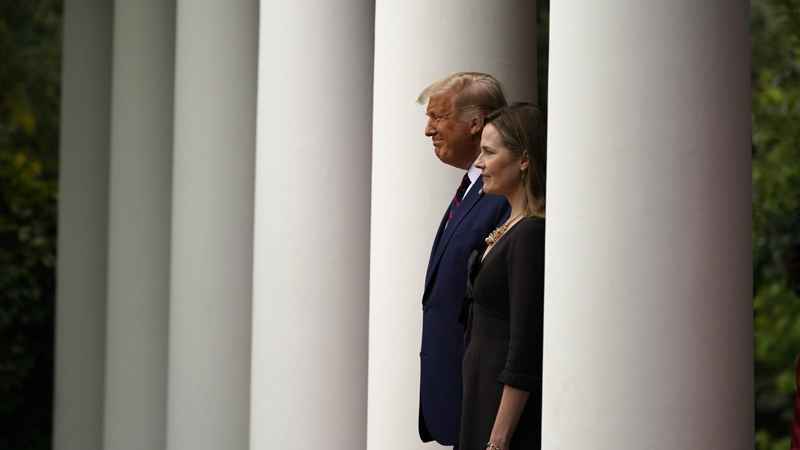
U.S. President Donald Trump walks with judge Amy Coney Barrett to a news conference to announce Barrett as his nominee to the Supreme Court in the Rose Garden at the White House, Washington D.C., September 26, 2020. /AP
Editor's note: Hannan Hussain is an assistant researcher at the Islamabad Policy Research Institute (IPRI) and an author. The article reflects the author's opinions and not necessarily the views of CGTN.
With less than six weeks before the U.S. elections, President Trump has struck a major chord with his hard-line conservative voter base. His answer is Amy Coney Barrett, a judge on the Chicago-based Seventh U.S. Circuit Court of Appeals, whose nomination to the Supreme Court he announced on September 26.
"Today, it is my honor to nominate one of our nation's most brilliant and gifted legal minds to the Supreme Court," said Trump during a White House ceremony. If confirmed by the Republican-majority Senate, Barrett would symbolize a solid conservative bend on issues of critical legal significance to both Trump and his broader election audience.
In her years on the bench, Barrett has maintained solid opposition to rulings that struck down abortion-related restrictions, while adding to the favor of expansive gun rights. Barrett communicated her position on gun rights most famously through a challenge to a federal law that barred people convicted of felonies from owning firearms.
"That power [of legislatures] extends only to people who are dangerous," fired Barrett in her March 2019 dissent. This view is consistent with Trump's aggressive defense of the Second Amendment, touted as liberation during violent protest attacks and recent election rallies. More tellingly, it became the introductory pitch to Barrett's promise and competence during Trump's Supreme Court announcement.
With Barrett's prospective selection, the broader goal is to cement a 6-to-3 conservative super-majority in the Supreme Court, which in Trump's words, "will decide the survival of our religious liberty, our public safety and so much more."
To better understand her significance to Trump's election campaign, consider three dynamics.
First, Barrett's Senate approval could optimize Trump's long-standing goal of appointing justices that are ready to change the face of key constitutional precedents, including the 1973 Roe vs. Wade ruling that the U.S. Constitution protects a pregnant woman's liberty to choose to have an abortion without excessive government restriction.
Despite any immediate change being unlikely, Barrett's presence in the court almost certainly helps position Republican narratives on constitutional liberties against their democratic equals, especially with the COVID-19 meta-narrative slipping out of Trump's hands.
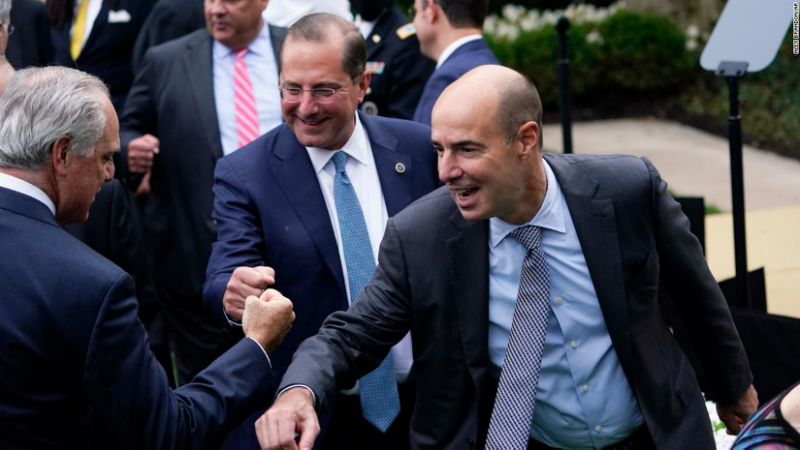
From right, U.S. Labor Secretary Eugene Scalia, Health and Human Services Secretary Alex Azar and former New Jersey Governor Chris Christie greet people after President Donald Trump announced Judge Amy Coney Barrett as his nominee to the Supreme Court in the Rose Garden at the White House in Washington D.C., September 26, 2020. /AP
Second, Barrett's prospective confirmation could be touted as Trump's landmark contribution to American democracy in next week's hotly anticipated Ohio presidential debate. Both Biden and Trump are expected to touch on the Supreme Court at the event.
Third, the most significant angle to Barrett's nomination is it means greater party support for Trump. Consider the fact that many Senate Republicans, including Senator Mike Braun, agree that Trump "is taking the right approach" with the Barrett nomination. Braun points to the earlier confirmation fight over Brett Kavanaugh, which helped pin GOP voters to his own Senate race, increasing the stakes for Trump – who is fighting the election of his lifetime.
Meanwhile, Biden and his Democrat allies realize the outsized threat of a 6-3 conservative majority in the Supreme Court, especially regarding decades of progressive laws and protections built into his campaign trail.
But the Democrats are more focused on slowing the pace of Barrett's rapid appointment chances as opposed to countering it. The decisive factor is the Republican Party's iron grip on the U.S. Senate, with many senators now scrambling to arrange Barrett's quick confirmation vote.
Therefore, having interpreted the nomination struggle as a lost cause, some progressives are pointing to Biden's less favorable options, such as expanding the net of Supreme Court judges once he is elected.
This prospect, which Biden has yet to endorse, underlines a fundamental limitation to his own vision for America. Leveraging his campaign won't change America's pivot toward the conservative right.
(If you want to contribute and have specific expertise, please contact us at opinions@cgtn.com.)