- Home
- China
- World
- Europe
- Politics
- Business
- Opinions
- Tech & Sci
- Culture
- Sports
- Travel
- Nature
- Picture
- Video
- Live
- TV
- Specials


Share






Copied
/Gettyimages
Editor's note: Hamzah Rifaat Hussain is a former visiting fellow at the Stimson Center in Washington, and currently serves as assistant researcher at the Islamabad Policy Research Institute (IPRI) in Pakistan. The article reflects the author's opinions, and not necessarily the views of CGTN.
In yet another instance of coaxing the leadership of another sovereign state, the Trump administration while speaking to a Sudanese delegation stated that Washington D.C. wishes for Sudan to follow a similar path to that of the United Arab Emirates and Bahrain by normalizing relations with Israel. In return, Sudan will be removed from the 1993 state sponsor of terrorism list.
This would allow Sudan to benefit from considerable economic relief since the Omar Al Bashir regime was toppled in 2019 by accessing American aid and debt relief. This offer has been rebuffed by Prime Minister Abdalla Hamdok on the grounds that the issues need to be dealt with separately.
There are considerable merits to Sudan's narrative as it lays bare the lack of strategic foresight and priorities of this Trump administration on subjects such as terrorism which in all honesty, have nothing to do with forging bilateral relations with other states.
Sudan's take on the issue of terrorism, terror financing and forging bilateral relationships with other sovereign states to be two completely disparate subjects, is precisely what the prime minister of Sudan told U.S. Secretary of State Mike Pompeo during the latter's visit to Khartoum last month.
Instead of pointing at Khartoum's counter terrorism efforts directed at curbing militia groups as a precondition for removing Sudan from the terrorism list of 1993, the United States has laid out a policy which is both shortsighted and negates on-ground realities.
Since the formation of the Transitional Military Council which paved the way for the Sovereignty Council to transit towards democracy, Sudan has actively cooperated with the United States in curbing terrorism on its shores such as promising to compensate the victims of the embassy bombings in 1998 and the attacks on the USS Cole.
Khartoum has also established a law reform commission and dismissed the undersecretary of the federal governance ministry which was a legacy from the previous Omar Al Bashir regime. Beyond the United States, Sudan has actively cooperated with international multilateral efforts in fighting terrorism as was stated by Hamdok during the 75th United Nations General Assembly session.
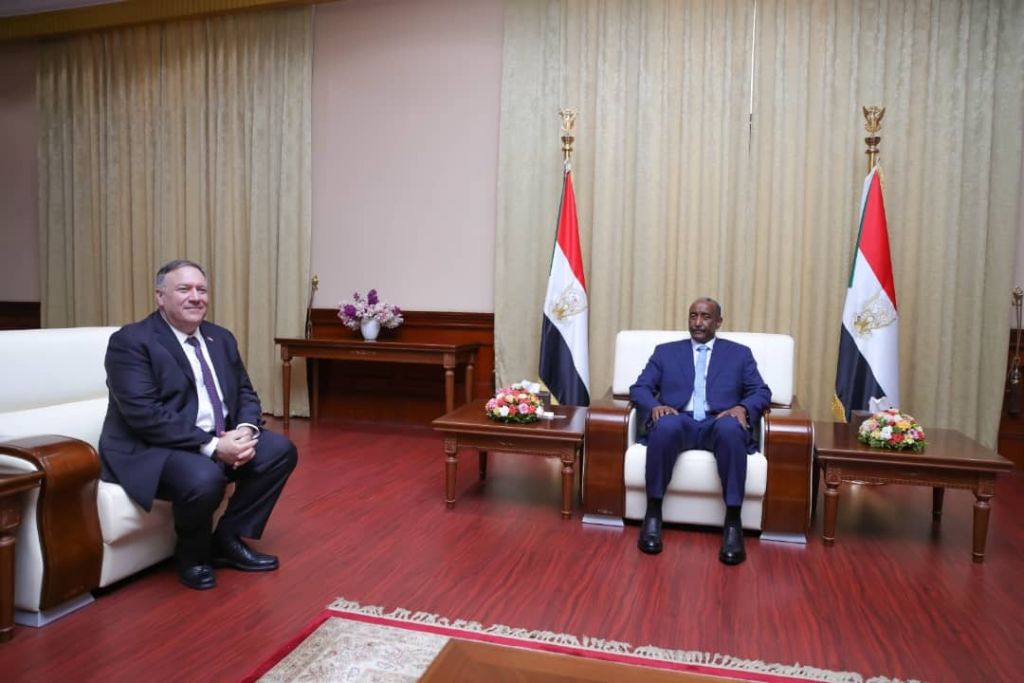
U.S. Secretary of State Mike Pompeo meets Chairman of Sudan's Transitional Military Council Abdel Fattah al-Burhan, in Khartoum, Sudan, August 25, 2020. /Gettyimages
The measures taken to curb terrorism include countering money laundering as well as monitoring banking transactions which allow terrorist groups, militias and insurgents to carry out attacks as operational techniques against governments, civilians and U.S. forces.
These are measures that the Paris-based intergovernmental organization the Financial Action Task Force use as a yardstick to measure a state's compliance and then categorize states such as Sudan into either the blacklist or the grey list of terror financing. Not once, has developing relations with another state been considered as a criteria to be included or removed in the grey/black list.
Yet according to the Trump administration's rationale, stronger ties with Israel will exonerate a country from being a state sponsor of terrorism. Hence, any state which has a checkered record with militia groups can easily become scot free if it forges relations with states based upon the whims and wishes of Washington D.C.
This reasoning is both bizarre and indicative of a complete lack of sincerity on part of the United States in dealing with sensitive issues such as regional terrorism which has a footprint beyond the confines or borders of Sudan.
Khartoum has also repeatedly hailed U.S. efforts and prospective Congressional moves in removing Sudan from the state sponsor of terrorism list of 1993. Yet, none of this is being factored in the American rationale for prospectively removing Sudan from the state sponsor of terrorism list.
In fact, other factors are also being sidelined, such as the plight of the impoverished population of the country which has endured prolonged conflicts between the North and the South, the presence of COVID-19 and severe malnutrition. According to the United States Institute of Peace, the United States would be able to vote in favor of debt relief packages from the IMF and the World Bank as well as other multilateral loans and financing initiatives for Sudan provided that Khartoum holds elections.
Based on preconditioning the transition towards democracy with the provision of financial aid, it is utterly bizarre that the Trump administration has equated the removal of Sudan from the 1993 terrorism list with forging ties with Israel. This logic entails that states which could be undemocratic would be given waivers from the United States if they were to establish bilateral relations with any state currently on America's radar
These contradictions demonstrate that the Trump administration has a convoluted, controversial and hypocritical stance on democratization and dictatorships where preferential treatment could be meted out if U.S. objectives and priorities on the foreign policy front are satisfied. The entire mantra of having an uncompromising stance on subjects such as human rights and democracy is significantly weakened based on the Sudan case alone.
Additionally, this lack of clarity also weakens the American narrative that dictatorships or undemocratic regimes deserve to be penalized. State sponsors of terrorism or any state which is categorized as such could be given sanction waivers and an increase in foreign investment provided that they toe the foreign policy line proposed by Washington D.C. Sudan's defiance on this proposal is well measured and base on principle.
After witnessing itself being isolated at multilateral forums such as the United Nations General Assembly recently, the United States has been rebuffed by the government of Sudan on preconditions which are rightly fallacious, myopic and shortsighted. If such trends persist, the U.S. could be failing on the bilateral front as well.
(If you want to contribute and have specific expertise, please contact us at opinions@cgtn.com.)