- Home
- China
- World
- Europe
- Politics
- Business
- Opinions
- Tech & Sci
- Culture
- Sports
- Travel
- Nature
- Picture
- Video
- Live
- TV
- Specials


Share







Copied

Tarin, a young man, searches for food in trash containers next to a supermarket in Toulouse, France, September 22, 2020. /Getty Images
Editor's note: Stephen Ndegwa is a Nairobi-based communication expert, lecturer-scholar at the United States International University-Africa, author and international affairs columnist. The article reflects the author's opinions and not necessarily the views of CGTN.
Food wastage and food loss is something that millions take for granted every day. Those who can afford the standard three meals a day have become so accustomed to eating and throwing away leftovers that the massive number of hungry people hardly comes to mind.
Further, millions of metric tonnes of food also rot in storage, oftentimes not even palatable to animals as fodder. It all ends up as compost, garbage or simply as ashes after being burned. It is only in times of acute food shortage that the folly of this habit is realized.
The injustice and "immorality" of both food loss and waste cannot be gainsaid. Not when, according to the Food and Agriculture Organization (FAO) estimates, over 820 million people suffer from hunger globally, which corresponds to one in every nine people.
Moreover, food wastage and accompanying food loss has been blamed for challenges like increasing emission of greenhouse gases, increase in pressure on both land and water resources, and hampering productivity and economic growth.
The FAO, the United Nations' body that leads international efforts to defeat hunger and improve nutrition and food security, estimates that a third of all food produced for human consumption globally is wasted, which is ironical in a world that is experiencing rapid population growth.
The categories of food wasted includes 45 percent of fruits and vegetables, 35 percent of fish and seafood, 30 percent of cereals, 20 percent of dairy products and 20 percent of meat.
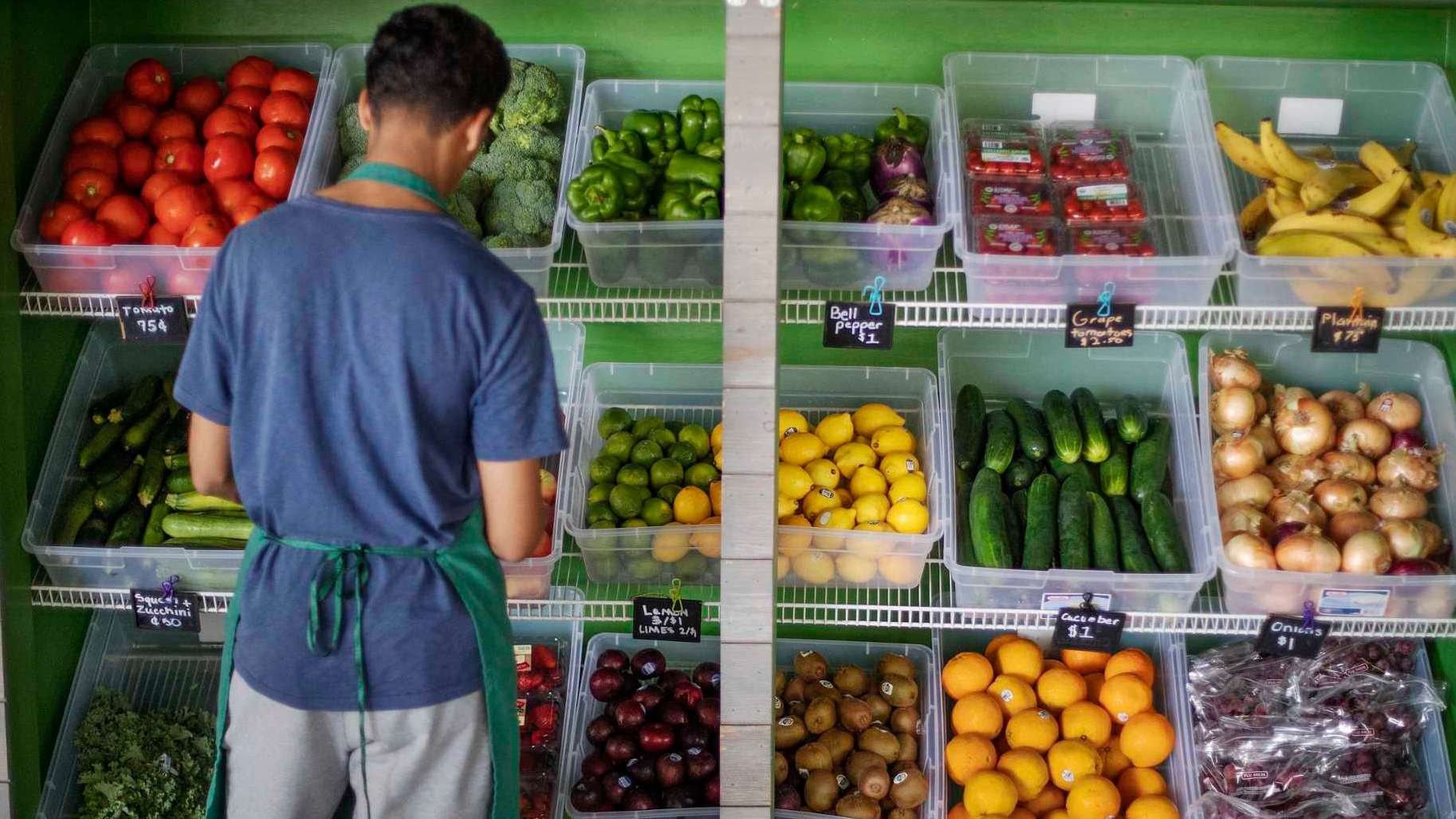
A produce stand at a metro station in Atlanta, Georgia, U.S., August 21, 2019. /AP
It is also important to differentiate between food loss and food waste. The former, estimated at 40 percent, is characteristic of developing countries due to poor harvesting and storage methods and facilities, while wastage includes uneaten food thrown away in homes, restaurants and cafeterias.
According to the FAO, the annual amount of food wasted globally is 1.6 billion tonnes, out of which 1.3 billion tonnes is still edible. Food wastage is also estimated to cost $750 billion, while 1.4 billion hectares of food goes to waste every year.
The coronavirus pandemic has woken the world's policymakers to this hitherto ignored phenomenon, as food supply chains were seriously interrupted or cut off altogether since the start of the year. Scenes of panic excessive buying and claims of hoarding were rampant. People started seeing the need for conserving diminishing food stocks, while at the local level sharing, particularly of perishables, became a way of survival regardless of social class.
It is from this background that the first International Day of Awareness for Food Loss and Waste Reduction is being marked on September 29. The day's theme is "Stop food loss and waste. For the people. For the planet."
The occasion will also focus on the challenge of reducing food loss and waste during COVID-19 pandemic. Indeed, the world's top three grains exporters, U.S., Brazil and India, are also the most affected countries by coronavirus.
China has already come up with a model aimed at containing the wanton loss of food. In August, President Xi Jinping launched the "Clean Plate" campaign, noting that COVID-19 had "sounded the alarm" on the "shocking and distressing" amount of food wasted.
During the course of this year, China has also lost millions of food crops in the farmlands and storage facilities, as the country experienced the worst flooding in recent decades. Analysts at the Chinese brokerage firm Shenwan Hongyuan estimated that the country could lose up to 11.2 million tonnes worth of food compared to 2019, equivalent to 5 percent of the country's rice production.
China's proactivity falls squarely within the purview of the target 12.3 of the UN's Sustainable Development Goals, which calls for halving of per capita global waste at the retail and consumer levels, and the reduction of food losses along production and supply chains, including post-harvest losses by 2030.
Eradicating food waste requires discipline and behavior change, particularly in affluent societies where big rations are seen as a status symbol.
In many cultures, serving people an amount of food that they clear from their plates is seen as a sign of meanness by the host. In large social and official banquets, massive amounts of food is wasted as guests over indulge.
Limiting food consumption to what is enough has many benefits. It leads to good health, helping to fight complications that result from obesity, especially heart disease. People are also able to save more money or put the funds to other uses. Decrease in demand for food also relieves the strain on the environment due to easing of pressure on the supply chain from farm to fork.
To curb this menace, FAO has proposed several ways in which people can adopt disciplined and modest culinary habits. These include serving just enough portions of food to avoid leftovers, buying only what one needs, avoid stacking up fridges, consuming foodstuffs before their expiry date and donating excess food to the vulnerable.
(If you want to contribute and have specific expertise, please contact us at opinions@cgtn.com.)