- Home
- China
- World
- Europe
- Politics
- Business
- Opinions
- Tech & Sci
- Culture
- Sports
- Travel
- Nature
- Picture
- Video
- Live
- TV
- Specials


Share






Copied

Joe Biden, 2020 Democratic presidential nominee (R), and U.S. President Donald Trump (L), speak during the first U.S. presidential debate hosted by Case Western Reserve University and the Cleveland Clinic in Cleveland, Ohio, U.S., September 29, 2020. /Getty
Editor's note: Josef Gregory Mahoney is a professor of politics at East China Normal University. The article reflects the author's opinion, and not necessarily the views of CGTN.
The first debate between the two major party candidates for U.S. president, Democrat Joe Biden and Republican Donald Trump, is in the bag – and what a bag of garbage. In fact, one can hardly call it an actual debate.
Rather, it was a cringeworthy performance of two septuagenarians hurling insults at each other, including "shut up," "clown," "liar," and "socialist" among others. This was expected from Trump, and Biden followed suit, telling Trump he's the "worst president America has ever had," and looked directly at the camera and asked viewers if they believed anything the president says.
In a moment when sober minds should have engaged the issues intelligently, and offer voters sensible alternative solutions, they were given instead a schoolyard brawl. This is the state of American politics. And to a large extent, this is the state of the American state.
The first question anyone will ask is "Who won?" The answer is no one.
There is only losing these days but some still hold out a strange hope, despite knowing better. Voters have lined up against each other in this deeply polarized country, one beset with multiple crises and systemic failures, might believe this election carries existential implications – that America will survive and recover or collapse completely if one or the other wins.
And yet, with reports of the U.S. military and police around the country preparing for post-election violence in an already fraught environment, one must wonder if the moral solution is to not vote at all. And yet, for many, that sort of surrender would be the final nail in the coffin.
No high road left
We are long past the era when presidential candidates aimed to appear "presidential." The dignity of the office no longer exists. History has long revealed the foibles and shortcomings of previous presidents, from George Washington to Trump, including damning moral failings in their professional and personal lives, and few today expect these leaders to be people of high character. But few have turned the office into a caricature as much as Trump has.
After four years in office and a nasty campaign before that, Trump's bullying tactics – his name calling, his racist "dog whistling," and his constant interruptions aiming to unbalance opponents or simply drown out their messages – have been his go-to method for decimating the field.
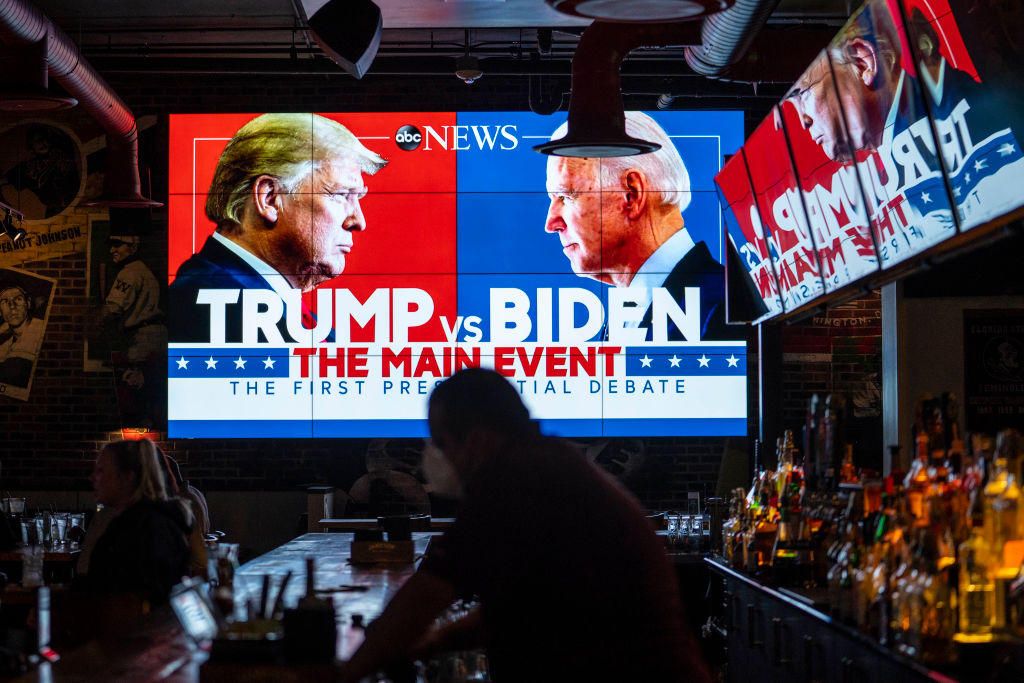
Television screens airing the first presidential debate are seen at Walters Sports Bar in Washington, U.S., September 29, 2020. /Getty
No one expected anything different from him in the debate. In fact, it's part of the Trump brand. And while some of his supporters find it a bit unsavory, his more unsavory voters relish and expect it.
This put Biden in a pickle. He could either take the high road and absorb a few punches, or sink down into ditches of contemporary American discourse and duke it out. For the most part, Biden embraced the brawl.
Despite his lead in the polls going into the debate, it would be a mistake to conclude the election was or is Biden's to lose. Nevertheless, it's also clear that Biden had the most to lose had he performed poorly. It's clear that Trump's supporters are satisfied for whatever reason with his performance regardless of what he says or does, and what Trump gave them was more of the same.
While Biden is relatively well-known to American voters given his long service in Congress and eight years as vice president under Barack Obama, Trump's constant portrayal of Biden as an old and weakening man had many voters wondering whether Biden was up to the task.
This talking point was hammered further ahead of the debate, with Trump's camp suggesting that Biden would take performance enhancing drugs to carry him through the evening, or that he had a secret earpiece feeding him answers and talking points. While these were unfounded accusations, many still wondered: How would Biden fare toe-to-toe with America's bully-in-chief?
The answer, not surprisingly, is that Biden decided that his biggest weakness was the question of whether or not he was weak, whether or not he was tough enough for the job, whether he was tougher than Trump.
But the real challenge was to do this without completely devolving to the level of idiocy adored by uneducated voters and those who profit from them. And if that's the standard by which Biden's performance is judged, then perhaps he did about as well as one could hope.
More to come
This was the first of three planned presidential debates, the second and third scheduled October 15 and October 22, respectively, plus a vice presidential debate between Republican Mike Pence and Democrat Kamala Harris scheduled for October 7.
It might be the case that subsequent engagements will be more substantive, but that hardly seems likely in a race where pathological levels of enmity are intersecting with unchecked national crises.
It's difficult to imagine Pence and Harris taking the same low road. Pence and Harris stand to lose more by fighting – Pence for fighting a woman, Harris for fighting as a woman – and given the responses already from viewers of the Trump-Biden dustup, it's clear that many voters are frustrated with the performance and their options.
In fact, both of these men and the parties they represent are deeply complicit in the problems facing the U.S. today, and neither offers a real path forward in terms of the substantial reforms and recovery efforts desperately needed. It's not surprising therefore to see two elderly men venting their frustrations at each other. What else could they do?
(If you want to contribute and have specific expertise, please contact us at opinions@cgtn.com.)