- Home
- China
- World
- Europe
- Politics
- Business
- Opinions
- Tech & Sci
- Culture
- Sports
- Travel
- Nature
- Picture
- Video
- Live
- TV
- Specials


Share







Copied
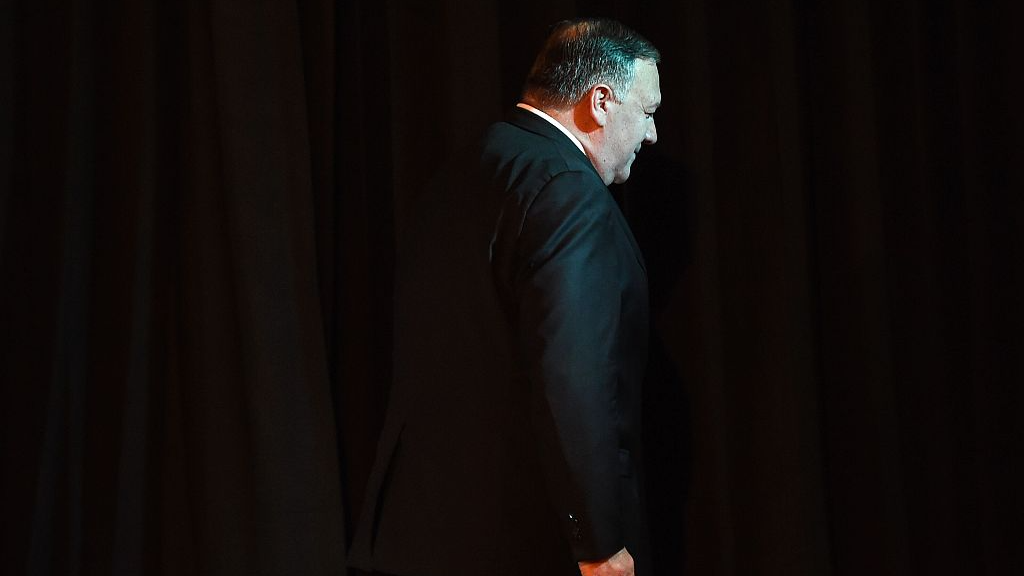
File photo of U.S. Secretary of State Mike Pompeo. /VCG
Editor's note: Zoran Spasic is the director of the Center for Cooperation with Asian Countries of Serbia. The article reflects the author's opinions and not necessarily the views of CGTN.
Mike Pompeo, the U.S. secretary of state, recently completed a tour of several European countries: the Vatican, Italy, Croatia, and Greece. Much like his previous visits to Europe, this one was not in the service of the U.S. President Donald Trump's election platform, but was rather aimed at creating additional tension. Not wanting to become victims of the "America First" policy, these European countries met Pompeo's demands with a cold response.
In the context of his visit to Greece, Pompeo reportedly warned Turkey on several occasions against its recent actions. The cooling of relations between the U.S. and Turkey can be explained by Turkish weapons (F-35 / S-400) and Ankara's exploratory activities in the Mediterranean.
However, Pompeo cannot directly confront Turkey, since the country retains an important role on the NATO's eastern flank. The U.S. hopes to expand energy cooperation with Greece and establish an energy center in the Balkans.
Washington's intention is to replace Russia's pipeline gas supplies to Europe with its own, substantially more expensive, liquid natural gas, to create an American energy base in this part of Europe, for the purpose of gaining easier access to Eastern Europe via Bulgaria.
Pope Francis' refusal to meet with Mike Pompeo during his visit to the Vatican is a further confirmation that what we see here is indeed a case of pressure policy.
The official statement explained that the pope does not meet with political figures in election periods; however, there are clearly much deeper reasons for this rebuff.
During his work visit to southern Europe, Pompeo heavily criticized the agreement struck between the Vatican and China, which was not at all appreciated by the Vatican. It was after that criticism that the pope refused to meet, not wanting to be dragged into Pompeo's anti-China propaganda.
In spite of mounting controversies between China and the U.S., the Vatican has continued its dialogue with China, which shows that the Holy See could be a reliable partner of interest to China.
Several days ago, the Cardinal Secretary of State confirmed that there is mutual interest in strengthening the Vatican-China dialogue. Earlier this year, foreign affairs ministers of China and the Vatican met for the first time at an international summit, which was an important step towards strengthening multilateralism.
The Belt and Road Initiative, signed by Italy with Beijing last year, is of great importance to the Italian leadership – a fact that Pompeo completely disregarded. Italian government experts have on multiple occasions stressed the enormous importance of Chinese investments in Italy and the safety that comes with them. Additionally, during the pandemic, China was the first country that offered aid to Italy.
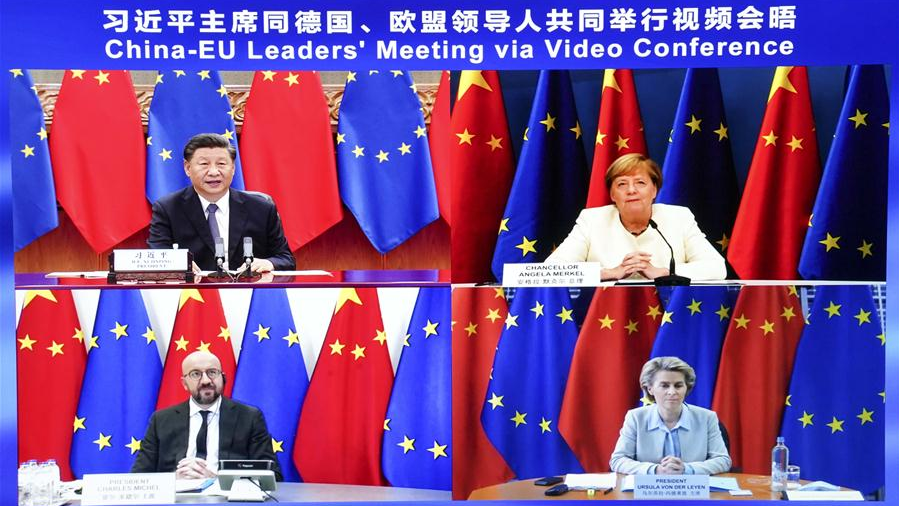
Chinese President Xi Jinping co-hosts a China-Germany-EU leaders' meeting via video link with German Chancellor Angela Merkel, European Council President Charles Michel and European Commission President Ursula von der Leyen in Beijing, capital of China, September 14, 2020. /Xinhua
When it comes to technology and energy issues, nothing is the same anymore in transatlantic relations. The purpose of Pompeo's last visit to Europe was to maintain American monopoly in the fields of high-tech and energy. Pompeo's pressure policy resembles that of the former Secretary of State John Foster Dulles, who similarly kept the world in constant fear.
Just what does Pompeo mean by "technology independence?" To start with, not even the U.S. is technologically independent. And if we take Europe as a case in point, numerous hardware components, equipment and pieces of software are predominantly owned by companies based outside the EU. Many European telecommunications companies remain highly interested in strengthening cooperation with Huawei, including Deutsche Telekom.
American politicians have encouraged "technological separation from China." This, however, inflicts greatest damage upon the U.S. itself.
At the moment, there is a widening gap between the U.S. and Europe on matters of the global pandemic response, the Iran nuclear deal, energy cooperation and others. German Chancellor Angela Merkel clearly stated that should the U.S. fail to assume its responsibility of a global power, Europe will have to re-evaluate European-American relations.
One should also note the recent video conference attended by Chinese President Xi Jinping, German Chancellor Angela Merkel, European Council President Charles Michel, and European Commission President Ursula von der Leyen.
At this meeting, President Xi proposed four principles, which build on and enrich the existing theories on China-EU relations, showing that the highest-ranking Chinese leaders have always seen the general direction of China-EU relations from a strategic perspective, putting forward proposals of practical importance.
Against the backdrop of the global economic recession, no European countries would want to lose such a reliable trade partner as China. China and the EU have a number of broad common interests, as well as the need for mutual cooperation.
Europeans are well aware that China is an exceptionally important partner, indispensable when it comes to both global pandemic response and economic recovery. Over the past 45 years, the healthy relations between China and the EU have been the foundation of international stability and development.
China has always been a global peacemaker. More efficient multilateral mechanisms and livelier regional cooperation will create a better outlook for human development worldwide.
(If you want to contribute and have specific expertise, please contact us at opinions@cgtn.com.)