- Home
- China
- World
- Europe
- Politics
- Business
- Opinions
- Tech & Sci
- Culture
- Sports
- Travel
- Nature
- Picture
- Video
- Live
- TV
- Specials


Share







Copied

Editor's note: CGTN's First Voice provides instant commentary on breaking stories. The daily column clarifies emerging issues and better defines the news agenda, offering a Chinese perspective on the latest global events.
As China turned out to be the first major economy to recover from the COVID-19 pandemic, certain Westerners became even more blatant in discrediting the country they deemed a challenge. The pandemic "is widening the gap between haves and have-nots in China, a trend that could bring social tensions and undermine the country's stronger-than-expected economic recovery," the Wall Street Journal (WSJ) said in its recent article.
In analyzing China's wealth inequality, the WSJ, interestingly, gave no solid figure to support its conclusion. The author tried to convince readers of China's "growing inequality" compared to where a Chinese factory worker was unable to get his salary paid in the pandemic while another Chinese bought a property in the same period. But an individual case is never supportive in reaching a conclusion on the economy. The WSJ did try to find some figures but only ended with questioning the Gini Coefficient's accuracy that suggests a contrasting conclusion.
The virus indeed left many already on meager payments laid off in China. But the Chinese economy has enough resilience to avoid being trapped in a wider wealth gap, Liu Chunsheng, an associate professor at China's Central University of Finance and Economics, told CGTN.
"Although traditional industries including tourism, retailing, and manufacturing, took a pounding in the pandemic, the crisis provides momentum to new business and entrepreneurship," Liu said. Take e-commerce as an example. A report by the China Internet Network Information Center suggests e-commerce livestreaming was the fastest-growing application in China in the first half of this year.
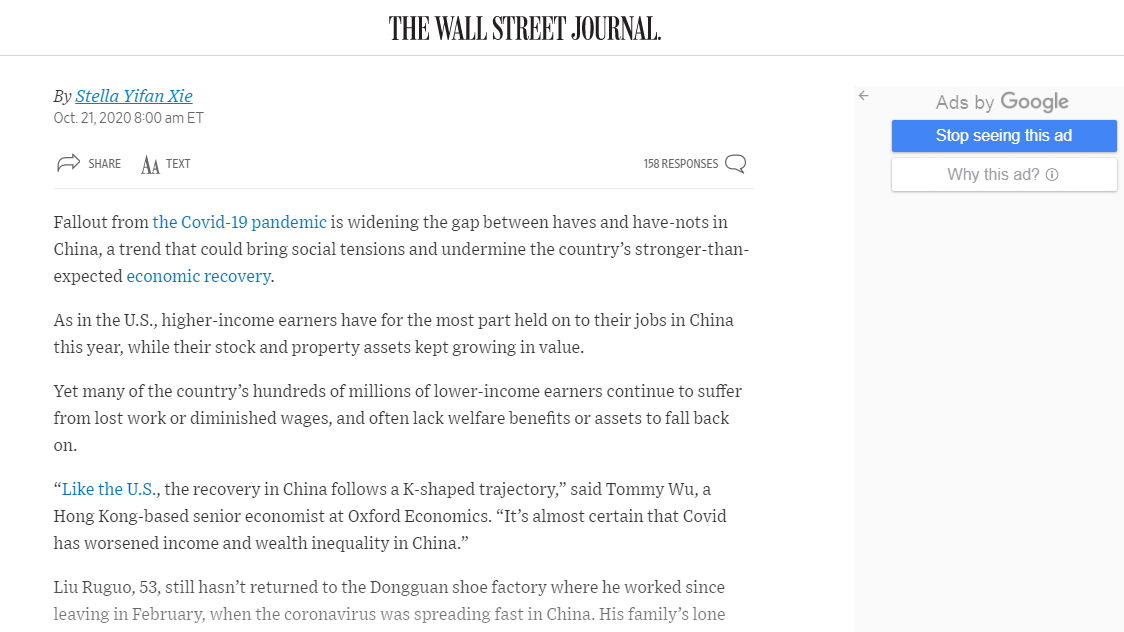
Screenshot of the WSJ article.
As a result of strict quarantine measures, Chinese people started to explore new business models. With an increasing number of consumers turning to online shopping for daily necessities, those having been laid off in the crisis found their job opportunities. As of June, the number of livestreaming users had hit 309 million. A charitable livestreaming program, according to the same report, has generated more than 40 million yuan ($5.87 million) for selling local specialties from the hardest virus-hit Hubei Province. Apart from injecting vitality to the Chinese economy, e-commerce turns out effective in narrowing, not widening, the income gap in China.
In addition, "the Chinese government, contrary to the WSJ's allegation, has rolled out a series of measures to add jobs," Liu noted. As compared with 390,000 newly added jobs in February, the central government created around one million urban jobs on a monthly basis, according to Xinhua. This has further reduced the risk of "growing inequality" in the world's second-largest economy.
"The resilience in the Chinese economy is recognized by the international community. The WSJ report cannot erase this fact," Liu emphasized. The International Monetary Fund predicted earlier that China would be the only major economy to grow in 2020, but all the figures and facts that suggest anything good about the Chinese economy were omitted in the WSJ article.
Speaking of wealth inequality, the situation in the United States is much more severe. According to Fed economists, the richest 10 percent of American households held 70 percent of total household wealth in 2018, up from 60 percent in 1989. The COVID-19 pandemic has made the life of lower-class Americans even more difficult.
The global economy is intertwined. China has put tremendous efforts into reviving its economy and is always willing to cooperate. This is not a time for finger-pointing, but a real-time to shelve prejudices and cooperate for the common good.
Scriptwriter: Liu Jianxi
(If you want to contribute and have specific expertise, please contact us at opinions@cgtn.com.)