- Home
- China
- World
- Asia-Pacific
- Americas
- Europe
- Middle-East and Africa
- Politics
- Business
- Opinions
- Tech & Sci
- Culture
- Sports
- Travel
- Nature
- Picture
- Video
- Live
- TV
- Specials
- Learn Chinese


Share







Copied

Editor's note: Hannan Hussain is a foreign affairs commentator and author. He is a Fulbright recipient at the University of Maryland, the U.S., and a former assistant researcher at Islamabad Policy Research Institute. The article reflects the author's opinions and not necessarily the views of CGTN.
Relations between Moscow and Beijing are rightly read at an all-time high.
On June 28, Chinese President Xi Jinping's video meeting with Russian President Vladimir Putin signified their second exchange within six weeks, after the momentous launch of the bilateral nuclear energy cooperation project – Tianwan nuclear power plant and Xudapu nuclear power plant – last month.
Monday's exchange enjoyed significant weight as it agreed to extend the Treaty of Good-Neighborliness and Friendly Cooperation. The signature treaty – fast-approaching its two-decade anniversary – has long served as a vehicle for deepening bilateral trust, deriving its strength from a shared value system that aligns fundamental Sino-Russian interests on peace and development, protects the sanctity of sovereign interests, and treats multi-sector partnerships in sync with strategic stability prospects "throughout the world."
"China and Russia have injected positive energy into the international community and set an example of a new type of international relations through their close cooperation, as the world is entering a period of turbulence and change and human development is confronted with multiple crises," stated Xi during the meeting.
Xi has a point. After all, the international community bears witness to the increased penetration of divisive ideologies within and beyond multilateral fora, and several regions of the world now face less symmetric post-pandemic development prospects than others. The Sino-Russian comprehensive strategic partnership of coordination comes through as a stabilizing force in global affairs, as it embodies both the structural merits and justice-oriented values necessary to address such frictions.
On the former front, bilateral communication between Moscow and Beijing has itself flourished over the years through a solid, multi-tier network of state-to-state engagement. Consider the fact that a series of intergovernmental commissions help streamline top leadership consensus on shared priorities and principles such as non-confrontation and trade cooperation – aspects that rang true to the spirit of genuine "true multilateralism and global justice" during the Putin-Xi exchange on Monday.
On the justice and equality front, the past twenty years testify to two key realities. First, that both Moscow and Beijing can continue to withstand bloc politics and geopolitical turbulence in a bid to substantiate what Xi called a "new type of international relations."
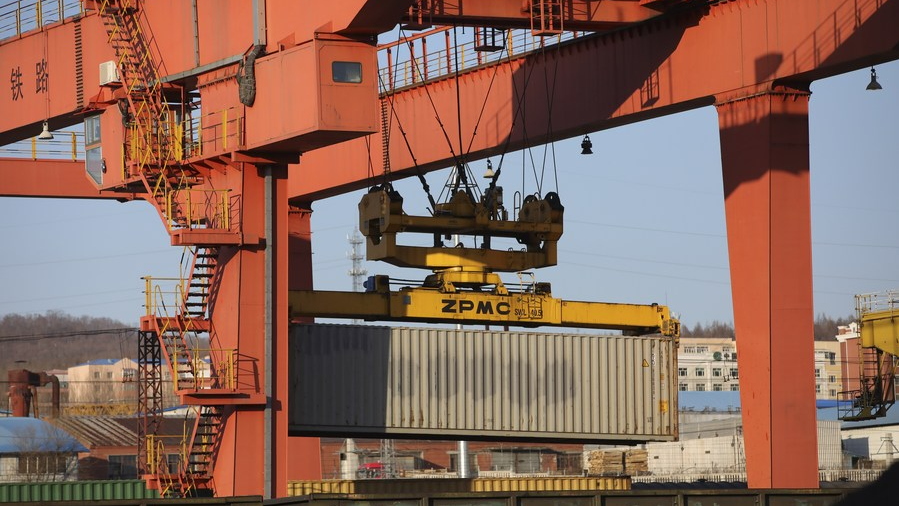
A container is lifted by a gantry crane at Suifenhe Railway Port in Suifenhe, an important Chinese port for trade with Russia, northeast China's Heilongjiang Province, October 28, 2020. /Xinhua
Put simply, this new paradigm for upgrading bilateral ties to all spheres of Sino-Russian mutual interests, is one where the development trajectory of a single partner is inextricably linked to that of the other. "Today's China-Russia ties are mature, stable and solid, and able to withstand the test of any change in the international situation," reaffirmed Xi.
It is that demonstrated bilateral confidence that undergirds the second hallmark of Sino-Russian ties: wide latitude in coordinating their defense for one another's common interests in major regional and international organizations. These staunchly advocated positions range from determinants of sovereignty to arms control and pandemic containment.
More deeply, Putin's determination to back that common-ground in future realms of practical cooperation, territorial integrity, cultural exchanges, and global affairs coordination, comes across as a service to the UN-led international order itself. Supporting this global appeal is the fact that Xi and Putin's vocal advocacy for Sino-Russian cohesion didn't compromise a modicum of activism against unilateral coercive sanctions, gross interference, or democratic exceptionalism.
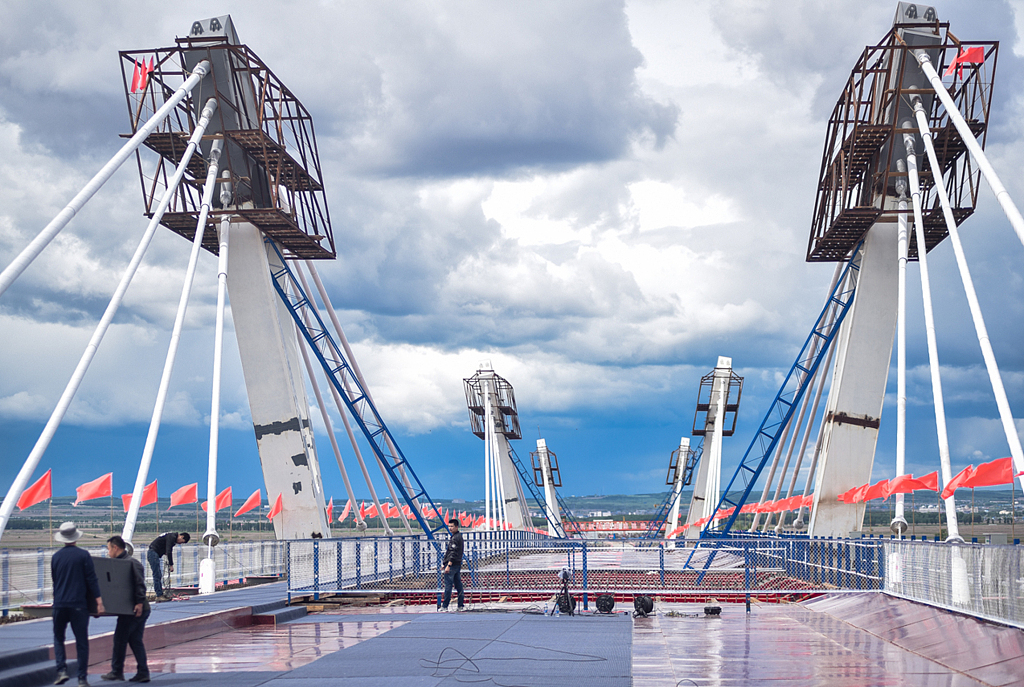
A cross-border bridge connecting Russia's Blagoveshchensk and China's Heihe is under construction in Blagoveshchensk, Russia, May 31, 2019. /VCG Photo
Above all, this is precisely why the extension of the Treaty of Good-Neighborliness and Friendly Cooperation comes at such a defining moment in Sino-Russian history: it is through this gold-standard of principled engagement that bilateral ties emerge as truly intergenerational between leaderships. It is only logical to further that ironclad commitment to reflect the common values of all humanity.
Interestingly, if the shared aspiration is to steer bilateral ties towards peaceful development, then Sino-Russian symbolism is unequivocally at the heart of it. President Putin congratulated President Xi ahead of the 100th anniversary of the Communist Party of China, sharing historical archives that document early periods of Soviet-Chinese linkages.
Putin's particular emphasis on Beijing's transformative social-economic development leaps "on the international stage" goes hand-in-hand with the shared constructs of future development that Moscow and Beijing view as one alignment. Similarly, it is not seasonal platitudes but rich historic symbolism that qualifies as impetus, one which Xi suggests as a binding measure of a "good neighbor and real partner."
Placed in the context of revitalizing the bilateral friendship treaty with "a modern meaning," both parties are well positioned to chalk-out their "new tasks and goals" in a bid to upgrade their entire range of bilateral interests. Especially as the treaty undergoes an automatic five-year extension beginning in February next year.
So, what is the most vital lesson that the Xi-Putin exchange offers for 21st century bilateral cooperation?
Simple: the idea that only through firm attention to the roots of a time-tested relationship can countries prepare concrete ground for its future endurance.
(If you want to contribute and have specific expertise, please contact us at opinions@cgtn.com.)
