- Home
- China
- World
- Asia-Pacific
- Americas
- Europe
- Middle-East and Africa
- Politics
- Business
- Opinions
- Tech & Sci
- Culture
- Sports
- Travel
- Nature
- Picture
- Video
- Live
- TV
- Specials
- Learn Chinese


Share







Copied

Senior citizens get inoculated with the AstraZeneca vaccines offered by Japan for free at Taipei Tzu Chi Hospital, following an increasing number of COVID-19 domestic infections and deaths, in New Taipei, Taiwan, June 2021. /VCG
Editor's note: Zhou Wenxing is a research fellow at Huazhi Institute for Global Governance, Nanjing University, and former Asia Fellow at John F. Kennedy School of Government, Harvard University. The article reflects the author's opinions, and not necessarily the views of CGTN.
The latest opinion survey conducted by a Taiwan-based polling company showed a "death cross" for the regional leader of the Taiwan island Tsai Ing-wen, whose reputation reached a record low of 43 percent – the lowest over the past two years. The polling data also revealed that the approval rating of the ruling (Democratic Progressive Party) DPP also hit a historically low level during the past five years.
The rapidly declining satisfaction ratings suggest a ruling crisis that the Tsai authorities are confronted with. Further analysis of the polling data indicates that such a crisis mainly stems from the authorities' mishandling of public affairs, including those leading to a shortage of water and power, and particularly of vaccines.
Indeed, the shortage of vaccines is the most urgent problem for Taiwan. Admittedly, most of the societies, including the Taiwan region around the globe, are suffering from shortage supply of vaccines due to their underdeveloped technology and facilities for vaccine production. But the DPP authorities' ill-considered vaccine policy is merely aggravating the problem.
The Taiwan authorities have politicized the vaccines, utilizing them as a weapon to balance against the Chinese mainland by colluding with the United States and Japan so as to seek so-called "independence."
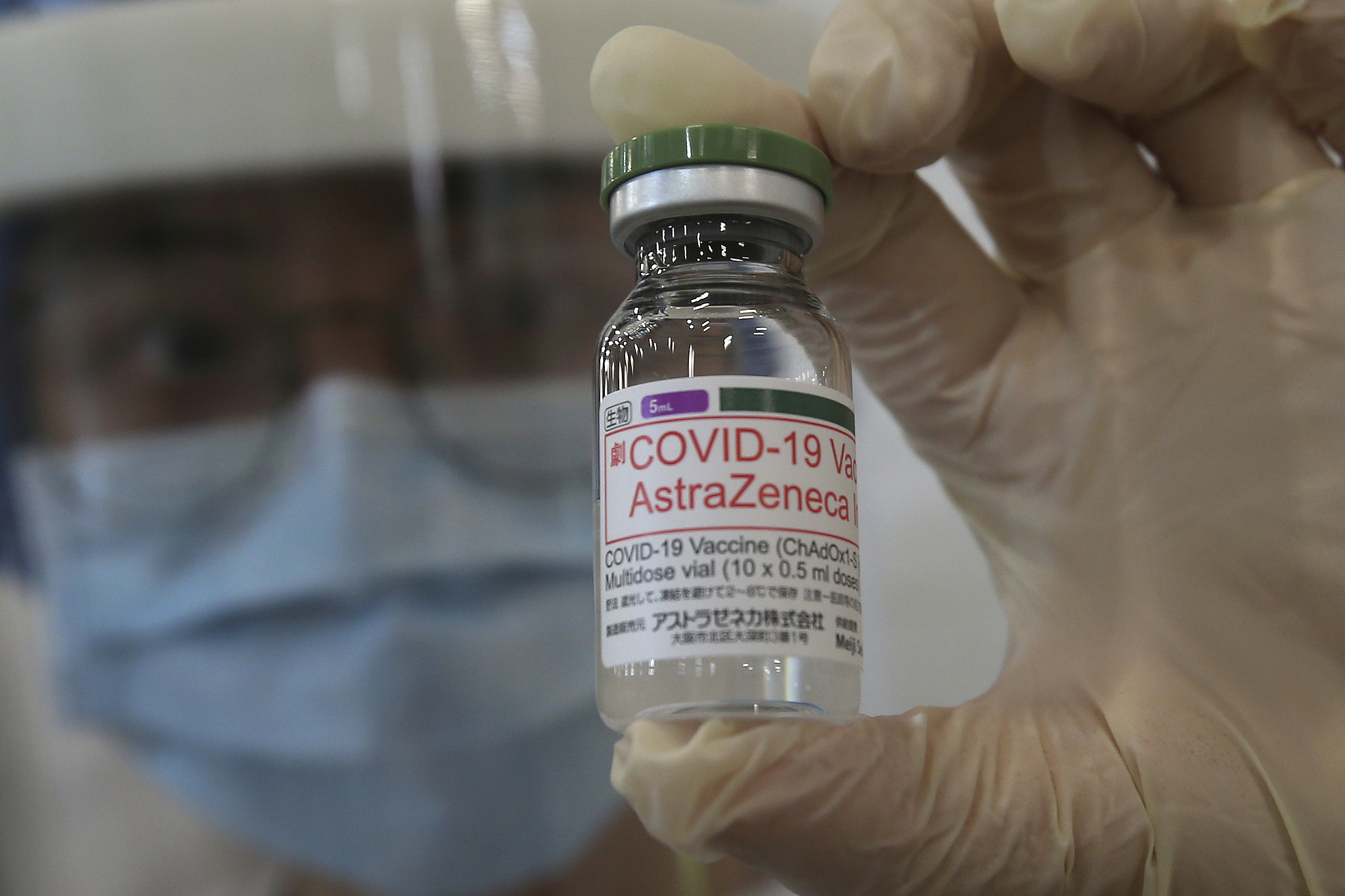
The AstraZeneca COVID-19 vaccine at Songshan Cultural and Creative Park in Taipei, Taiwan, June 16, 2021. /VCG
On the one hand, the DPP authorities refused the goodwill of the mainland, claiming that the latter's proposals to provide vaccines for Taiwanese residents are "united front means." The fact is, however, that a growing number of Taiwanese people have come to the mainland to get vaccinated.
On the other hand, the DPP authorities begged for vaccines from the United States and Japan. They regard vaccine procurement as one of the best opportunities to improve the connections between Taiwan and external forces, and therefore to enhance the alleged presence in international society. Unfortunately, the U.S. did not provide many vaccines until late June. Japan did deliver some amount of AstraZeneca vaccines but caused more than 60 post-injection deaths around the island. Vaccines are still urgently needed.
The Tsai authorities' mismatched vaccine policy is unable to deter the pandemic, which already deepened Taiwanese residents' mounting worries. It's hence like the last straw that breaks the camel's back when Tsai Ing-wen mourned for American President Joe Biden's dog while ignoring the security of millions of Taiwanese people, reducing Tsai and her party's favorable ratings drastically.
The declining approval ratings sounded the alarm for Tsai and her DPP colleagues. Since mid-May, over 14,000 cases have been confirmed in total and more than 600 people had died as of June 30. The pandemic situation still remains quite severe.
This means that the satisfaction ratings for Tsai and DPP will likely drop further should the pandemic not be deterred effectively in the near future. The decrease of DPP authorities' favorable ratings contributes to the increase of favorable ratings of Kuomintang (KMT), among other opposition parties, comparatively. In this context, a new round of ruling party alternation should not be excluded in 2024, when the next election of the Taiwanese regional leader is to be held.
If the DPP authorities really want to overcome the current crisis and win a third term in 2024, they need to make vaccine policy based on public interest by taking into account Taiwanese people's needs and wants, rather than on the authorities' political calculation and narrow interests by resorting to external forces. They should now change course to make changes.
(If you want to contribute and have specific expertise, please contact us at opinions@cgtn.com.)
