- Home
- China
- World
- Asia-Pacific
- Americas
- Europe
- Middle-East and Africa
- Politics
- Business
- Opinions
- Tech & Sci
- Culture
- Sports
- Travel
- Nature
- Picture
- Video
- Live
- TV
- Specials
- Learn Chinese


Share






Copied
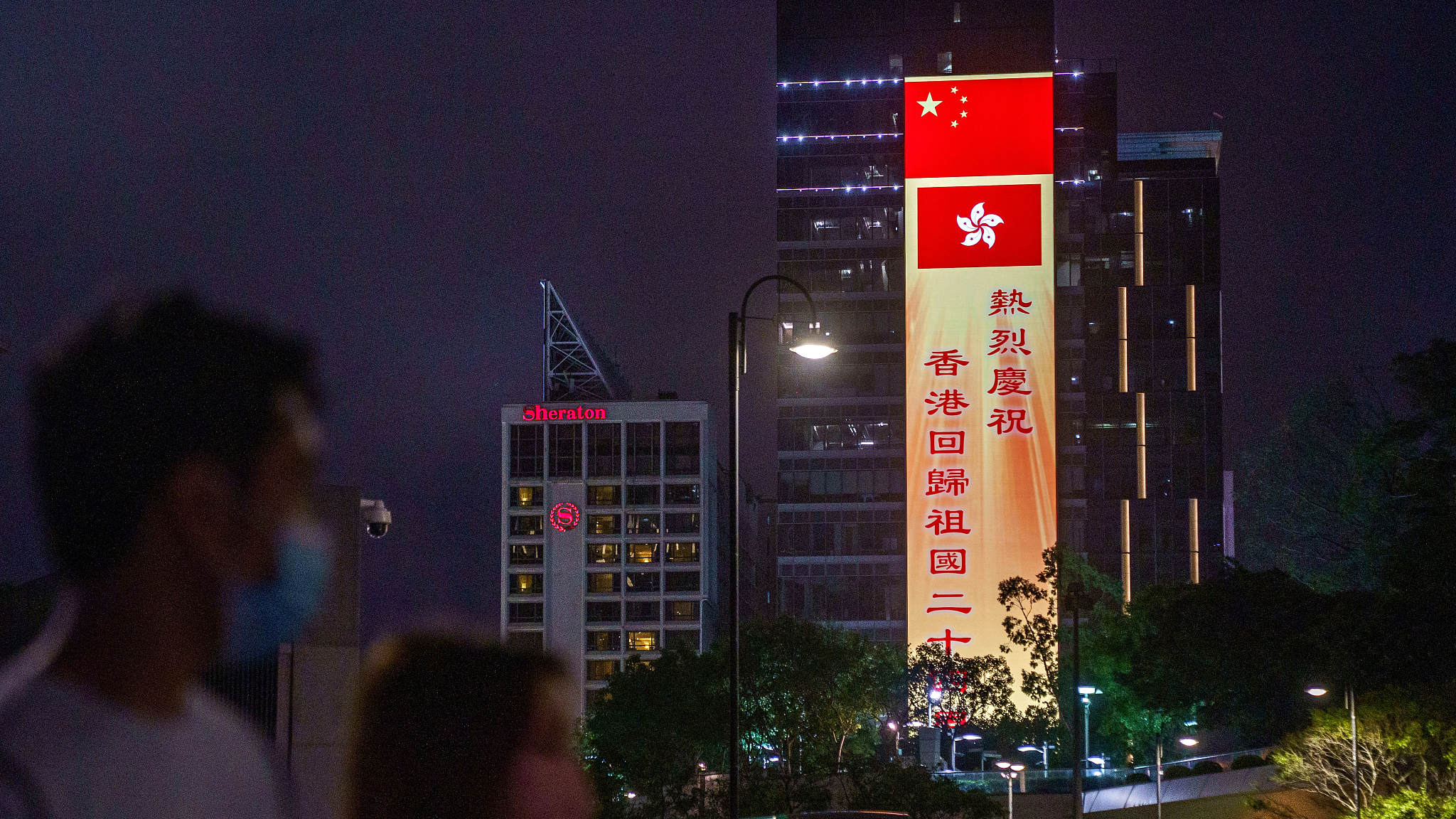
A banner displays a message celebrating the anniversary of Hong Kong's return to China on a building at night in Hong Kong, China, June 30, 2021. /CFP
Editor's note: The following article is taken from the Chinese-language "The Real Point." The article reflects the author's opinions and not necessarily the views of CGTN.
In a statement on July 10, the U.S. Department of State expressed its "concerns" over the closure of the Hong Kong newspaper Apple Daily and accusing the Hong Kong Special Administrative Region (HKSAR) government of "suppressing journalism." This so-called statement is full of annoying clichés and undersigned by the U.S. and some other Western countries. Apparently, it is yet another political farce in which the U.S. ganged some other Western countries in an attempt to interfere with the affairs of Hong Kong in the name of "freedom of the press." In fact, what they do will not change anything and is at best showing a "caring" gesture for themselves and the anti-China, destabilizing forces in Hong Kong.
The statement only has 21 undersigned countries, less than half of the total number of members of the Media Freedom Coalition and just a tiny proportion of the number of UN member states. How are they supposed to represent the international community? What qualifications do they have to define freedom of the press and assume a lecturing posture and point fingers at China?
The U.S. and the rest of the undersigned countries are merely trying to make some noise and put pressure on China. The international community will not be fooled by their political tricks for the following apparent reasons.
First, the closure of Apple Daily had nothing to do with freedom of the press, but with its violation of the National Security Law in Hong Kong. The newspaper, in the guise of a media outlet, had been doing illegal deeds unsettling Hong Kong as well as the Chinese mainland. That cannot be tolerated in any society governed by the rule of law. Legal action taken by the Hong Kong police against the newspaper's staff was a just act. The attempt by the U.S. and the rest of the undersigned countries to justify the staff under the guise of "freedom of the press" not only seriously desecrated the spirit of the rule of law, but also grossly trampled on the idea of "freedom of the press."
Second, the decision to shut down Apple Daily was made by the company's board of directors, and there is no such thing as "forced closure." According to Hong Kong media reports, Apple Daily had long been in a bad situation and has been surviving on political "dark money." It is inevitable for such a company to shut down because it can no longer win any market or users. No one will buy the stories made up by the U.S. and some other Western countries that justify the wrong and shift blame to the HKSAR government.
Freedom of the press is not meant to be a shield for illegal and criminal acts. What country in the world would allow a media outlet like Apple Daily to act in a way that jeopardizes its national security? Would the U.S.? Would the U.K.? Absolutely not. In fact, the U.S. and some other Western countries have shown they are often ready to sacrifice freedom of the press if is in their best interests, though they are the loudest advocates of it.
For example, after George Floyd was killed by a white police officer in May 2020, foreign journalists in the U.S. covering anti-racism protests were attacked by American police. There was no respect for freedom of the press at all.
In April this year, Bloomberg journalist Tom Hancock tweeted that the U.S. Senate Foreign Relations Committee was proposing to fund the media with millions of dollars to report on the "negative impacts" of Belt and Road projects. Most of the $300 million would be used to target China. As a result, the tweet was blocked. Some Twitter users said that Tom Hancock was criticized by his boss for telling the truth.
When it comes to press freedom, the U.S. and some other Western countries always say one thing and do another. More than 80 years ago, E.H. Carr, a leading British international relations scholar, called the U.S. "masters in the art of concealing their selfish national interests in the guise". Their action to politicize freedom of the press in the case of Apple Daily is yet another example of such hypocrisy.
In Hong Kong, freedom of the press is protected by the Basic Law, the National Security Law, the Hong Kong Bill of Rights Ordinance and other laws. In particular, the human rights and freedom of Hong Kong residents have been better protected in the past year since the introduction of the National Security Law. According to data from the Information Services Department of the HKSAR government, there are currently 93, 69 and 39 local, overseas and online media outlets registered in Hong Kong respectively, an increase over last year.
Social order has been restored in Hong Kong. There is no position for hypocrites to point fingers or muddy the waters. It is a much wiser choice for the U.S. and some other Western countries to focus on protecting freedom of the press on their own soil rather than wasting time putting on political clown shows.
(If you have specific expertise and want to contribute, please contact us at opinions@cgtn.com.)
