- Home
- China
- World
- Asia-Pacific
- Americas
- Europe
- Middle-East and Africa
- Politics
- Business
- Opinions
- Tech & Sci
- Culture
- Sports
- Travel
- Nature
- Picture
- Video
- Live
- TV
- Specials
- Learn Chinese


Share







Copied
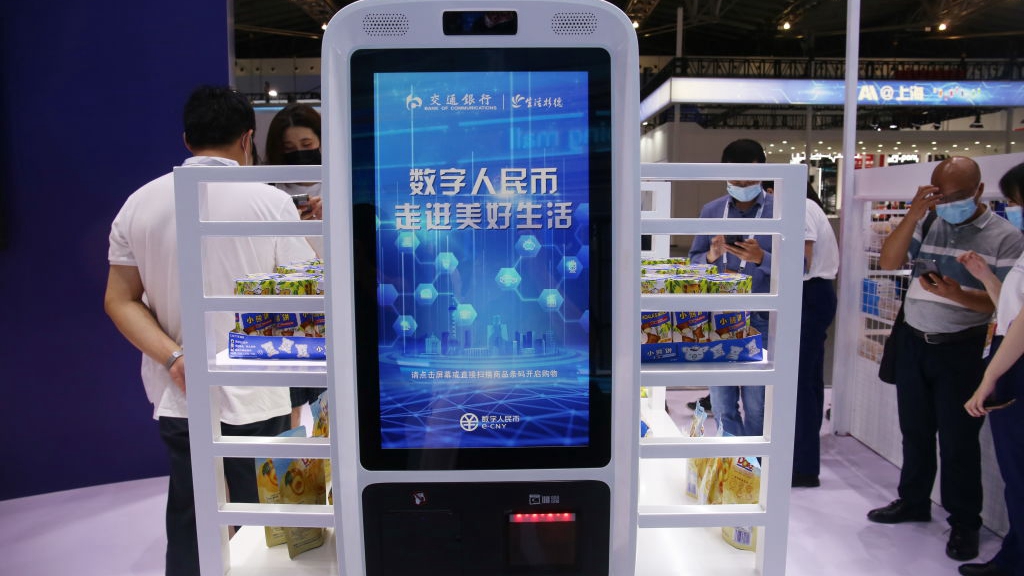
Digital RMB of Bank is promoted by traditional banks at the World Conference on Artificial Intelligence in Shanghai, China, July 7, 2021. /Getty
Editor's note: Luigi Gambardella serves as the president of ChinaEU, a business-led international association aimed at intensifying business cooperation and mutual investments in internet, telecom and hi-tech between China and Europe. The article reflects the author's opinions and not necessarily the views of CGTN.
In Europe, we have been strongly impressed by the rapid expansion of China's digital economy since the beginning of the century and the emergence of global Chinese digital players.
Today, China is perceived as the trendsetter in groundbreaking areas such as e-commerce, fintech, artificial intelligence and robotics. Chinese companies have a major advantage over their European counterparts, including the huge volume of big data generated by internet use and transactions by more than one billion users.
However, this perception does not necessarily fully correspond with reality. According to a 2020 report published by the China Academy of Information and Communication Technology, China's digital economy stood at about 35 percent of its GDP compared to above 60 percent in Germany, the UK and the U.S., 40 percent in France, and about 20 percent in major emerging economies, such as Brazil, India and South Africa.
Moreover, the degree of digitalization varies across provinces and sectors according to income level, reflecting the diverse stages of economic development across China. In Beijing and Shanghai, for example, the digital economy scale was already surpassing France. In northwest China's Gansu Province, however, the size was only 20 percent of the provincial GDP.
If we look at the factors that brought about China's success story, we find that digitalization in China has been strongly supported by massive foreign direct investment, including major U.S. companies like Apple and its subcontractors or global EU car manufacturers like Volkswagen, for example, which established a partnership with a Chinese battery maker.
This trend is likely to continue over this decade, all the more because the ecosystem established by the tech giants in China provides suppliers with instant access to a large pool of consumers.
China's success story shows that digitalization is a global process, providing many opportunities for win-win cooperation between China and Europe. Chinese technology and innovation is increasingly being adopted in Europe. For example, the QR-ization of our lives is catching on in Europe as well as the rise of mobile payments – something that was already pervasive in China several years ago has now become the norm in Europe.
There is also large potential for using Chinese drones for last mile delivery and robots in restaurants, hotels and even in coffee shops in Europe. Chinese companies Meituan and OrionStar are already exploiting this opportunity.

A Meituan advertisement inside a subway station in Beijing, China, July 16, 2021. /Getty
In the retail sector, we have seen the proliferation of new forms of vending and new models of online shopping in the Chinese market. The advent of automated services has been illuminating for European players like Rhea Vendors Group, a world-leading coffee machine manufacturer, for accelerating its digital transformation process.
Livestreaming commerce pioneered by Chinese platforms Kuaishou and Douyin as well as Alibaba's Taobao Live and JD Live are also opening up tremendous opportunities. On the one hand, these platforms boost cross-border e-commerce through Multi-Channel Networks. Xinxuan Selection, for example, makes access to foreign brands much easier for Chinese consumers. On the other hand, these platforms inspire many retailers in Europe to revolutionize their business models.
The deployment of 5G in Europe will also provide the opportunity for Chinese vendors, like Xiaomi and Oppo, to expand market shares globally, through agreements with European telecommunications firms seeking to reduce their dependency on leading smartphone vendors.
However, issues related to data privacy and cybersecurity must be tackled to foster further international trade and investments. In addition, the gatekeeper role of tech giants in digital sectors has recently raised concerns over the impact of monopoly power on innovation and market stability. As a result, policy makers and competition authorities have interfered with the business models of the companies concerned.
The restrictions imposed by central banks on innovative payment services that Chinese fintech companies are considering to market in Europe is another constraint to consider when looking for win-win cooperation between global Chinese platforms and potential European partners,
Ensuring that borders are open for trade and investments and promoting the exchange of best practices and partnerships are key to supporting innovation in the global digital economy.
(If you want to contribute and have specific expertise, please contact us at opinions@cgtn.com.)
