- Home
- China
- World
- Asia-Pacific
- Americas
- Europe
- Middle-East and Africa
- Politics
- Business
- Opinions
- Tech & Sci
- Culture
- Sports
- Travel
- Nature
- Picture
- Video
- Live
- TV
- Specials
- Learn Chinese


Share







Copied
Getty
Editor's note: Xin Ping is a commentator on international affairs. The article reflects the author's opinions and not necessarily the views of CGTN.
On July 26, Mary Simon became Canada's first Inuk Governor General in the country's 154-year history. In her speech, Simon said she was grateful to her parents for "teaching her about Canada's 'two worlds': the Inuit world and the one to the south." She said her upbringing made it possible to "lose her fear of the non-indigenous world, and to gain enough self-confidence to assert herself in it."
For Canadian Inuit, it is a moment of glory to have an Inuit in such a prominent representative role; however, Simon's words reveal the harsh reality: Indigenous peoples and non-indigenous Canadians live in two different worlds when it comes to basic rights and dignity as human beings.
According to the Universal Declaration of Human Rights (UDHR) to which Canada is a signatory, everyone has the right to a standard of living adequate for health and well-being of himself and of his family, including housing, medical care and necessary social services. But it's not the case for Canadian Inuit.
According to Statistics Canada, two-fifths (40.6 percent) of the Inuit population lives in crowded housing. The harsh housing conditions contribute to many health and social issues for Inuit children and youth. The rates of tuberculosis are 400 times higher than those of non-indigenous Canadians. Inuit children living in Nunavut face the highest known rates of RSV bronchiolitis requiring hospitalization — 484 per 1000 infants in the first year of life, vs. 27 per 1000 infants in temperate Canada and the U.S. A Nunavut Tunngavik Incorporated report shows that, Nunavut, a territory in northern Canada where 85 percent of the people are Inuit, has the fewest staffed and operational hospital beds per capita in the country (1,095 persons per bed, compared to a national average of 409).
The UDHR states that no one shall be subjected to torture or to cruel, inhuman or degrading treatment or punishment. But it's not the case for Canadian Inuit.
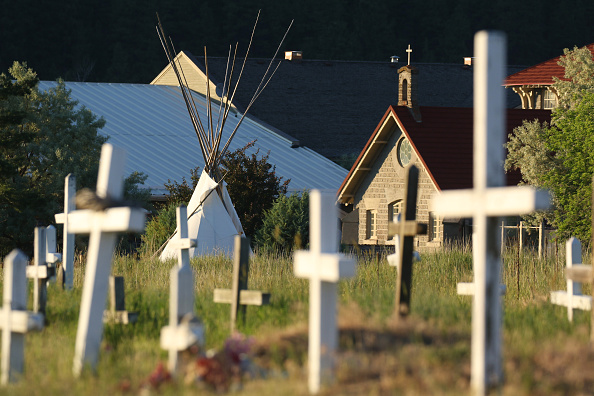
A cemetery near a former residential school in Cranbrook, British Columbia, Canada, June 30, 2021. /Getty
In June, 2020, a Legal aid agency named the Legal Services Board of Nunavut described over 30 allegations of misconduct, abuse and inhumane treatment of Inuit, especially women, at the hands of Royal Canadian Mounted Police (RCMP) across the territory, including inadequate response to domestic violence and sexual assault, strip-searching of women, systemic violence and warrantless entries into homes.
A Pauktuutit Inuit Women's Association report emphasized, "Gendered and racialized violence is a genocide…woven into the fabric of Canadian society." "Women in Nunavut are the victims of violent crimes at a rate more than 13 times higher than the rate for women in Canada as a whole."
The UDHR stipulates that everyone has the right to freedom of thought, conscience and religion. Still, it's not the case for Canadian Inuit.
After 1950, almost all Inuit children were required to attend residential schools or federal hostels in order to assimilate them into the dominant Canadian culture. As a result, the rich tradition of oral storytelling, music, dance and craft, and a respect for the environment that were an integral part of Inuit knowledge and way of life was eroded. At residential schools, the Inuit children were forbidden to speak their native language, and often shamed, ridiculed, punished and beaten in all sorts of awful ways for doing so. Evidently, this was not isolated to Inuit Children. Canada's more than 130 residential schools were home to 150,000 indigenous children seized from their families.
Mary Simon was installed as Canada's Governor General in the wake of the discovery of hundreds of unmarked graves of children who died prematurely while attending residential schools. Some Canadians hope that her appointment is a meaningful step towards reconciliation. But given the severe and widespread harms inflicted on indigenous peoples in Canada, to eradicate the legacy of intergenerational trauma surely doesn't hinge on this symbolic political gesture.
The Canadian government must address — by concrete actions, not just words — its historic and ongoing systemic racism against indigenous peoples, be they First Nations people, Inuit or Metis, and preserve the basics of universal human rights they are entitled to. Otherwise, the road to reconciliation will be a bumpy one indeed.
(If you want to contribute and have specific expertise, please contact us at opinions@cgtn.com.)
