- Home
- China
- World
- Asia-Pacific
- Americas
- Europe
- Middle-East and Africa
- Politics
- Business
- Opinions
- Tech & Sci
- Culture
- Sports
- Travel
- Nature
- Picture
- Video
- Live
- TV
- Specials
- Learn Chinese


Share







Copied
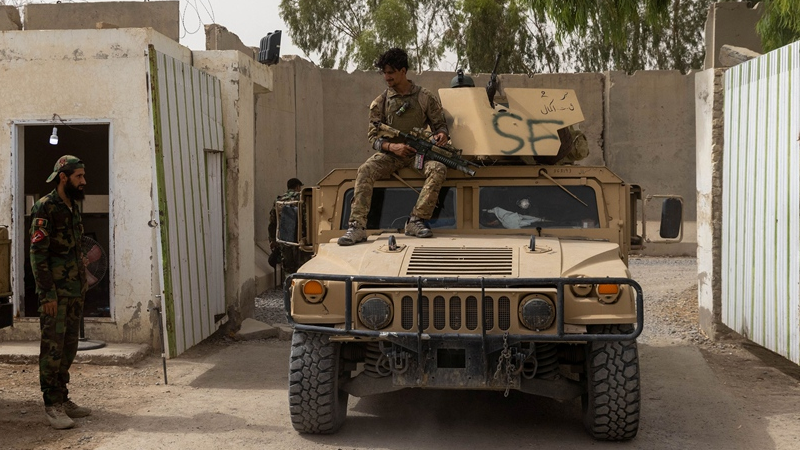
A member of Afghan Special Forces sits on the rooftop of his humvee as he arrives at the base after heavy clashes with the Taliban in Kandahar Province, Afghanistan, July 13, 2021. /Reuters
Editor's note: MD Pathik Hasan, a Dhaka-based NGO worker, is a freelance writer. The article reflects the author's opinions, and not necessarily the views of CGTN.
As the United States begins to draw down troops after a two-decade-long "mission" in Afghanistan, the country along with the rest of South Asia faces a new challenge — to predict and prepare for the "new" Taliban. Two realities are currently juxtaposed to each other. One is an emboldened Taliban that has currently decided to seek legitimacy from its neighbors and the international community for its political metamorphosis. On the other hand, the group stubbornly clings to its radical footholds on Islamic orthodoxy and fundamentalism. The rest of the countries of South Asia, irrespective of their ethnic or religious compositions, undoubtedly have been practicing at least a more moderate version of Islam than what the Taliban pushes for as "the ideal."
The journey of the Taliban even after 2001 is quite fascinating. Somehow, they managed to turn a probable Taliban takeover of Afghanistan into a big worry. The Taliban’s growing power within Afghan territory is undeniable. They are currently looking forward to taking over three major cities along the southern belt— Kandahar, Lashkar Gah and Herat.
It's important to note that all of these cities are significant due to their historical and geopolitical value, particularly Herat which has a border with Iran. Afghanistan's borders with Pakistan and Tajikistan are already under Taliban control. The Taliban advance from the outskirts of Afghanistan can no longer be ignored. They have recently caught global attention for reaching out to past adversaries with a view to making international allies.
The National Public Radio of the United States quoted Austin S. Miller, Commander of the U.S. and NATO forces in Afghanistan, "…The Taliban are keen not to repeat the mistakes of the past. In recent weeks, they have reached out for allies and to reassure past adversaries, dispatching high-level delegations to Russia, China and Iran in hopes of gaining legitimacy, if not outright support, from powerful regional players… [and] have been very eager for public displays of their acceptance by governments around the world."
The critical part is to identify the extent to which the "revamped" foreign policy may mean to the Taliban themselves and the rest of the world in the future. However, for South Asian countries, Taliban behavior has very negative connotations. The Muslim majority states in the region like Bangladesh, Pakistan and the Maldives are calculating the risk of radicalism and Islamist militancy fueled by Taliban influence. Pakistan's connection with the Taliban has serious if not the gravest of all. Even though Pakistan explicitly supported the U.S. in the War against Terror and in capturing Osama bin Laden, some analysts see Pakistan as fertile ground for recruiting Taliban fighters who cross the borders of Pakistan and even have their families there.
The Taliban also spawned a splinter group in Pakistan named Tehrik-i-Taliban Pakistan (TTP) and these groups have been referred to as "two faces of the same coin." The deep roots of the Taliban in Pakistan make it easier to wield influence, gaining sympathy, money and recruits. In recent days, a Pakistani preacher was reported to be asking donations from the followers for the Taliban; and the black and white Taliban flag was waved in front of security officials in a bordering city as Afghan insurgents were seizing the border crossing.
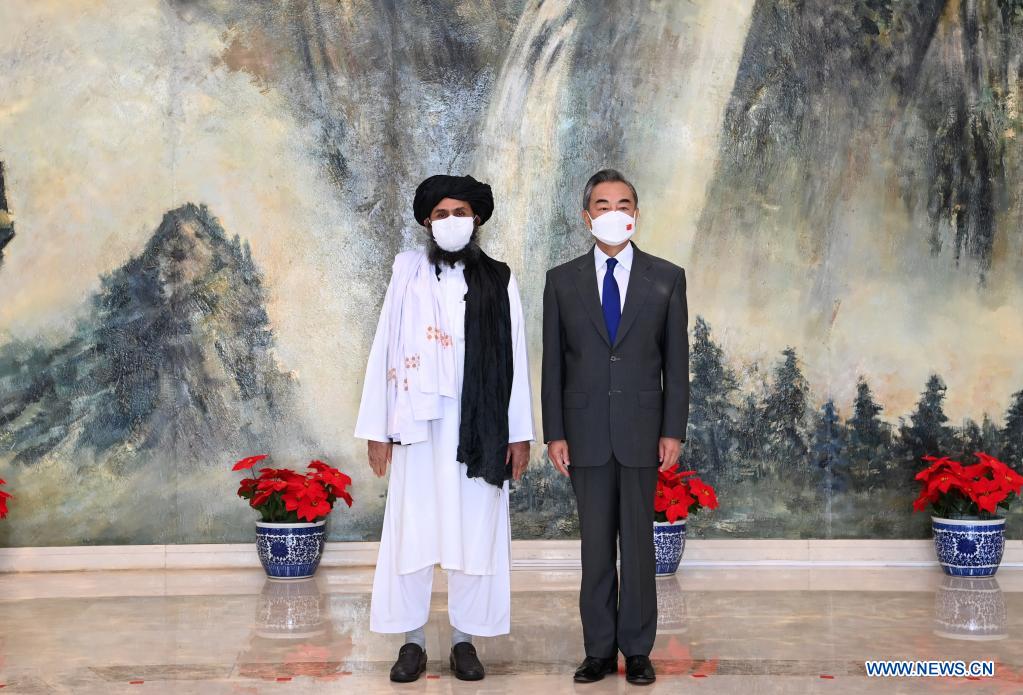
Chinese State Councilor and Foreign Minister Wang Yi meets with Mullah Abdul Ghani Baradar, political chief of Afghanistan's Taliban, in north China's Tianjin, July 28, 2021. /Xinhua
Both Bangladesh and the Maldives have reportedly found their homegrown extremist groups having connections with the Taliban. The Maldives' introduction to Salafi Wahabism in the 1990s was followed by the 2004 tsunami resulted in politico-economic vulnerabilities which provided space for the terrorist groups to emerge and widen their influence. Some of these groups have reportedly fought in favor of both Al Qaeda and the Islamic State along the Pak-Afghan border with the vision of the caliphate restoration in mind.
For Bangladesh, one of the most alarming terrorist incidents was the Holey Artisan Bakery attack coordinated by the Neo-JMB, an offshoot of banned militant outfit Jamaat-ul-Mujahideen Bangladesh (JMB). This group, along with other organizations like Ansar Al Islam, Harkat-ul-Jihad-al-Islami Bangladesh (HuJI-B), has been in contact with the Taliban since the 1990s for financing, operation and shelter. The influx of Rohingya refugees also risks radicalization from these groups which might be looking forward to a bigger support base in the Indian subcontinent.
The aftermath of the 2019 Easter bombings in Sri Lanka, including the ban on burqa and the temporary cremation policy (for Muslims) during the pandemic, has already caused resentment among minority Muslims in Sri Lanka. Similarly, the hanging of the war criminals of the 1971 liberation war of Bangladesh by the Sheikh Hasina government along with the zero-tolerance policy against terrorism also led to protests from some of the radical groups and their political umbrella organizations. All of these grievances can be targeted for potential influence, large-scale radicalization, silencing secular and democratic voices as well as venturing the prophetic battle in the subcontinent known as the Ghazwa-e-Hind.
The anti-Indian sentiment is one of the common points that the Taliban use to exert narratives and scapegoat the frustrated Muslims in various regions. Interestingly, the Taliban have recently posited a favorable dialogue towards the Indian projects stating: "We do not threaten or oppose economic projects by any country. We are in favour of other countries investing in our country. We had a trip to China a few days ago, one of our main demands was that they should cooperate with Afghanistan in trade and investment."
Nonetheless, military analysts in India are suspecting an adverse impact on the Kashmir insurgency as a result of the Taliban expansion in Afghanistan. As per the security specialists, the foreign jihadi fighters who are now leaving the territory following the declaration of the U.S. withdrawal might come back, explore and jeopardize the entire region including India, where Kashmir already provides a favorable ground to engage in warfare. In the face of these changes, India is planning to have "direct communications" with the Taliban following External Affairs Minister S. Jaishankar’s participation in the intra-Afghan dialogue in Doha in September 2020.
In conclusion, it can be said that the potential Taliban control of the Afghan lands has certain implications for the South Asian region as a whole as well as for the individual countries. Time will show exactly what and how. But, if the Taliban manages to gain legitimacy following reconciliation and relocation, these countries have to consider both formal dialogues and strategic shifts in their foreign policies keeping Afghanistan in mind.
The silver lining here is the apparent interest of the Taliban in shifting themselves from a militant to a political force. So the major task for the South Asian countries will be to observe if these changes will be able to incorporate the ethos of democracy and to prepare their own security and foreign policy.
(If you want to contribute and have specific expertise, please contact us at opinions@cgtn.com.)
