- Home
- China
- World
- Asia-Pacific
- Americas
- Europe
- Middle-East and Africa
- Politics
- Business
- Opinions
- Tech & Sci
- Culture
- Sports
- Travel
- Nature
- Picture
- Video
- Live
- TV
- Specials
- Learn Chinese


Share







Copied

CFP
Editor's note: Hannan Hussain is a foreign affairs commentator and author. He is a Fulbright recipient at the University of Maryland, the U.S., and a former assistant researcher at Islamabad Policy Research Institute. The article reflects the author's opinions and not necessarily the views of CGTN.
On August 6, scores of nations gathered virtually to mark the 28th Association of Southeast Asian Nations (ASEAN) Regional Forum (ARF), synthesizing views on youth representation, joint cooperation on law enforcement at sea, and the mechanisms necessary to cultivate best practices for strategic security considerations. A joint statement towards the end emphasized "the importance of a comprehensive and inclusive approach to the peaceful settlement of disputes and the sustainability of peace, particularly through the prevention of armed conflict, the rule of law and the promotion of inclusive and sustainable economic growth."
And yet, Washington's anti-China rhetoric struck a glaring contrast to the collective spirit of cooperation in Asia. Falsehoods targeting China's nuclear strategy, and its international law compliance at sea, capture the waning credibility of Washington's mixed messaging in Asia, and the anti-China hysteria that accompanies it.
U.S. Secretary of State Antony Blinken's accusation that China represents "provocative behavior in the South China Sea" must be seen as part of the unwarranted rhetoric that demands a united front of non-interference in the region. In the context of the South China Sea, it is this very bedrock principle of non-interference that continues to underpin ASEAN's support for legally-protected freedom of navigation operations, as Chinese Foreign Minister Wang Yi rightly acknowledged at the Forum. Staying the course for regional allies also means shielding existing stability in the South China Sea from the perils of external provocation and undesired geopolitical tensions.
Understand that Washington's posturing on international law of the sea is exactly that: posturing. "Secretary Blinken called on China to abide by its obligations under the international law of the sea," mentioned a State Department read-out.
Behind these unilateral actions lies an exceedingly poor understanding of what international law demonstrates in the South China Sea. Critical reference points, such as ASEAN's current progression with China on a Code of Conduct (COC) in the region, seldom make it to the U.S. discourse, despite the code's clear alignment with the 1982 United Nations Convention on the Law of the Sea (UNCLOS). Thus, with U.S. exceptions, ASEAN's common understanding on a South China Sea arrangement puts Blinken's anti-China conjecture in an isolated camp.
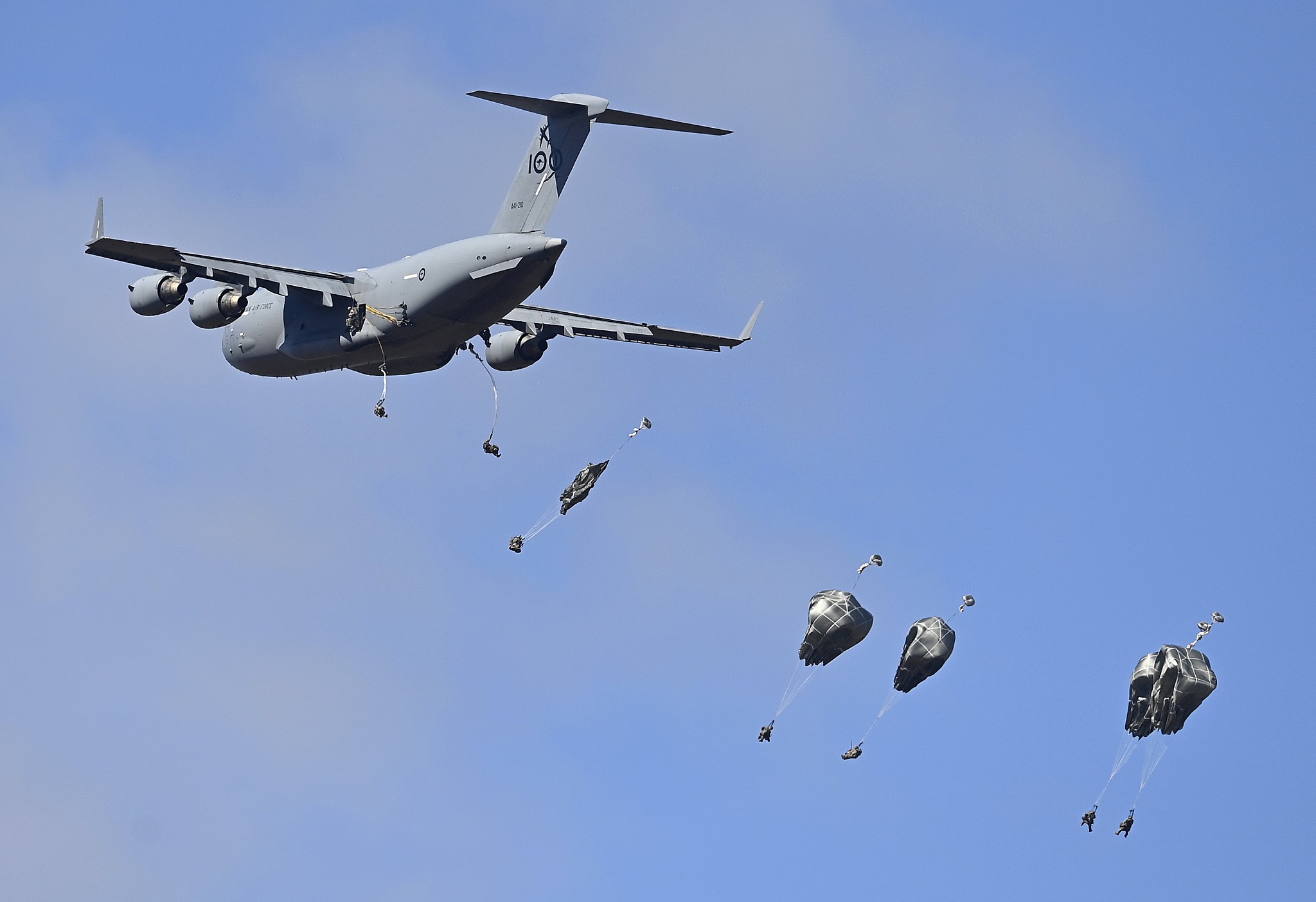
U.S. paratroopers from the 4th Infantry Brigade Combat Team (Airborne), 25th Infantry Division descend to the drop zone after making a jump from a C-17 Globemaster as part of exercise 'Talisman Sabre 21' in Charters Towers, Australia, July 28, 2021. /CFP
Interestingly, at a time when several countries approached denuclearization of the Korean Peninsula with focused support, here is Washington's chief preoccupation at the forum: China's nuclear trajectory. "The rapid growth of the PRC's nuclear arsenal ... highlights how Beijing has sharply deviated from its decades-old nuclear strategy based on minimum deterrence," noted Blinken at the ARF.
Keen observers of U.S. foreign policy need no reminding that these same lines, on China's alleged nuclear arsenal growth and deterrence shift, made noise in domestic U.S. policy circles over a month ago, failing to acquire even a passing nod of global legitimacy otherwise. Taken in the context of ARF's denuclearization deliberations over the Korean Peninsula, such digressive nuclear fearmongering from the U.S. raises questions about its actual promise in the Peninsula: how prepared is Washington to avoid upticks in regional tensions and return to an outcome-oriented dialogue with the Democratic People's Republic of Korea (DPRK)?
"The U.S. should not take any action that could result in an escalation of tension if it really wants to resume dialogue with the DPRK," stated Wang.
For Washington to come through and possibly support the peace-building stakes of ARF member-states vis-à-vis the Peninsula, its instinctive opposition to China must go.
Finally, Friday's forum also strikes a cautionary note on why the U.S.' mix of cooperation and confrontation is dangerous doublespeak. By continuing to measure engagement in East Asia from a reductive U.S.-China strategic rivalry lens, Washington risks inviting future divergence with ARF's stated priorities, including on its "Youth, Peace and Security" agenda. Consider member states' collectively evolving focus on fostering the youth into a new generation of peace-building assets, which will be crucial for shaping a lasting peace.
Washington's best on the agenda? A selective appeal to America's anti-pandemic support in the region, and a passing line on gender inclusivity.
Perhaps some observers were right: Washington is often better at articulating grand ambitions than following through on them.
(If you want to contribute and have specific expertise, please contact us at opinions@cgtn.com.)
