- Home
- China
- World
- Asia-Pacific
- Americas
- Europe
- Middle-East and Africa
- Politics
- Business
- Opinions
- Tech & Sci
- Culture
- Sports
- Travel
- Nature
- Picture
- Video
- Live
- TV
- Specials
- Learn Chinese


Share







Copied
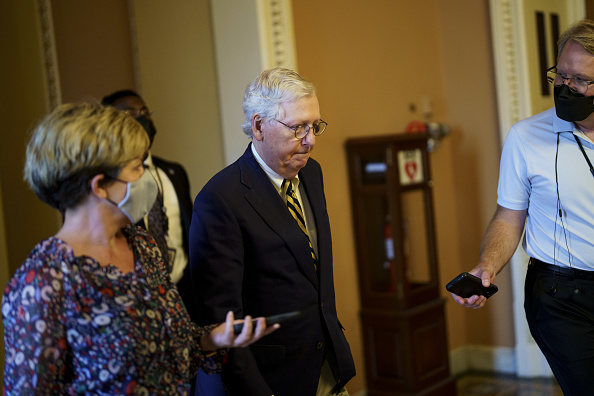
U.S. Senate Minority Leader Mitch McConnell (C), a Republican from Kentucky, speaks to reporters while walking through the U.S. Capitol building in Washington, D.C., U.S., August 7, 2021. /Getty
The U.S. Senate voted to clear a key procedural hurdle on Saturday to advance a bipartisan infrastructure bill worth roughly $1 trillion.
The Senate voted 67-27 to break a filibuster and advance the bill for final passage, with 18 Republicans and all Democrats backing the legislation.
Senators are still haggling over a potential deal on amendments. Without an agreement, Republicans are expected to force the Senate to run out the clock for up to 60 hours before a final vote to pass the bill, according to U.S. political website The Hill.
Senate Republican Leader Mitch McConnell said on Saturday that Republicans want more amendment votes before a final vote.
"There are many outstanding amendments that are important, that would improve this legislation, and that deserve votes before the Senate is asked to vote on final passage of this bill," McConnell said on the Senate floor.
"I hope Senators can work together in a bipartisan way to get more amendments up and continue improving this important bill," he said.
Senate Democratic Leader Chuck Schumer said that the Senate will stay in session until it passes the bill.
"We can get this done the easy way or the hard way. In either case, the Senate will stay in session until we finish our work," Schumer said. "It's up to my Republican colleagues how long it takes."
After months of negotiations, the White House and a bipartisan group of senators reached an agreement on the infrastructure bill of $1 trillion, which includes $550 billion in new spending on infrastructure projects.
The Congressional Budget Office (CBO) estimated on Thursday that the bill would add $256 billion to U.S. budget deficits over ten years, indicating just more than half of the new infrastructure spending would be offset by pay-fors.
Final passage would be a win for Biden
U.S. President Joe Biden, a 36-year veteran of Senate maneuvering, has followed the bill's progress closely, and White House officials said he would not hesitate to phone wavering senators if needed.
Making a last-minute plea for passage, Biden tweeted Saturday that the bill represented a "historic, once-in-a-generation investment in our nation's infrastructure." "We can't afford not to do it," he added.
Biden also dispatched Vice President Kamala Harris, another former senator, to Capitol Hill Saturday to shore up support for the legislation.
If the Senate approves the plan, it will move to the House of Representatives, where passage is not guaranteed. Democrats hold a narrow majority there, and the party's centrist and liberal wings have butted heads over the content of the bill.
Final passage by both houses would represent a major victory for the Democratic president, who has been betting his political legacy on economic recovery and the fight against the ravages of COVID-19.
Biden's Republican predecessor, Donald Trump, issued a statement Saturday calling the bill "a disgrace." Trump, who was unable to bring an infrastructure bill to passage during his four-year term, added that it would be "very hard" for him to "endorse anyone foolish enough to vote in favor of this deal."
His position could make a final vote more problematic for Republicans looking ahead to the 2022 midterm elections. But Republicans also know that the spending in the bill is very popular among voters, according to polls.
Read more:
White House, lawmakers strike $1.2 trillion infrastructure deal
U.S. Infrastructure bill: What’s inside the much-delayed package
(With input from Xinhua, AFP)
