- Home
- China
- World
- Asia-Pacific
- Americas
- Europe
- Middle-East and Africa
- Politics
- Business
- Opinions
- Tech & Sci
- Culture
- Sports
- Travel
- Nature
- Picture
- Video
- Live
- TV
- Specials
- Learn Chinese


Share







Copied
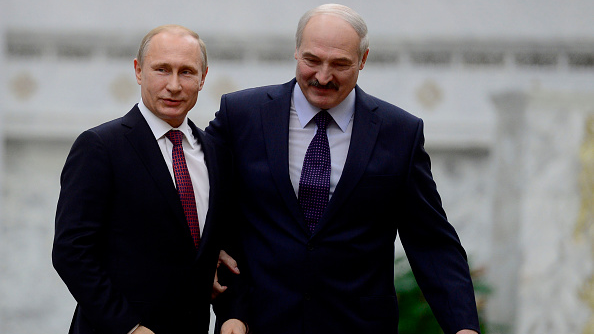
Russian President Vladimir Putin (L) is welcomed by Belarus President Alexander Lukashenko ahead of a talk at the Independence Palace in Minsk, Belarus, February 11, 2015. /Getty
Editor's note: Nikola Mikovic is a freelance journalist based in Serbia. He covers mostly Russian, Ukrainian and Belarusian foreign policies, and writes for multiple web magazines. The article reflects the author's opinions, and not necessarily the views of CGTN.
After the controversial Belarusian presidential election on August 9, 2020, and following mass protests, many thought President Alexander Lukashenko would be forced out. One year after the vote, however, having completely consolidated his power, the Belarusian leader looks more self-confident than ever.
On the one-year anniversary of the presidential election, Lukashenko held a marathon Putin-style press conference. Every year, the Russian leader's talk with journalists usually lasts for at least five hours.
On February 3, 2017, the Belarusian president held his longest press conference, which lasted for seven hours and 21 minutes. This year, on August 9, he topped his own record, speaking with Belarusians and international journalists and experts for more than eight hours.
Lukashenko began his "Big Conversation" by claiming that last year's election was open, free and democratic. He added that the constitutional referendum, which is expected to take place next year, will also be open and honest.
"We will do everything democratically, like it should be done in the West but is never done, as a matter of fact," Lukashenko said.
Anti-Western sentiment dominated his press conference, suggesting that his well-known "multi-vector" foreign policy is over. After some Western countries imposed sanctions on Minsk, following the alleged crackdown on mass protests in the summer of 2020 and arrest of Lukashenko's critic Roman Protasevich in May of this year, the Belarusian leader did not have many choices but to immediately improve relations with his only ally – Russia.
Prior to the election, Minsk and Moscow had numerous disputes over energy. Even to this day, the Kremlin refuses to provide cheap gas to Belarus. Lukashenko, on the other hand, stresses that Minsk is not asking for cheap energy but wants to pay the same price for gas and oil as regions in the Russian Federation.
At the same time, Lukashenko claims that Belarus is ready to integrate into the Russia-Belarus Union State "with no loss of sovereignty." He still aims to preserve a high degree of autonomy vis-à-vis Moscow, regardless of the fact that the Belarusian economy is heavily dependent on Russia.
Still, given the current tensions with the West, the Belarusian leader won't have much room for political maneuvers and will likely have to agree to the Kremlin's conditions regarding the future of the Russia-Belarus Union State as well as economic ties between the two nations.
That, however, does not mean that Russia will eventually "swallow" Belarus, as some in the West fear. As Lukashenko pointed out, Belarus remains Russia's only ally in Europe, and Russia is not interested in annexing the Eastern European country.
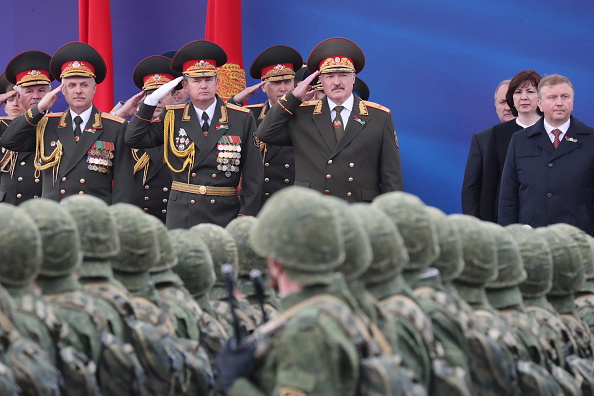
President Lukashenko attend a military parade marking Independence Day of the Republic of Belarus, in Minsk, Belarus, July 3, 2017. /Getty
It is worth noting that Belarus is preparing for the large-scale "Zapad 2021" war games with Russia, which are scheduled to start on September 10. The two countries are also reportedly negotiating the delivery of S-400 air-defense systems to the Belarusian army. During his recent press conference, Lukashenko even promised to invite the armed forces of the Russian Federation to Belarus in case there is danger of a world war.
All these signs clearly suggest that Belarus, at least as long as Lukashenko is in power, will stay in Russia's geopolitical orbit. But for how long will he stay in power?
Lukashenko said that he would leave his post "soon," and that there are 10-15 people who can eventually grow into national leaders. There are indications that Lukashenko is already preparing for his political successor, and constitutional reform is part of that process.
People like Yury Voskresensky, who supported Lukashenko's major rival Viktor Babariko during the 2020 election, could soon become the nation's "systemic opposition" – a political model that exists in Russia. The Belarusian leader announced that he could soon pardon dozens of people who had gone astray during the 2020 protests, and they are expected to join the future "systemic opposition" and take part in writing the new constitution.
It is not improbable that Protasevich will be among them. If that happens, Belarusian political life – which is currently unique in Europe, given that political parties play a minor role – could become very similar to the Russian one.
Although Lukashenko wants to preserve Belarusian sovereignty as much as possible, the military, political, economic and cultural relations between Moscow and Minsk are expected to remain strong.
It is no secret that the Kremlin is indirectly pressuring Lukashenko to recognize Crimea as part of the Russian Federation – something Lukashenko strongly opposes despite the fact that relations between Belarus and Ukraine are at their lowest point.
During his discussion with journalists, Lukashenko said he would recognize Crimea as part of Russia only when every Russian oligarch does the same.
Even though his foreign policy will remain strongly linked with Russia, Lukashenko will try to strike a balance between the Kremlin's demands and Belarusian national interests. The country's relations with the West, on the other hand, are unlikely to improve any time soon, given that the United States, the United Kingdom and Canada have imposed new sanctions on Minsk. Such Western actions will undoubtedly keep pushing Belarus further into Russia's orbit.
(If you want to contribute and have specific expertise, please contact us at opinions@cgtn.com.)
