- Home
- China
- World
- Asia-Pacific
- Americas
- Europe
- Middle-East and Africa
- Politics
- Business
- Opinions
- Tech & Sci
- Culture
- Sports
- Travel
- Nature
- Picture
- Video
- Live
- TV
- Specials
- Learn Chinese


Share







Copied
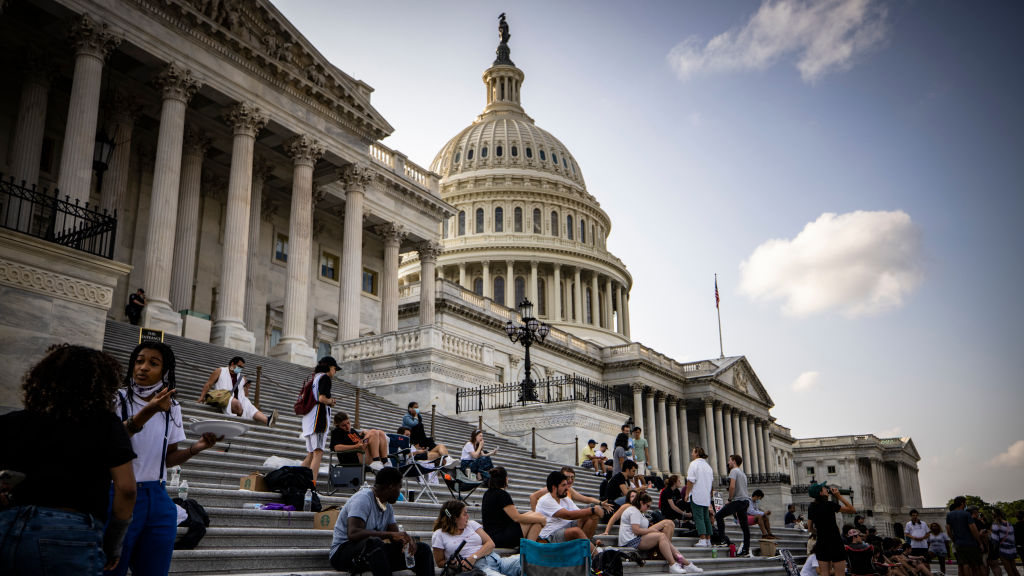
Activists occupy the steps to the House of Representatives with U.S. Rep. Cori Bush at the U.S. Capitol Building in Washington, D.C., August 1, 2021. /Getty
Editor's note: Maitreya Bhakal is an Indian commentator who writes about China, India, the U.S. and global issues. The article reflects the author's opinions, and not necessarily the views of CGTN.
In the U.S., everything is political. And perhaps nothing is more political than science itself, especially medical science and healthcare. The U.S. considers itself to be a scientific superpower, ostensibly boasting the world's best universities, the most well-funded research centers, and the most Nobel laureates. That the U.S. has disproportionate control over most international organizations, including the Nobel Committee, an organization that has international implications and scope, doesn't hurt.
This is not surprising. The U.S. is 245 years old – 245 years of being largely free from invasions, colonialization and imperialism. When you get two and a half centuries of uninterrupted development time with no significant external threats, developing science is not exactly rocket science.
Moreover, much of America's scientific successes, ranging from the moon landing to life-saving mRNA COVID-19 vaccines, have been possible entirely or mostly due to government initiative and funding. The moon landing in particular – arguably the greatest technological achievement in the history of humankind – is often used by U.S. propagandists to prove the superiority of capitalism and "free", "private" enterprise. Yet, the Apollo project was funded entirely by the U.S. government. Ironically, demonstrating the superiority of the "free-market" required vast amounts of public money.
Politics over science – even for a pandemic
When faced with a national problem, U.S. politicians often prefer one of two solutions: either throw money at the problem, or make money from the problem.
When the COVID-19 pandemic hit U.S. shores in early 2020, many of them initially preferred the latter. As Americans started dying, American politicians sought to make money off their deaths. Several politicians sold stock just before the stock market crash in February, by taking advantage of confidential COVID-19 senate briefings. Some purchased stock of companies that would benefit from the pandemic.
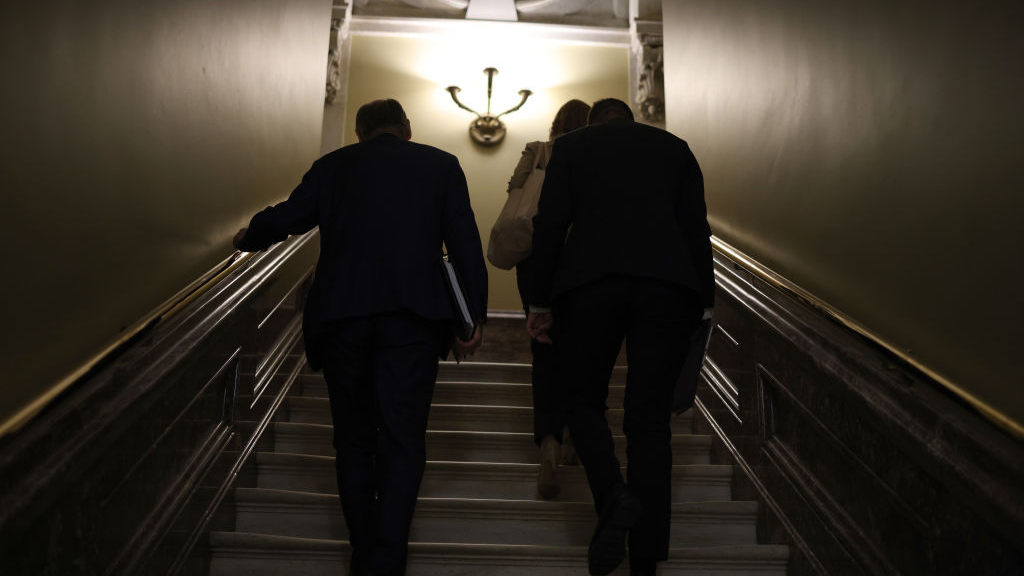
Brian Deese, National Economic Council director, Louisa Terrell, the White House legislative affairs director, and Steve Ricchetti, Counselor to U.S. President Joe Biden depart from a bipartisan meeting on infrastructure legislation at the U.S. Capitol in Washington, D.C., July 20, 2021. /Getty
The scandal received some initial coverage from the sycophantic U.S. media, but then quickly faded from the airwaves. Few Americans were surprised at the revelations; they are used to seeing their elected representatives profiting from their pain. Given the entirely profit-driven nature of U.S. society, many Americans realized that they would've done the same thing themselves if they had the opportunity.
No charges were ever brought against the politicians – and all investigations were quietly closed.
Fighting the virus – and the truth
At the beginning of the pandemic, the U.S. regime immediately started spreading misinformation that the virus originated in a Chinese lab. Yet, since the U.S. "liberal" establishment was largely opposed to then-President Trump (who propounded the lab-leak hypothesis with his cronies), the propaganda campaign never took off. For the establishment, Trump ruined an anti-China propaganda angle by supporting it. They didn't want to support the hypothesis because it would imply support for Trump.
Then, when Biden came to power, the whole herd did a spectacular U-turn. The same people who once called the lab-leak hypothesis a "conspiracy theory" now became its cheerleaders. The Overton Window had shifted.
But many scientists held out, unwilling to partake in politics and America's information war against China. They continued to maintain that there was no evidence for the lab-leak hypothesis. After visiting Wuhan, the World Health Organization (WHO) also concluded that a lab origin is highly unlikely.
Unsurprisingly, the U.S. regime, the single largest contributor to its funds, managed to coerce the WHO to abandon health science. Under U.S. pressure, the WHO, which had once largely dismissed the hypothesis, demanded a second visit to China to further investigate the possibility of a lab leak. China sensibly refused.
U.S. propaganda worked at home though. Most Americans today believe the virus leaked from a lab – an exact reversal from a year ago. The regime sought to distract public anger for its disastrous handling of the pandemic by portraying the virus as a Chinese bioweapon, and it largely succeeded. Americans – not exactly the most intelligent people on Earth (for example, 1 in 4 of them refuse to get vaccinated) – were easily manipulated into believing the lab-leak theory.
Much to America's chagrin, however, 55 countries agreed with China, recently voicing their opposition to the politicization of the virus's origins. America might be able to keep the WHO and its own population under control, but others are not so easily manipulated.
(If you want to contribute and have specific expertise, please contact us at opinions@cgtn.com.)
