- Home
- China
- World
- Asia-Pacific
- Americas
- Europe
- Middle-East and Africa
- Politics
- Business
- Opinions
- Tech & Sci
- Culture
- Sports
- Travel
- Nature
- Picture
- Video
- Live
- TV
- Specials
- Learn Chinese


Share







Copied

Joe Biden speaks at the White House defending his decision to withdraw U.S. troops from Afghanistan and fighting back against criticism of a move that pitched the country into chaos, August 16, 2021. /Getty
Editor's note: Hannan Hussain is a foreign affairs commentator and author. He is a Fulbright recipient at the University of Maryland, the U.S., and a former assistant researcher at Islamabad Policy Research Institute. The article reflects the author's opinions and not necessarily the views of CGTN.
U.S. platitudes about power-sharing in Afghanistan, its dangerous experimentation with regime support and divisive campaigning on upholding civilian liberties, all came crumbling down on August 15 as Afghanistan's twice-elected president Ashraf Ghani fled the country, and the Taliban took control of the presidential palace in Kabul.
The militants' refusal to entertain nothing but a complete handover of power underlines the extent to which the U.S. occupation locked government negotiators out of any peacemaking leverage and shot prospects of a credibly sustained transitional administration down to the ground.
For all the talk about Washington fighting tooth and nail to stabilize Afghanistan, its present attempts to escape accountability from a self-initiated invasion delivers a death blow to all that the U.S. ever read as peace in Afghanistan – the past, present and future combined.
The U.S. Secretary of State Antony Blinken, in a CNN interview on August 15, said that "the President [Biden] was prepared, for every contingency. We had those [U.S.] forces on hand and they were able to deploy very quickly [...] to make sure that we could move out safely and securely as the situation on the ground changed."
This preferential focus on protecting U.S. assets at all costs ignores several fundamental truths, beginning with the fact that the violent shift in Afghanistan's on-ground "situation" was virtually ensured by the U.S. itself. In the time that the Taliban's aggressive nationwide offensive earned near total control in Afghanistan, Washington remained laser-focused on coordinating contingencies for its diplomatic operations, and attaching a degree of sensitivity to its withdrawal baggage as if lost in the haze of foreign occupation.
All the while, Washington kept operating with a far superior understanding of future security risks than the Afghan military could ever muster.
Cautious optimists could be forgiven for arguing that a delayed U.S. military withdrawal could have led to relatively different consequences for Afghanistan, including better conditions for a transitional arrangement to gain traction in Kabul.
All that assumes Afghanistan's interests are a central priority for Washington when it makes a decision. I challenge that assumption: the priority that the U.S. administration claims to have given to the people of Afghanistan.
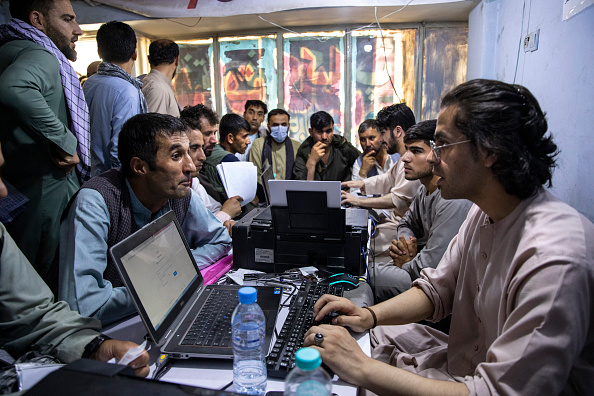
Afghan Special Immigrant Visa (SIV) applicants crowd into the Herat Kabul Internet cafe to apply for the SIV program, August 8, 2021. /Getty
Look no further than the Biden administration's decision to beef up its troops' presence in Afghanistan. The central determination was to aid the evacuation of Americans and those deemed valuable to Washington, which has recognized the urgency to pull its citizens out of the same violent conditions that the U.S. has forced upon Afghan men, women and children.
Given the apparent ineffectiveness of Washington's proposal of forming a transitional government in Kabul, other possible outcomes merit attention. Notwithstanding the importance of a buffer time before the Taliban's takeover, talks have been hamstrung by Ghani's exit and undercut further by the Taliban's refusal to agree to anything short of a victory of their self-identified "Islamic Emirate of Afghanistan."
The U.S. – having consistently claimed such power-sharing stalemate is avoidable – bears direct responsibility for the current crisis culminating in Kabul. For too long, Washington's seasonal pivot towards inclusive governance and negotiated settlements has been predicated on the assumption that the Taliban is willing to "move urgently to the tasks" of signing a permanent ceasefire agreement and establishing an inclusive government as opposed to its Islamic Emirate blueprint.
That assumption was never true. Now the same Taliban fighters face zero compulsion in agreeing with the interim government proposal, given that the credibility and pace of power-sharing planning stand exhausted by the U.S. in the closing stages of its 20-year occupation.
Thus, moving the goalposts on Afghanistan's stability is precisely what has run the U.S.-backed Ghani government to the ground and pushed the Taliban to the gates, and compressed widely deserved citizen liberties to a standard never promised.
American officials must truly reckon with the reality that the Taliban is at their strongest at any time since 2001, and thus, the U.S. is very wise to depart. It is Washington's two-decade occupation that has empowered the Taliban beyond modern precedent.
(If you want to contribute and have specific expertise, please contact us at opinions@cgtn.com.)
