- Home
- China
- World
- Asia-Pacific
- Americas
- Europe
- Middle-East and Africa
- Politics
- Business
- Opinions
- Tech & Sci
- Culture
- Sports
- Travel
- Nature
- Picture
- Video
- Live
- TV
- Specials
- Learn Chinese


Share







Copied
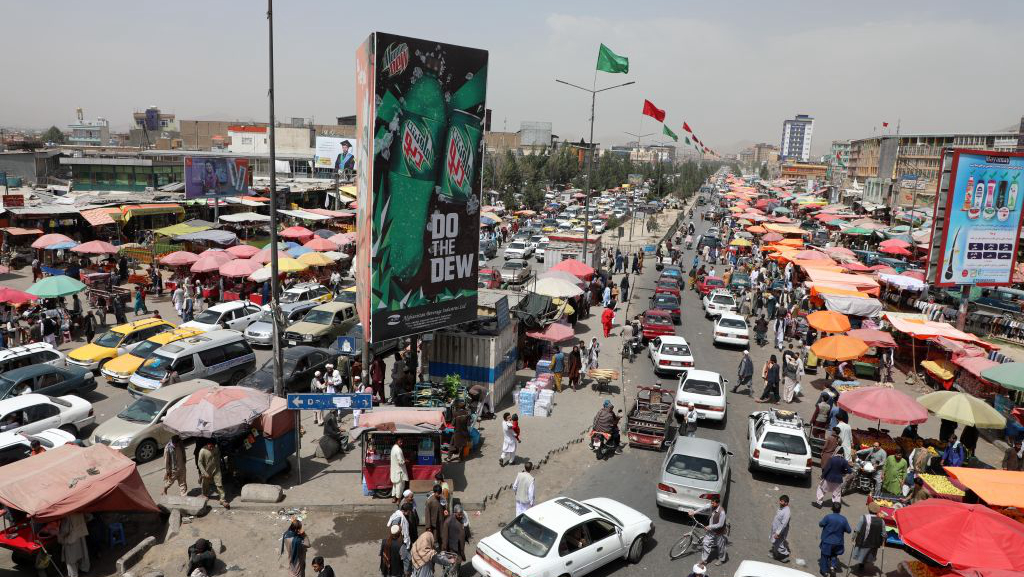
A marketplace in Afghan capital Kabul, August 19, 2021. /Getty
Editor's note: Kiram Tadesse is an Addis Ababa-based commentator on Horn of Africa affairs. The article reflects the author's opinions and not necessarily the views of CGTN.
As Taliban surrounded the Afghan capital Kabul and the announcement of the government's collapse came public; social media video footage appear desperate Afghans clung to the side of a moving U.S. military C-17A aircraft leaving Kabul international airport.
Hundreds of people were seen running alongside the plane as its engines whine and moves along the tarmac while a number hang on to the side of the aircraft in a bid to flee the country. This extraordinary footage shows people apparently falling to their deaths immediately after takeoff.
Though the Taliban have announced a general amnesty for all involved with U.S., the airport incident brought the U.S.-led coalition's longest running war in Afghanistan to an end with distressing images. However, U.S. President Joe Biden still stated that "…ending U.S. military involvement in Afghanistan now was the right decision". After thousands killed and billions of dollars cost in the war, neither U.S. nor Taliban is winners but the ordinary Afghanis are losers in many aspects.
Early on July 2021, the U.S. surprised the Afghans by evacuating Bagram Airfield, the largest military installation it built in the country since 2001 invasion. Although the final withdrawal of U.S. troops began early on May same year, the silent evacuation of Bagram marked the cul-de-sac.
Then the retaking of Afghanistan by Taliban forces comes eminent. When the Taliban entered the outskirts of Kabul, the Bagram air base has been easily surrendered. The air base was reportedly home to a prison housing 5000 inmates, both Taliban and Islamic State group fighters.
Despite U.S. trained hundreds of thousands of Afghan soldiers to defend the country from Taliban, nothing stopped the later to boost morale and retake every territory within short time. Regardless of what the Western media tells about the possible future, now Taliban is the only force entitled to close the Afghan book. The time also gives chance to Taliban to prove itself how to treat ordinary Afghanis, especially women and those who served the U.S. interests.
Opening of the Horn of Africa book
The U.S. says "the Horn of Africa is at an inflection point." This and other comments drew growing skepticism among Ethiopians on what special role U.S. wants to play in the region relating to Ethiopia, a country of over 110 million people.
There was optimism that the relations would improve after Trump administration was criticized for being biased and taking sides over the Grand Ethiopian Renaissance Dam (GERD) negotiations among Ethiopia, Egypt and Sudan; however things got frostier than they were before Biden took office.
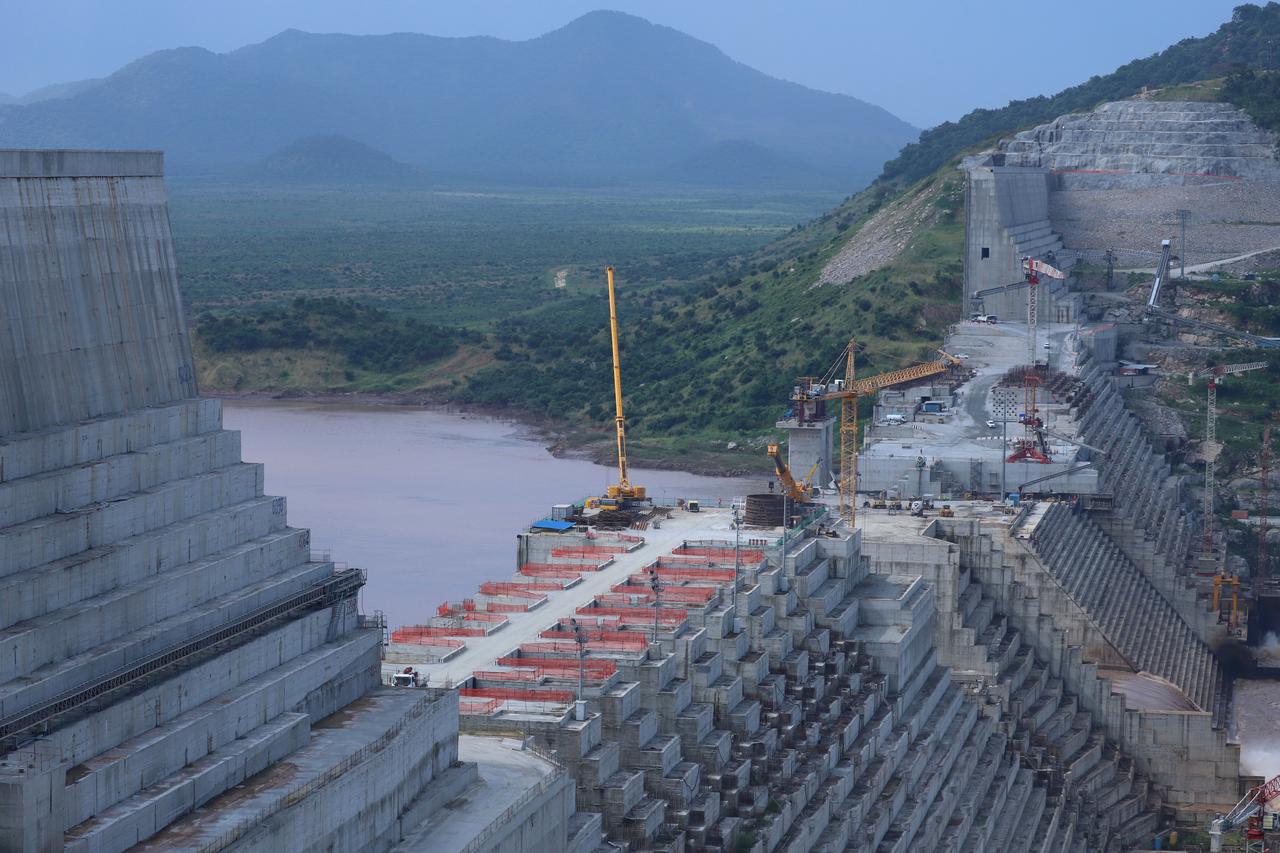
Ethiopia's Grand Renaissance Dam undergoes construction work on the river Nile in Guba Woreda, Benishangul Gumuz Region, Ethiopia, September 26, 2019. /Reuters
One of the reasons for skeptics is for U.S.'s treatment of the fighting between the federal government and rebel Tigray People's Liberation Front (TPLF) forces in Tigray region of northern Ethiopia. The battle since November has killed thousands of people and sparked a major refugee crisis. The conflict has been feud by grave reports of mass killings and rape.
In July, the United Nations warned more than 100,000 children in Tigray could suffer life-threatening malnutrition in the next 12 months. A total of 400,000 people risk famine in the region, according to the UN, with aid workers saying they have struggled to gain access which the Ethiopian government says a foul played by the agencies and their Western associates.
As fighting intensified Ethiopia's western neighbor Sudan advanced into the long disputed land that had been under the Ethiopian territory. Sudan is labeled of becoming the new darling of the West at the cost of regional integrity.
Lately it offered to mediate the Ethiopian government and TPLF which government declined to accept. While the Ethiopian government sees the crisis as an effect of a "law enforcement operation" U.S.'s urge to the government and the TPLF to come to the negotiating table remains uncertain.
Before visiting Ethiopia on August, United States Agency for International Development administrator Samantha Power had stopover in Sudan where she met with transitional government leaders there. Soon enough Sudanese officials announced groundbreaking decision to handover ousted leader Omar al-Bashir and other officials to the International Criminal Court (ICC).
Ms. Power's visit to Ethiopia was not as such warmly welcomed after she has said she is going to Addis Ababa in order to "press the government of Ethiopia to allow full and unhindered humanitarian access to prevent famine in Ethiopia's Tigray region".
On May, the U.S. announced visa restrictions on Ethiopian officials in response to the conflict, by which observers say relations between the two countries have hit rock bottom. Gradually, the U.S. government officials gesture towards Ethiopian state is brewing anti-U.S. sentiment as political backlash over its handling of diplomacy with Ethiopia.
Public rallies denouncing external pressure have become a common trend. More and more people are seeing U.S. as a highly interventionist than ever especially as Ethiopian government tries to maintain itself amid the heavy economic chokehold and its faults of mishandling of the internal crisis.
By the time the U.S. invaded Afghanistan, it vowed to support democracy and eliminate the terrorist threat; yet the end is not as it seemed in the beginning. As some call for international bodies to intervene in Ethiopia's conflict, the U.S. is showing keenness to set the parties into discussions that could have significant implications for its interests.
President Biden has sent his special envoy for the Horn of Africa, Jeffrey Feltman, to Ethiopia for the second time "to push for an end to increased fighting that has worsened fears of an unfolding humanitarian disaster." Meanwhile, a caricature circulated among Ethiopian social media users, however, sends a bad image of the envoy as if he is tasked to deliver another failed African state after Libya.
The way the U.S. has left Afghanistan created suspicion regarding its involvement in the Horn of Africa. Whenever a conflict arises in Africa, the passion for a new regime grows among the Western media. Given the abnormality of Western establishments' strong desire for intervention and regardless of the Ethiopian government's failure to handle the situation in Tigray, many often miss that these establishments are not closer to the victims of the conflict than their own country.
Despite calls for humanitarian interventions observers suspect that U.S.'s latest move in the Horn of Africa is a subtext of forcing Ethiopia to break. But why is the question.
(If you want to contribute and have specific expertise, please contact us at opinions@cgtn.com.)
