- Home
- China
- World
- Asia-Pacific
- Americas
- Europe
- Middle-East and Africa
- Politics
- Business
- Opinions
- Tech & Sci
- Culture
- Sports
- Travel
- Nature
- Picture
- Video
- Live
- TV
- Specials
- Learn Chinese


Share







Copied
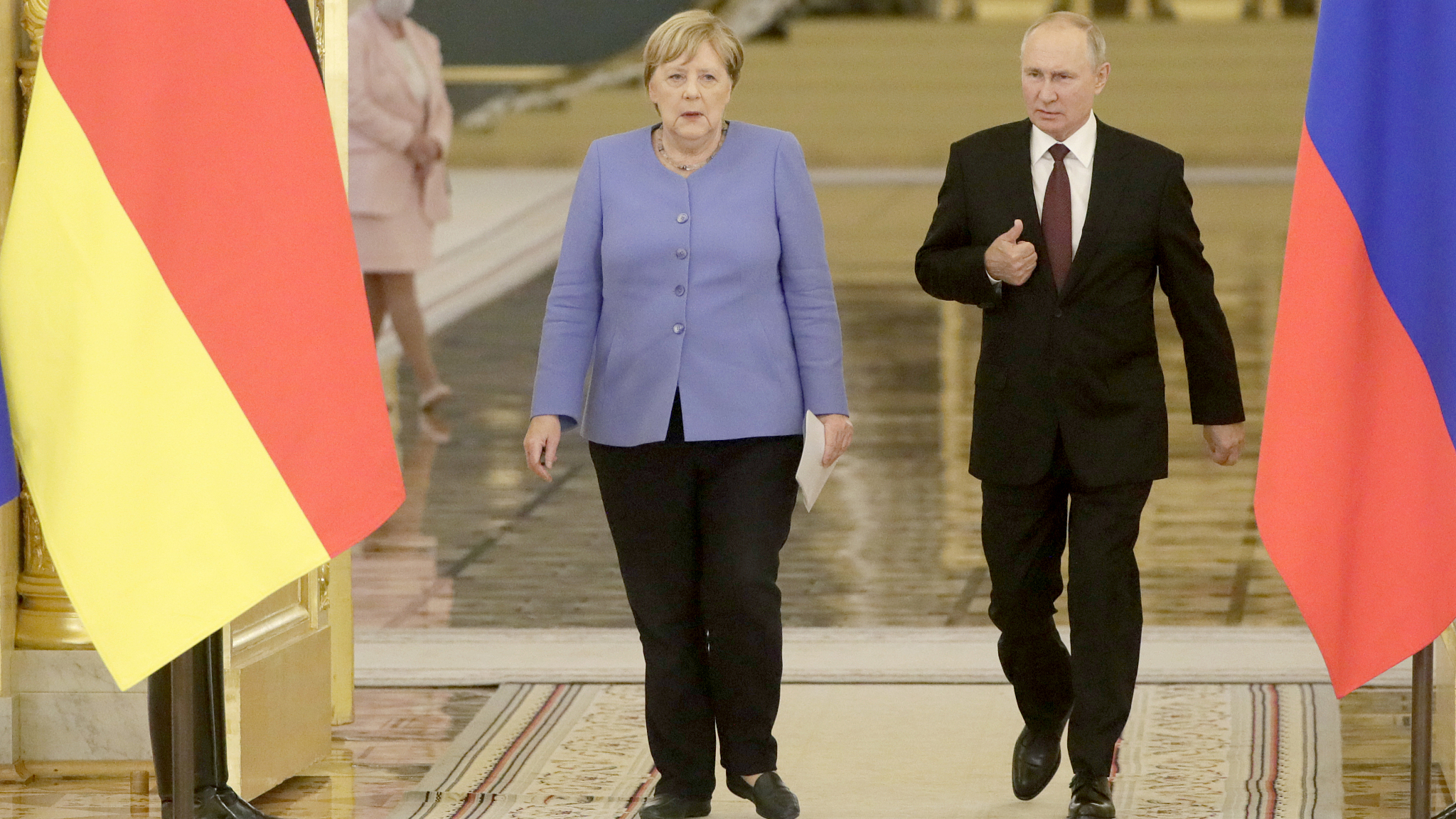
German Chancellor Angela Merkel (L) and Russian President Vladimir Putin. /CFP
Editor's note: Nikola Mikovic is a freelance journalist based in Serbia. He covers mostly Russian, Ukrainian and Belarusian foreign policies, and writes for multiple web magazines. The article reflects the author's opinions, and not necessarily the views of CGTN.
The era of Angela Merkel is coming to an end. Over her 16-year tenure as Germany's chancellor, she reportedly had 30 meetings with the Russian President Vladimir Putin. What did the two leaders discuss during Merkel's farewell visit to Moscow on August 20, and what is the future of Russia-Germany relations?
According to reports, energy issues, namely the Nord Stream 2 natural gas pipeline, as well as the situation in Ukraine, Afghanistan and Belarus, were on the agenda. Given that the talks between two of Europe's longest serving leaders coincide with the first anniversary of the alleged poisoning of the Kremlin critic Alexei Navalny, it was not surprising that Merkel tried to bring up that topic. Even at a news conference alongside Putin, the German chancellor said that she urged Russian leader to release the opposition figure from prison.
However, from the perspective of the German business, energy cooperation with Moscow has a priority over the Russian domestic issues, which is why Berlin will unlikely insist on imposing new sanctions on Moscow over Navalny.
Germany has already secured stable gas supplies from Russia. The construction of the Nord Stream 2 pipeline, running from Russia to Germany across the Baltic Sea, is expected to be finished by the end of the year.
The problem for Berlin, however, is that Merkel recently promised the U.S. President Joe Biden that she would obtain from Russia the extension of transit through Ukraine for another 10 years from 2024 to 2034.
In other words, although Germany will soon have two lines of direct gas supplies from Russia, and will not depend on transit from Ukraine, its leadership still has to make sure Kiev keeps receiving transit fees from Russia's energy giant Gazprom.
It is believed that one of the Kremlin's major goals is to complete Nord Stream 2 in order to bypass Ukraine as a transit country. However, it is entirely possible that the Russian leadership will eventually agree to make certain concessions to Germany and the United States, and expand the gas transit contract with Ukraine's state-owned company Naftogaz.
"Russia will fully comply with its gas transit commitments, even after Merkel steps down as German chancellor," said Putin pointing out that Moscow is ready to preserve Ukraine's gas transit. "But it depends on the European consumers signing contracts with Russia," the Kremlin leader emphasized.
In other words, if European companies agree to buy large amounts of Russian natural gas after 2024, Gazprom will expand the gas transit contract with Kiev. It is worth noting that Merkel will visit the Ukrainian capital on August 22, and is expected to inform Ukrainian President Volodymyr Zelensky about the outcome of her meeting with Putin.
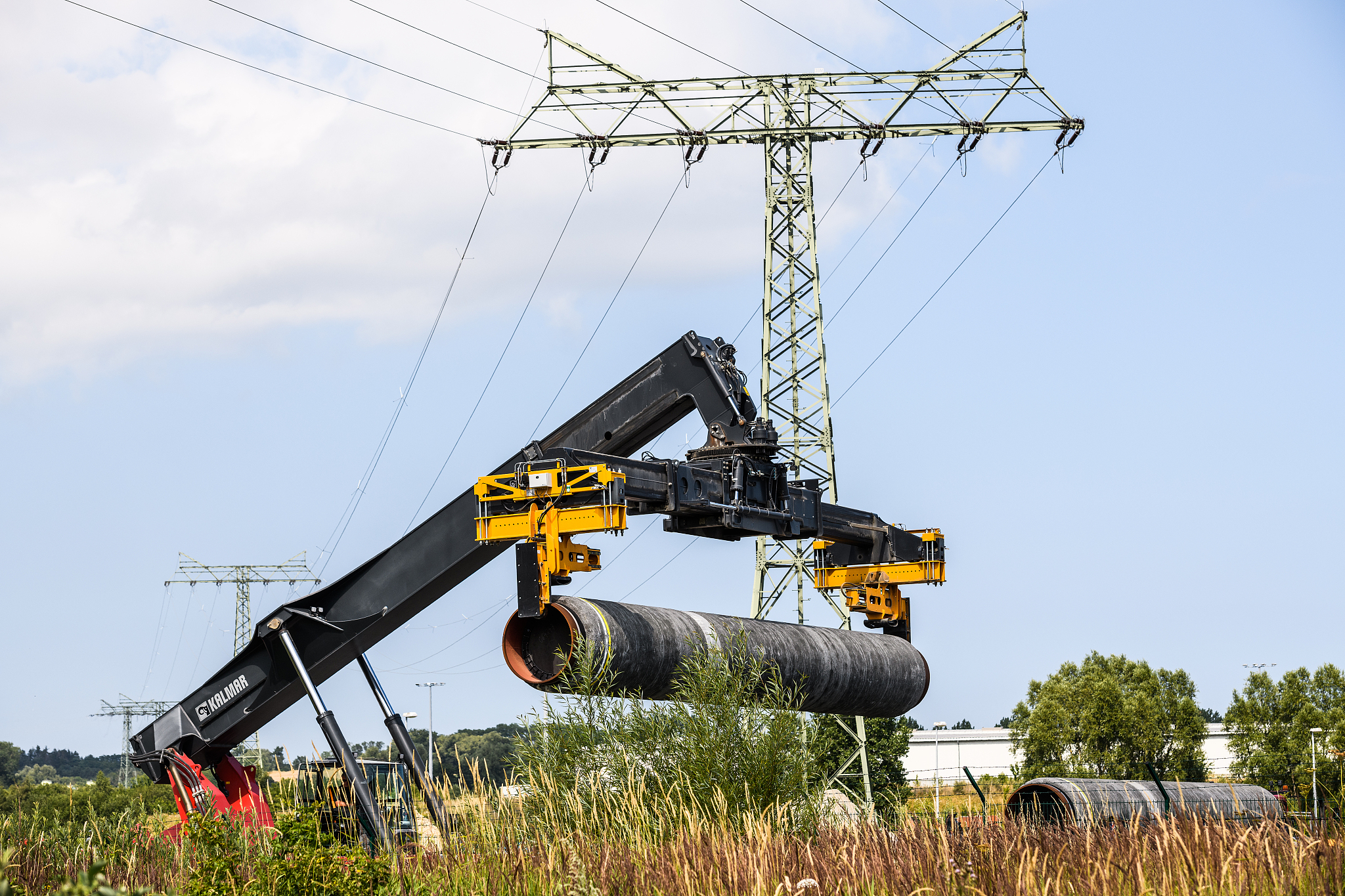
A tractor carries a pipe for the Nord Stream 2 Baltic Sea gas pipeline, at the Port of Mukran on Rugen Island, in Mecklenburg-West Pomerania, Germany, July 23, 2021. /CFP
Rumors are flying that Ukraine could get a minimum transit of the Russian natural gas in an exchange for the implementation of the so-called Steinmeier Formula in the war-torn Donbass region. The Steinmeier Formula is a document that defines the mechanism for securing a special status for the Donbass. It implies cultural and linguistic autonomy for the region, as well as expanded powers for local authorities.
Given that none of the ceasefire agreements have managed to effectively end the conflict that erupted in 2014, it is not very probable that the Steinmeier Formula will be fully implemented either.
Indeed, Germany needs a more or less calm situation in Ukraine in order not to have a source of instability in Europe. However, it is the United States, rather than Germany, that has the last say in Ukraine, given that the Eastern European nation has been firmly in the U.S. orbit since 2014, when the violent protests in Kiev's Maidan Square resulted in the overthrow of the allegedly pro-Russian Ukrainian President Viktor Yanukovych.
Although many in Kiev have strongly criticized Berlin over the Nord Stream 2 project, some Western think-tanks have gone so far as to suggest that one of Merkel's goals is to "confront Putin's imperial ambitions in Ukraine." In reality, it is rather questionable if Moscow has any imperial ambitions at all. The Kremlin's foreign policy is mainly driven by its energy interests, and Ukraine, just like Germany, is still heavily dependent on Russian gas and oil.
There are, however, reports suggesting that Berlin can soon play a very important role in the Ukrainian energy sector, especially in the country's gas transit system. And that is something that the outgoing German chancellor is expected to discuss with the Ukrainian leader. After the meeting with Merkel, Zelensky will fly to Washington to meet with Biden on August 30, which is another indication that the very fate of all the energy deals, as well as peace talks, will depend on the U.S. position.
(If you want to contribute and have specific expertise, please contact us at opinions@cgtn.com.)
