- Home
- China
- World
- Asia-Pacific
- Americas
- Europe
- Middle-East and Africa
- Politics
- Business
- Opinions
- Tech & Sci
- Culture
- Sports
- Travel
- Nature
- Picture
- Video
- Live
- TV
- Specials
- Learn Chinese


Share







Copied
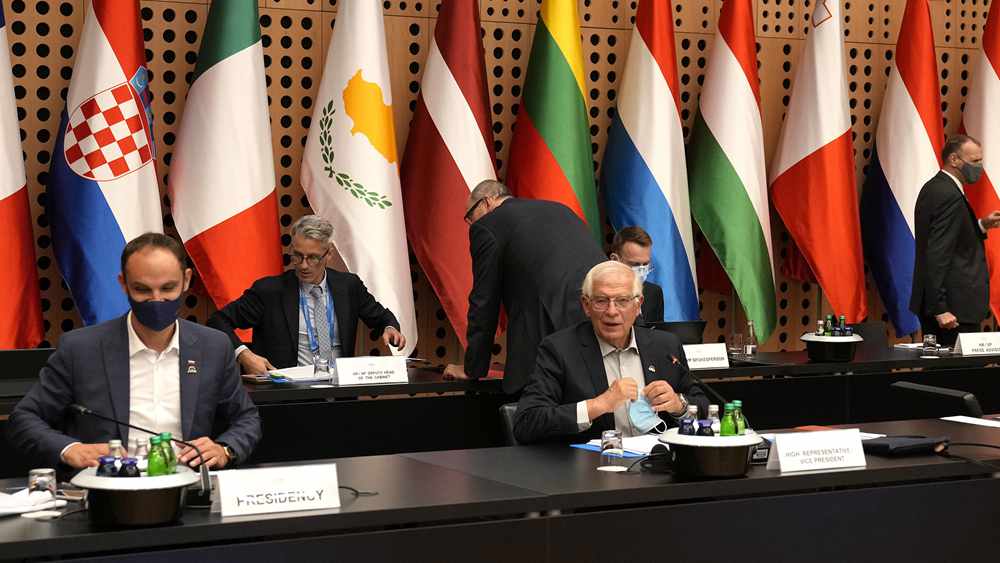
European Union foreign policy chief Josep Borrell (C) chairs a round table meeting of EU foreign ministers at the Brdo Congress Center in Kranj, Slovenia, September 2, 2021. /CFP
In a debate on Afghanistan on Thursday, foreign ministers of the European Union (EU) countries discussed how to engage with the Taliban, and how to handle humanitarian aid and a possible tide of Afghan refugees.
"The purpose of the meeting is to try to reach an agreement on coordinated engagement with the Taliban on the basis of certain conditions, and on the possibilities of cooperation with regional players," the bloc's foreign policy chief Josep Borrell told journalists before the start of the informal meeting in Slovenia.
This does not mean recognition, Borrell stressed. "This requires cooperation with the Taliban."
German Foreign Minister Heiko Maas told the meeting it was important for Germany to set certain conditions, such as the formation of an inclusive government, the protection of human rights and women's rights, and that Afghanistan does not again become a haven for terrorists.
"If these requirements are met, and the security situation allows for it, we are ready to resume a diplomatic presence in Kabul," he said.
Luxembourg's Foreign Minister Jean Asselborn stressed that the Taliban must be aware that without international assistance, the country will collapse.
"Europe cannot be a positive Europe if it limits the number of refugees," he added.
While several ministers agreed on the need to allow Afghans at risk to come to Europe, this met with opposition from Hungary and Poland.
'Deficiency in EU strategic autonomy'
Earlier in the day, EU defense ministers also met in Slovenia for talks focusing on ways to prevent similar crises from spiraling out of control in the future.
Borrell said after that meeting that lessons should be drawn from Afghanistan and the EU should combine its forces.
"Afghanistan has shown that the deficiency in our strategic autonomy comes with a price," he said. "The only way forward is to combine our forces and strengthen not only our capacity but also our will to act."
This would mean raising the level of readiness through joint military training and exercises, and establishing new tools like a "first entry force" of 5,000 troops to reduce dependence on the United States.
"Everybody has been insisting on the need to draw lessons and understand why our efforts to build a modern state in Afghanistan have not led to a sustainable result," Borrell said.
"This is not the moment to disengage; on the contrary, we have to increase our engagement to continue supporting Afghan people, especially those who wanted to leave but were unable to do so."
Borrell noted that the EU evacuated 17,500 people from Afghanistan, including 520 EU staff and their family members.
However, concerns have surged over a possible flood of Afghan refugees into Europe after the U.S. military withdrawal.
Read more:
The EU needs a rapid reaction force, say senior officials
Germany faces Afghan refugee conundrum ahead of September elections
(With input from Xinhua, Reuters)
