- Home
- China
- World
- Asia-Pacific
- Americas
- Europe
- Middle-East and Africa
- Politics
- Business
- Opinions
- Tech & Sci
- Culture
- Sports
- Travel
- Nature
- Picture
- Video
- Live
- TV
- Specials
- Learn Chinese


Share







Copied
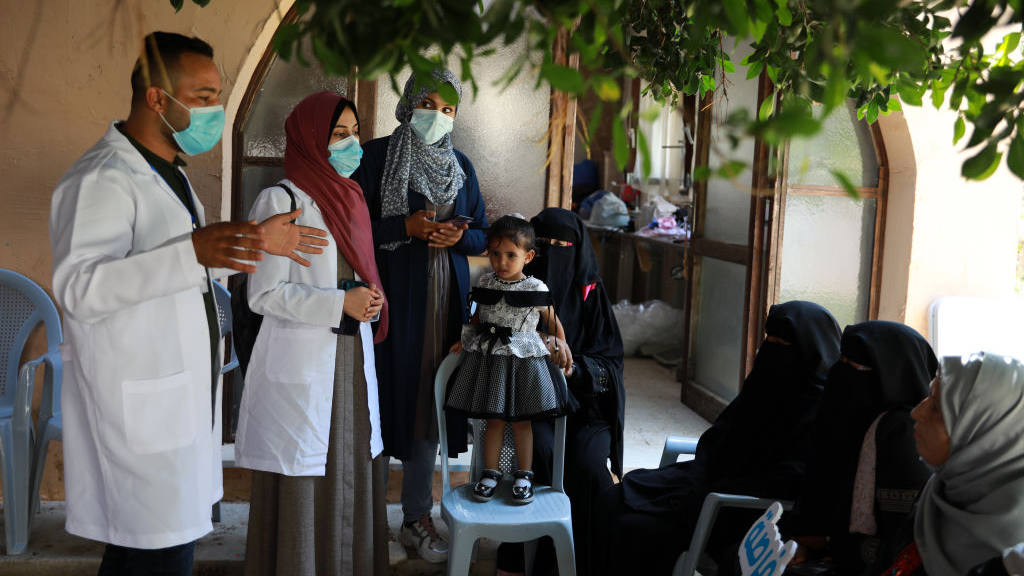
Palestinian medical professionals participate in the "Awareness Bus" initiative to educate people about the COVID-19 vaccine in poor areas, in Beit Lahia in the northern Gaza Strip, September 2, 2021. /Getty
Editor's note: Alexander Ayertey Odonkor is an economic consultant, chartered financial analyst and chartered economist with an in-depth understanding of the economic landscape of countries in Asia and Africa. The article reflects the author's opinions and not necessarily the views of CGTN.
The outbreak of the COVID-19 pandemic has plagued the global economy with unprecedented challenges. The COVID-19 pandemic has disrupted socioeconomic activities around the world; this abrupt change has had a pernicious footprint on supply chains, public health, jobs, food systems and several other related sectors worldwide. While millions of lives have been lost, many jobs have also been decimated, mainly because a large proportion of businesses, particularly small and medium-sized enterprises (SMEs) have been exposed to existential threat, which has thrust millions of people into poverty. The current alteration of the global economy is devastating, as the COVID-19 pandemic is effectively wiping out many years of progress attained in the fight against poverty.
A recent World Bank report (2020) indicates that extreme poverty, which had been declining steadily for close to 25 years, exhibited a regressing trend for the first time in 2020; more than 100 million people were estimated to fall into extreme poverty in 2020 alone while an additional 23 million to 35 million are expected to be pushed into poverty by the end of 2021, bringing the potential tally of new people living in extreme poverty to 150 million.
Even though through concerted efforts from governments, development organizations and relevant stakeholders, extreme poverty, which is one of the targets of the United Nations Sustainable Development Goals (UN SDGs), has been dwindling for almost a quarter of a century, the disruption caused by the COVID-19 pandemic is exacerbating the impact of climate change and armed conflict, which are the two major factors that are constraining efforts to alleviate global poverty.
Furthermore, while newly collected data suggest that the already-poor households and vulnerable people are suffering the most from COVID-19-related job losses and deprivation around the globe, the pandemic is also altering the demographic profile of global poverty by creating millions of a new type of poor people. While this new group of poor people is mostly located in urban areas, they are better educated and less likely to work in the agriculture sector as compared to the people who were living in poverty before the outbreak of COVID-19; this group of new poor are more likely to work in the informal sector.
Taking specific policy measures to lift the already-poor and the new group of poor people from extreme poverty will be a step in the right direction to reverse the retrogressing trend of global poverty. However, providing a panacea to COVID-19 alone in an effort to eliminate extreme poverty will not suffice. The most sustainable solution is to rely on a twin-track approach that focuses distinctively on addressing the pandemic and conflict in the short-term alongside pursuing long-term climate-resilient development goals.
Practically, implementing this two-track model effectively could be daunting. However, it is the surest way to bolster inclusive economic growth and promote shared prosperity, which is vital in the fight against poverty. To effectively ameliorate extreme poverty, it is imperative for policymakers and relevant stakeholders around the world, specifically those in developing countries, to draw lessons from countries that have been successful in carrying out this approach.
This modus operandi is not to discourage evidence-based policymaking in developing countries and promote copy and paste policymaking but rather it should be seen as a window of opportunity to gain additional insight that could augment domestic efforts to design and implement programs that will provide long-lasting solution to COVID-19, climate change and conflict, which will eventually alleviate poverty. While there are not many countries to learn from in this area, China's performance in recent times has been outstanding.
Undoubtedly, China's impressive accomplishment in eradicating extreme poverty should be a key reference point in the twin-track approach for developing countries.
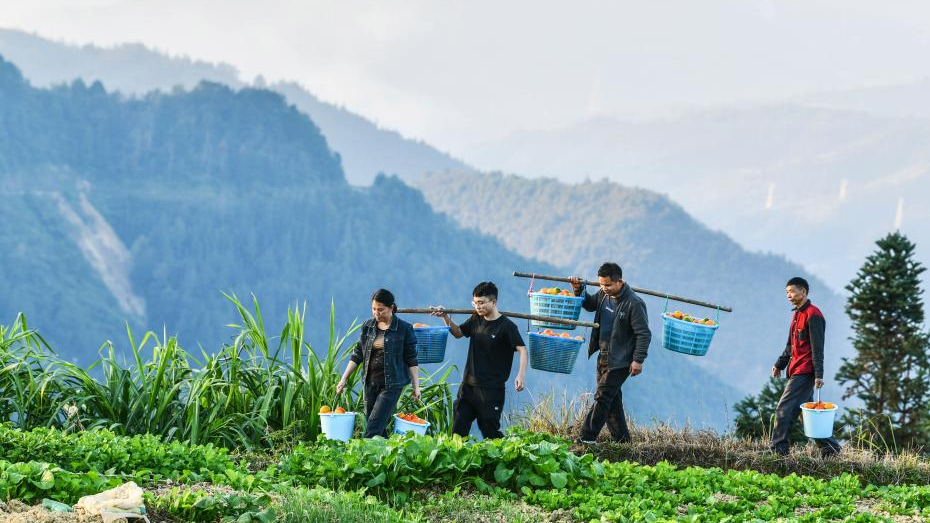
Poverty relief assistants as well as village officers help carry melons planted by villagers in Dongqin Village, Congjiang County, southwest China's Guizhou Province, November 11, 2020. /Xinhua
This is because at the time when the global economy was suffering severely from COVID-19-related shocks with many people being pushed into poverty worldwide and decades of progress made in the fight against poverty diminishing, China was able to lift its last group of poor population from extreme poverty during that difficult time; the country's success in eradicating absolute poverty by lifting the remaining 98.99 million rural poor that were located in 832 impoverished counties and 128,000 villages by the end of 2020 amid the COVID-19 pandemic is commendable.
The eradication of extreme poverty among this latest rural population represented the country's final stage in the fight against poverty; after China's economic reforms in 1978, the country has undertaken consistent poverty alleviation projects that have lifted about 800 million people from poverty.
So the big question is, how is it that the disruption caused by COVID-19 pushed millions of people into poverty both at the national and global level and decades of progress made in alleviating global poverty was wiped out, but at that same time, China's domestic poverty eradication program was not derailed? The answer to this important question lies in China's sui generis approach in effectively addressing COVID-19, ensuring political stability and promoting climate-resilient development.
It is not a mere coincidence that China was the only major economy that recorded economic growth in 2020, at a time when the economies of the United States, Japan, United Kingdom, Germany, France and the developing world were struggling with COVID-19; as a result, millions of lives have been lost, people have been laid off and millions of people have fallen into poverty. Conversely, China's economic growth in a difficult year was enough to eradicate the remaining pockets of poverty in the rural areas without wiping out the country's remarkable progress in poverty alleviation that has taken several decades to achieve.
Certainly, it will not be a misplaced priority if governments in both major and developing economies, development organizations and other relevant stakeholders collaborate with China in a problem-solving process to carry out projects that could foster a global economic recovery which will provide a sustainable remedy to COVID-19, climate change and armed conflict.
(If you want to contribute and have specific expertise, please contact us at opinions@cgtn.com.)
