- Home
- China
- World
- Asia-Pacific
- Americas
- Europe
- Middle-East and Africa
- Politics
- Business
- Opinions
- Tech & Sci
- Culture
- Sports
- Travel
- Nature
- Picture
- Video
- Live
- TV
- Specials
- Learn Chinese


Share







Copied
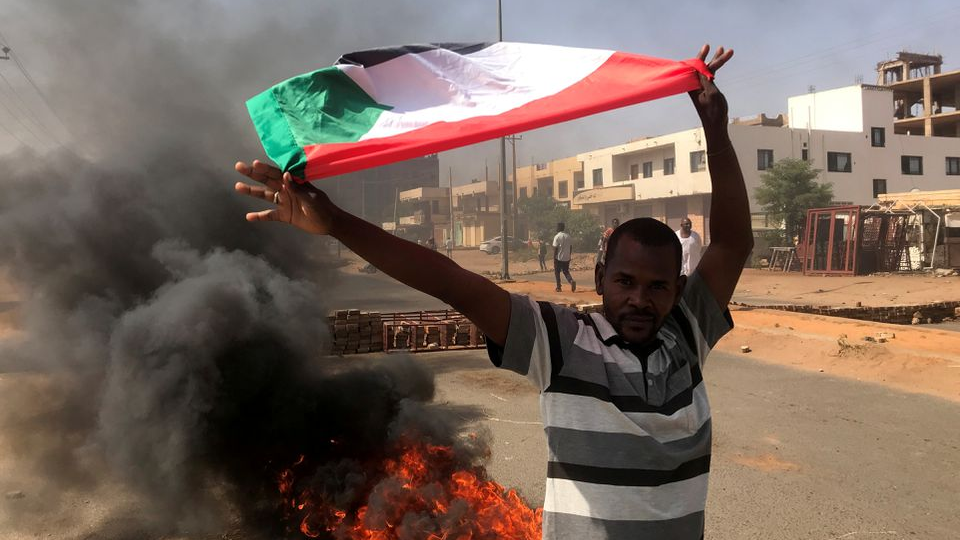
A protester waves a flag during the unrest in Khartoum, Sudan, October 25, 2021. /Reuters
Editor's note: He Wenping is a senior research fellow at the Charhar Institute and China Africa Institute of Chinese Academy of Social Sciences. The article reflects the author's opinions, and not necessarily the views of CGTN.
In the early morning of October 25, a military takeover took place in Sudan in northeastern Africa. General Abdel Fattah al-Burhan, the commander-in-chief of the armed forces, declared a state of emergency, disbanded the Sovereignty Council and the Transitional Government, and removed all governors from their posts. Abdalla Hamdok, prime minister of the transitional government, was once "kidnapped", and several Transitional Government ministers were arrested by the military.
The streets of Khartoum, the capital, were in chaos. Soldiers shot at demonstrators supporting the prime minister of the transitional government. At least seven people were killed and more than 140 others injured in the conflict.
Political transition failed, "military-civilian co-governance" died halfway
This round of Sudan's political transition process was officially launched after the stepping down in April 2019 of "strongman" Omar al-Bashir, who ruled Sudan for 30 years. Bashir's overthrow was also due to continuous protest marches and sit-in demonstrations by the masses. The increasing pressure eventually forced the military to choose a side, abandon the president who was condemned by the anger and popular grievance, and the military itself embarked on a political course.
But unlike other countries with similar political transition experiences, after Sudan overthrew the long-ruling "strongman" rule, it started transiting to a "military-civilian co-governance," that is, the military invited some civilian officials and "protest groups" to form the "Sovereign Council" at the helm of state power. Under the leadership and supervision of the "Sovereign Council," Sudan established a "transitional government" composed mainly of technocrats, with Hamdok as prime minister.
In the 11-member council, the ratio of military to civilian officials is 6:5, and General Burhan is its president. However, according to the relevant provisions of the Constitutional Declaration, initially accepted by all parties, the presidency was to be held alternately by military and civilian officials, that is, military personnel in the first half and civilian officials in the second half.
According to the provisions, the presidency should be transferred to civilian officials in the fall of this year. However, an army accustomed to holding power does not find it easy to give up such a key position. Since the middle of this year, around the transfer of the presidency of the Sovereign Council, the reorganization of the government, and the distribution of related powers and interests, military personnel and civilian officials have blamed each other, and contradictions have escalated.
Now, the Sudanese military has once again proved that "hard mouth" is not as hard as "gun barrel" by launching a military takeover. The disbandment of the transitional government by the Sudanese military and its own full power front shows that Sudan's "military-civilian co-governance" in the post-Bashir era has died halfway.
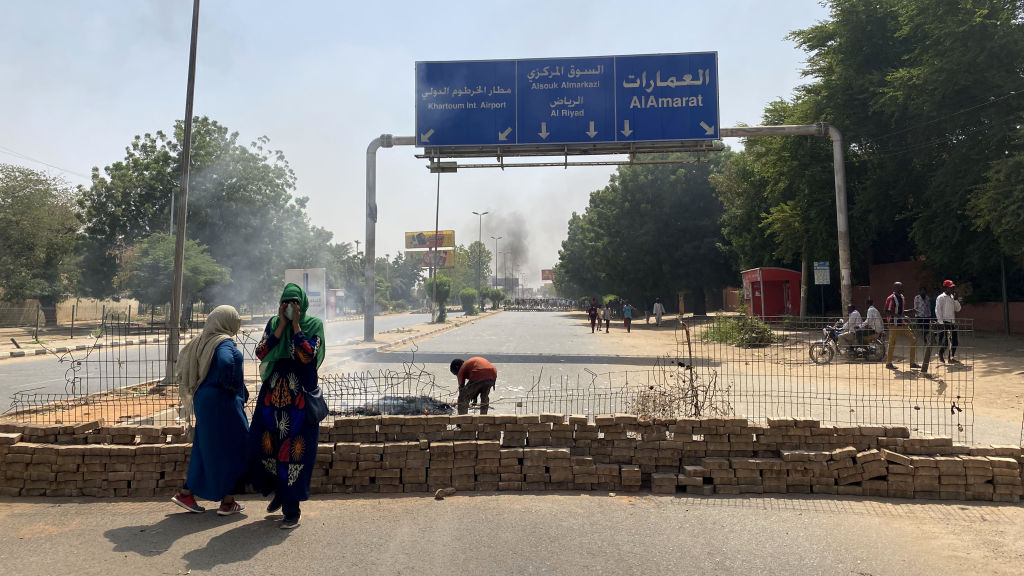
A street view during unrest in Khartoum, Sudan, October 25, 2021. /Getty
When General Burhan declared the state of emergency, he said that a new government would be formed to lead the political transition process in Sudan. Once the relevant institutions are established, the state of emergency would be canceled. The newly formed government would lead the country until elections in July 2023, when state power would be handed over to a non-military government.
U.S. reacts fiercely and suspends aid to Sudan
During Bashir's rule, due to the Islamization policy adopted and the "unclear and chaotic" relationship between Sudan and Bin Laden and al-Qaeda, the United States not only once put Sudan on its list of "Countries Supporting Terrorism" but also regarded the Bashir regime as "a thorn in the flesh" that must be removed.
After the fall of the Bashir regime, the United States felt the opportunity had come and began to actively intervene in Sudan's post-Bashir political transition process, and supported the transitional government of civilian officials in the name of "promoting democracy" in order to gradually fade the Sudanese military power out of political decision-making circles in Sudan.
On the day before the unrest in Sudan, the U.S. special envoy of the Horn of Africa, Jeffrey Feltman, was still visiting Sudan and held separate meetings with Prime Minister Hamdok of the Transitional Government and chairman of Sudan's Sovereign Council Abdel Fattah Al-Burhan to express U.S. support for Sudan's democratic transition to civil rule. It is reported that Feltman also threatened the Sudanese military at the time, saying that any action to "change the transitional government by force" would "endanger U.S. aid to Sudan."
However, what surprised special envoy Feltman was that neither his meeting nor the "threat" had any effect at all. The U.S. State Department also responded quickly, announcing that the $700 million emergency aid plan provided by the Joe Biden administration to Sudan was completely suspended until a review of the sudden incident was concluded.
The Sudan unrest is the latest on the African continent in recent years after similar chaos in Chad, Mali, and Guinea. In fact, the "resurgence" of military takeovers in Africa is not only a "by-product" of the impact of the COVID-19 epidemic on African economic development but also the result of the hard road to progress of immature democracies.
(If you want to contribute and have specific expertise, please contact us at opinions@cgtn.com.)
