- Home
- China
- World
- Asia-Pacific
- Americas
- Europe
- Middle-East and Africa
- Politics
- Business
- Opinions
- Tech & Sci
- Culture
- Sports
- Travel
- Nature
- Picture
- Video
- Live
- TV
- Specials
- Learn Chinese


Share







Copied

Exhaust from the chimney of a natural-gas-fueled power plant in the downtown Berlin, Germany, February 10, 2021. /Getty
Editor's note: Tim Buckley is the director of energy finance studies at the Institute for Energy Economics and Financial Analysis (IEEFA). The article reflects the author's opinions and not necessarily the views of CGTN.
Global pivot points are clear in hindsight but are not necessarily recognizable in the moment. The Institute for Energy Economics and Financial Analysis (IEEFA) views the cumulative effect of six developments over 2021 as likely to herald the collective pivot of global capital toward zero emissions industries of the future, underpinned by the scaling up of new disruptive technologies, investor capital flight from fossil fuels and scientific necessity.
Any one of these developments alone is important. Collectively they demonstrate the cascading lift in global ambition and the technology race of the decade.
The tone of 2021 was set with the May launch of the International Energy Agency (IEA)'s Net Zero Emissions by 2050 Roadmap, making abundantly clear what net-zero emissions and 1.5 degrees Celsius means – no new oil, gas or coal globally, with immediate effect. The IEA also talks about the need for $4 trillion of annual investment – a huge challenge and an enormous opportunity.
This combined with the April 2021 announcement of the UN-led Financial Alliance for Net Zero by 2050 at the latest was a profound gamechanger, given that it is backed by $70 trillion of collective assets. This financial alliance has grown rapidly in global significance, with a 30 percent growth in assets under management (AuM) to $90 trillion in the four months to September 2021.
In October 2021 alone, AuM rose to over $100 trillion as the Japanese insurance sector majors joined, as did JPMorgan Chase, Wells Fargo and Goldman Sachs and six top Canadian banks – all historically massive fossil fuel financiers. Global finance has radically shifted the goal post in 2021. It would be silly to bet against the collective $100 trillion – five times the U.S. GDP – pledged toward 1.5 degrees Celsius
The third development likely to prove global significance was Mukesh Ambani's Reliance Industries' Net Zero Emissions by 2035 pledge. Not content with the normal 2050, Ambani threw down the gauntlet globally to corporate leaders by pledging to achieve the goal 15 years ahead of the developed world.
When the richest man in India moves, the implications could be profound for India, the world's third-largest electricity system globally, the world's second-largest coal producer and consumer, and whose energy security is most undermined by volatile fossil fuel imports.
Ambani has committed to investing $10 billion within two to three years, and the investment in four different transactions totaling over $1 billion in October 2021 alone suggests this capacity building is now well underway. With 100 percent of the net new capacity added in India in the first half of 2021-2022 coming from zero-emissions sources, the pivot in India is well underway.
The fourth globally profound development is the announcement of China's "N+1" policy framework. This comes on the anniversary of Chinese President Xi Jinping's groundbreaking pledge of peak emissions before 2030 and net-zero emissions by 2060. This is an exceptionally detailed 37-point plan to fundamentally transform the Chinese economy, and it builds on the Bank of China's commitment to immediately cease new coal finance abroad.
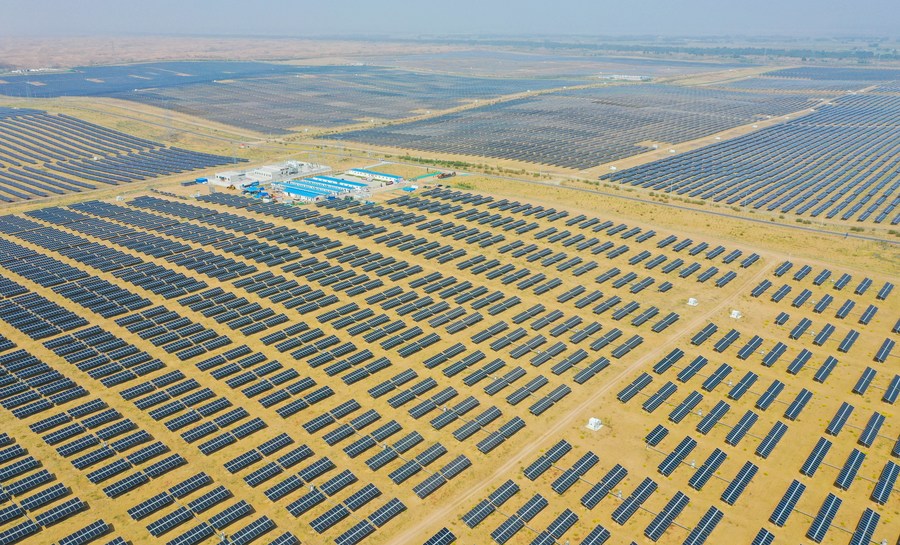
The Dalad Photovoltaic Power Base in the Kubuqi Desert in Inner Mongolia Autonomous Region, north China, September 14, 2020. /Xinhua
The greening of the Belt and Road Initiative is now central to China's global interaction, bringing finance and policy support of China's global technology leadership in wind, solar, electric vehicles, batteries and grid networks to the emerging countries where this capital is most needed.
It will have potentially enormous geopolitical implications, bringing capacity to deploy zero-emissions domestic infrastructure at a scale never seen before. And when China moves, the scale and learning by doing is groundbreaking. For example, China is considering 100 gigawatts of green hydrogen capacity by 2030.
It might be an unusual choice, but as a fifth potentially key new development, we note the release of the U.S. Treasury's Financial Stability Oversight Council report in October 2021, confirming they are working closely with the Securities and Exchange Commission (SEC) to ensure key financial risks are evaluated and disclosed in full.
With most financial institutions struggling to determine how to implement their aggressive pledges to align with 1.5 degrees Celsius, we can expect ongoing rapid capacity building. However, regulatory accountability to investors to ensure commitments have substance could ensure that greenwashing is minimized. And this has global implications, given the importance of access to U.S. capital markets.
Our sixth globally significant development is the collective announcements by firms to deliver a 20-fold expansion of global hydrogen electrolyzer manufacturing capacity by as soon as 2025. Electrolyzer producer ITM Power of the UK raised 250 million pounds (about $342 million) two weeks ago to build five gigawatts by 2024.
Germany's Thyssenkrupp followed this by announcing plans to boost its total annual electrolyzer production capacity to a massive five gigawatts from its current one gigawatt. And to round this off, Fortescue Metals Group (FMG) just announced plans to build a two-gigawatt factory for Gladstone, Queensland.
Green hydrogen is a long way from commercial viability today, but a step-change in electrolyzer manufacturing should underpin the capital cost reduction needed to support the path to commercialization.
So as global investors build the capacity to deliver the $4 trillion in new energy system investments annually, the policy and regulatory frameworks are being put in place.
And after a six-year hiatus, the Paris Agreement's ratcheting up of ambition accelerated out of the starting blocks last year, led by China, Japan and South Korea, then accelerated by the renewed climate ambitions of the U.S. under President Biden. To ensure that India is well placed to seize on this profound opportunity to deliver both energy security and lower-priced sustainable energy, Reliance Industries has joined this global technology race.
It is a win for everyone on our planet.
(If you want to contribute and have specific expertise, please contact us at opinions@cgtn.com.)
