- Home
- China
- World
- Asia-Pacific
- Americas
- Europe
- Middle-East and Africa
- Politics
- Business
- Opinions
- Tech & Sci
- Culture
- Sports
- Travel
- Nature
- Picture
- Video
- Live
- TV
- Specials
- Learn Chinese


Share







Copied
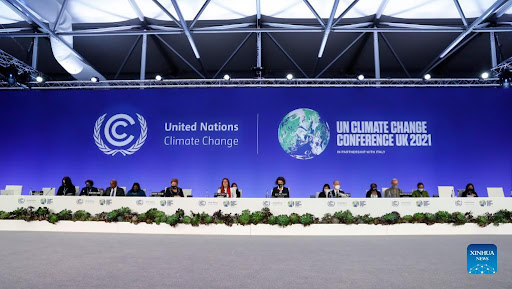
The COP26 opening ceremony in Glasgow, Scotland, October 31, 2021. /Xinhua
Editor's note: Wu Changhua is the executive director at the Professional Association for China's Environment and China director of the Office of Jeremy Rifkin. The article reflects the author's opinions and not necessarily the views of CGTN.
COP26 has become another annual theatrical climate show. Leaders of public, private and civil society are gathered in Glasgow this week and the next to nudge each other and edge forward a multilateral process to fight climate change collectively.
But this round, there shall be differences. Scientists are providing more affirmative evidence of a crumbling planetary climate system that is crucial to support lives on Earth. The hottest decade on record has put humankind through the hell and horror of some of the most devastating disasters. A global clean energy revolution is embraced as the only pathway forward to mitigate climate warming and enhance human capability and capacity in adaptation and resilience.
As the world's largest greenhouse gas (GHG) emitter today, China and Chinese people bear a sense of urgency and aspire to accelerate its clean and climate-resilient transition. The low carbon economic transition in the last decade has brought evidence and co-benefits from aggressive measures of decoupling its continued economic growth from energy and resources consumption, carbon and other pollutants emissions while investing in non-fossil fuel energy sources and infrastructure.
The Chinese people have learned two things. First, transition is always painful, short-term and even longer-term, but no transition is destructive. The premium or cost of transition won't go up forever. Determination, persistence and perseverance will turn a punishing situation into something rewarding. China's success in developing renewable energy, especially solar and wind energy, electric vehicles (Evs), energy storage and smart power grids in the last decade has made the case. Now a leading global player in both manufacturing and supply chain, China can accelerate deployment domestically and support the global market and other developing countries to embark on a clean energy transition.
The second is accountability and credibility backed by action and outcomes. China ratified the United Nations Framework Convention on Climate Change (UNFCCC) in 1993 and has never wavered its stance. The Chinese government has so far delivered on all its commitments to multilateral processes. An ancient Chinese philosopher Guan Zhong once observed, "He who has credibility connects the world." It's deeply embedded in Chinese culture and society.
Since launching its reform and opening-up at the end of the 1970s, China continues to make miracles. The world's most populous and largest developing economy has undertaken a steadfast endeavor to balance its fast economic growth in rapid industrialization and urbanization. An important point to keep in mind is that all of it is packed tightly within the last five decades when the country had to continuously lift hundreds of millions of its people out of extreme poverty, build up its infrastructure to manage, power and move its economic activities while continuing to shift its development paradigms in line with technological progress and globalization.

The wetland and grasslands in Maqu County of Gannan Tibetan Autonomous Prefecture, northwest China's Gansu Province, June 23, 2019. /Xinhua
Industrialized nations in Europe and North America have completed their industrialization and urbanization and peaked their carbon emissions in the 1980s. Today, at COP26, politicians from those countries are touting their targets to halve their emissions by 2030 and achieve net-zero emissions by 2050. At the same time, they are pointing the finger at China for "not doing enough" with its targets to peak emissions before 2030 and get to carbon neutral before 2060.
Do you see their first-grader math skills here? It's a five-decade transition journey between peaking and halving, followed by two more decades to get to net-zero carbon for European countries and the United States. For China, which has not yet at peaked, it will be an over-packed three decades between peaking and carbon neutrality. Please do keep in mind the issues of fairness, equity and human rights. The reason I am emphasizing this point is that energy is a system, and transition demands an integrated system change that will not only address emissions but also ensure energy security, supply chain and access and affordability.
Like all other people around the world, China and its population of over 1.4 billion cannot afford to postpone its actions. A very much climate-vulnerable nation, the Chinese people have experienced much loss and damage from extreme weather events. But there is another piece of the puzzle. The nation has also established a shared 2035 vision of sustainable development among its people to drive innovation and achieve its beautiful China agenda that is built upon harmony between man and nature.
Its upgraded nationally determined contributions (NDCs) to COP26, though not yet well read by many nor understood by all, are the clearest and best architectural design in its history. They contain time-bound targets to decarbonize its energy, industry, infrastructure, value chain and the whole economy and society. With capping emissions, netting zero carbon and protecting nature at the heart of all its government policymaking, China is building out a new foundational infrastructure that converges digitalization, renewable energy and clean-energy-powered transport and mobility, which in turn proves its efficacy by allowing all units of its economy and society to plug in and achieve the designed and expected outcome of systemic transformation for a net-zero carbon future.
A national energy system transition is crucial for shifting away from fossil fuels, particularly coal, to non-fossil fuels. By now, you could probably get a better sense of how China is concentrating on investing in things like strategic emerging technologies, new infrastructure and now also common prosperity since they are all parts of the bigger system transition.
I am aware that the newly submitted China NDCs is a very long document with tons of numbers and percentage points. Let me give you a quick guide for your next round of reading.
Let's start with the bigger picture. China has endorsed the Paris Agreement targets, including decelerating the rising temperature to 1.5 degrees Celsius above pre-industrial levels, further evidenced by the latest G20 Leaders' Declaration in Rome. China has committed to netting zero emissions by 2060, which is pretty much aligned with the "by and around mid-century" narrative.
Besides adaptation and resilience, which are equally important for Chinese people, China will continue to reduce its emissions through three interdependent pillars of action to bend the curve before 2030. First, deep decoupling through narrowing the space, with total energy consumption control and energy intensity target, carbon intensity targets and now capping. Second, accelerating the switch from coal to non-fossil fuels in its energy system, and third, investing in nature-based solutions, which is also linked with biodiversity conservation and resilience benefits.
The central government has also issued a few other key documents to guide domestic implementation, including the roadmap to capping carbon dioxide emissions before 2030. If we all agree that the biggest gap to bridge at COP26 is how to translate climate science into policy and action, China's NDCs and the implementation plan and roadmap have definitely set the country on a solid pathway to accelerate transition.
Fear and despair, hostility and confrontation, on one side, and aspiration, inspiration, hope and love on the other reflect the psychological journey I have experienced over the years attending COPs. I know I feel scared reading daily briefs and media coverage of a world crumbling around my family and me. I also understand what a 2.7 degrees Celsius temperature rise will look like. But I don't want my children and grandchildren to experience the horror of accelerated extinction. So, I am betting on the future of China's action to bend the curve. Let's work together for the shared human destiny.
(If you want to contribute and have specific expertise, please contact us at opinions@cgtn.com.)
