- Home
- China
- World
- Asia-Pacific
- Americas
- Europe
- Middle-East and Africa
- Politics
- Business
- Opinions
- Tech & Sci
- Culture
- Sports
- Travel
- Nature
- Picture
- Video
- Live
- TV
- Specials
- Learn Chinese


Share







Copied
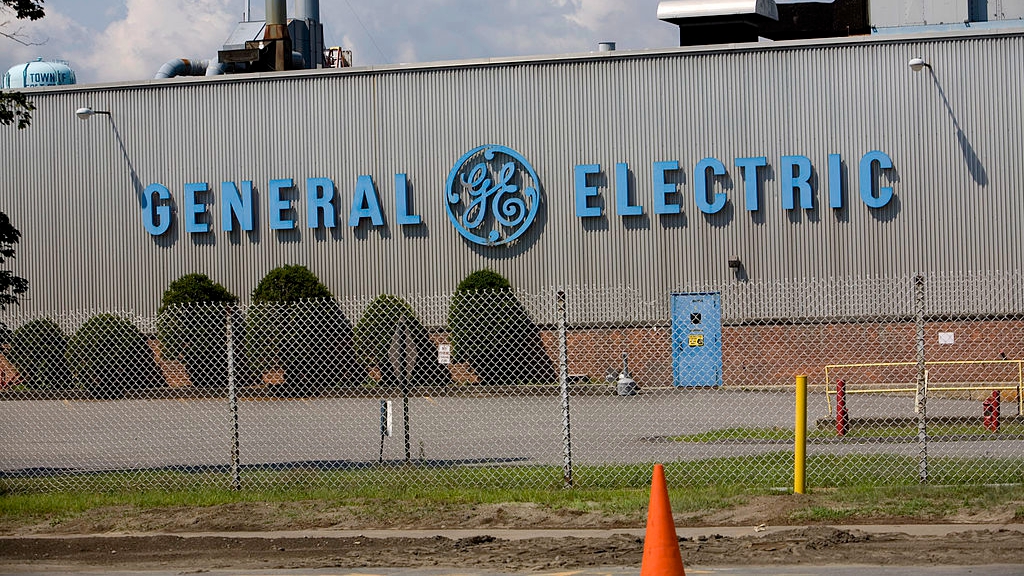
A General Electric logo hangs on the side of a GE factory in Fort Edward, New York. /Getty
Editor's note: Lu Jianfei, a research fellow at State Grid Energy Research Institute, specializes in energy, SOE reform and corporate governance. She holds a doctorate in management from Renmin University of China. The article reflects the author's opinions, and not necessarily the views of CGTN.
General Electric (GE), a 129-year-old American industrial conglomerate announced that it is breaking up into three separate companies earlier this month. The company will be divided into separate units focused on aviation, health care and energy by early 2024. Following a series of business line spinoffs, this movement is interpreted by the capital market as the collapse of an industrial giant. The company, once among the world's most valuable, is now worth only about 23 percent more than Uber. How could something that was once so right end up so wrong?
Decarbonization transition: The elephant in the room for GE
Represented by the adoption of the Paris Agreement by more than 200 countries, the importance of decarbonization has become an international consensus. Nevertheless, GE still held the assumption that demand for fossil fuels would continue to track global economic growth.
As a result, the company made a $13.7 billion acquisition of fossil fuel business of French industrial giant Alstom in 2015. But the levelized cost of energy (LCOE) from renewable energy had dropped rapidly in the meantime-wind's LCOE deceasing from $59 per MWh to $45 per MWh and solar's LCOE dropping from $79 per MWh to $43 MWh. It significantly weakened the advantage of fossil fuel generation.
GE was still optimistic about electricity power generation would continue to rise and the role of fossil fuels would be extremely important. The company doubled down on its bet on fossil fuels and paid $30 billion in 2017 to be major shareholder in oil and gas services company Baker Hughes. This movement intensified GE`s excessive financial leverage and led to years of corporate decline. Yet GE has paid its bill for misjudging the trend of energy transition.
China's answer to energy transition: A new-energy-dominant power system
Electric power plays a key role in energy transition in two ways. Firstly, electric power as clean energy will be the principal part in the total final energy consumption. According to IRENA data, electricity will increase from a 21 percent share of total final energy consumption in 2018 to over 50 percent in 2050.
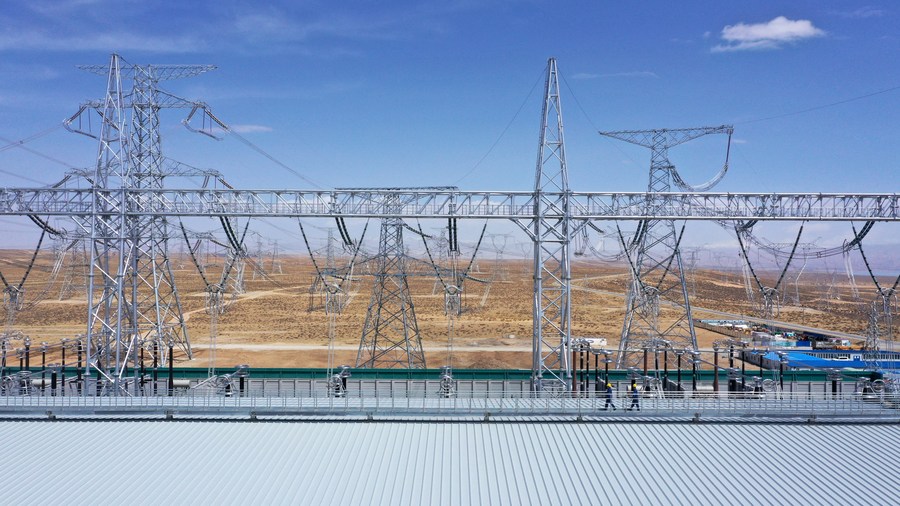
An ultra-high voltage direct current converter station in northwest China's Qinghai Province, April 16, 2021. /Xinhua
Secondly, as a secondary energy source, electric power can boost energy transition by adopting more renewable resources in place of fossil fuels. Renewable resource would come up to 86 percent of total electricity generation by 2050, and 66 percent of the world`s electricity generation would come from solar and wind power with installed wind capacity exceeding 6000 GW and solar capacity of more than 8500 GW by then.
Responding to the call of energy transition and the goals of peak carbon emissions and carbon neutrality, China proposed a new-energy-dominant power system as the answer in March this year. As is the core feature of the new system, new energy will become the main source of power supply. And electricity will be the main body in total final energy consumption. It forges ahead to reduce coal consumption and increase renewable energy in the power mix.
As a result, the new power system will significantly reduce the proportion of coal in China's total energy consumption which has dropped from 72.4 percent in 2005 to 56.8 percent in 2020. The new-energy-dominant power system, as an energy transition pathway ensures stable power and energy supplies, as well as save carbon reduction costs for the whole society.
Unlike GE, power enterprises in China are ready to seize the opportunities brought by the new-energy-dominant power system during global energy transition. Considering the renewable resources, especially solar and wind are intermittent and volatile, China's traditional grid network needs to be upgraded into an "energy internet."
To achieve this goal, power enterprises should make serious effort in power technology innovation and comprehensive power regulation capability improvement, as well as deeper market-oriented reform.
There is a long way to go, but power enterprises in China have already made remarkable progress in this direction. They have scored outstanding achievements in recent years to build a strong smart grid and improve the grid security level, such as guiding self-supplied power plants, traditional high-energy industrial loads, industrial and commercial interruptible loads, electric vehicle charging networks and virtual power plants to participate in system regulation. This will greatly boost the new power system construction, as well as the growth of the enterprise themselves.
As an ancient Chinese saying goes, "the heaven has its own law and those who embrace it will prosper." China has contributed its solution with a new-energy-dominant power system to promote global energy transition. Power enterprises in China also demonstrate a clear attitude to make further contribution to energy transition. All these efforts make energy transition in China worth looking forward to.
(If you want to contribute and have specific expertise, please contact us at opinions@cgtn.com.)
