- Home
- China
- World
- Asia-Pacific
- Americas
- Europe
- Middle-East and Africa
- Politics
- Business
- Opinions
- Tech & Sci
- Culture
- Sports
- Travel
- Nature
- Picture
- Video
- Live
- TV
- Specials
- Learn Chinese


Share







Copied
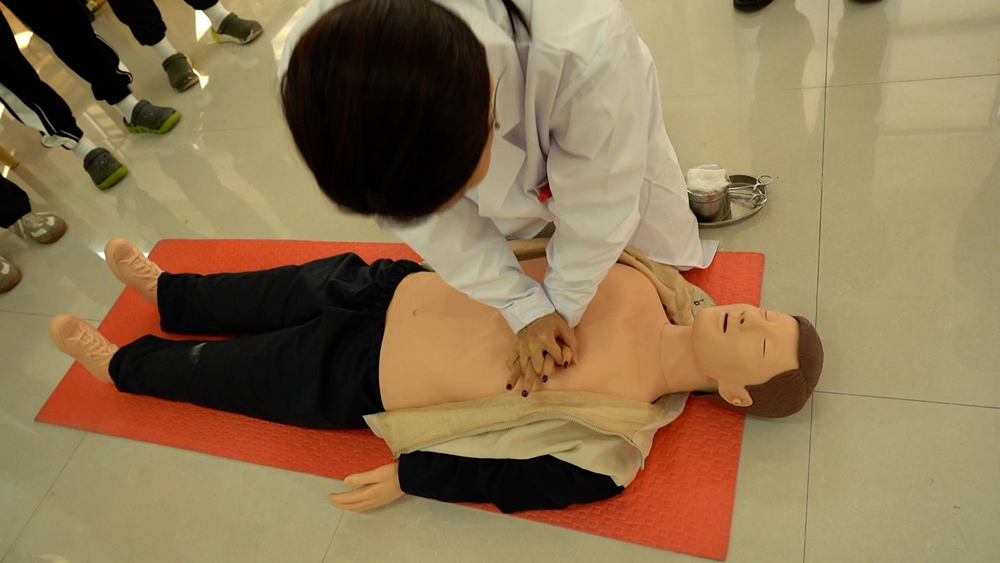
Cardiopulmonary resuscitation (CPR) is a technique that can save lives during an emergency. It helps keep the blood circulating after cardiac arrest until professional help arrives.
However, a report released by the National Center for Cardiovascular Diseases (NCCD) in 2019 said the rescue rate of cardiac arrest in China is less than 1 percent, urging the country to step up the training.
A compulsory course
Apply pressure with both hands on the patient's chest and blow air through the mouth – this instruction is part of the compulsory first aid course at the Physical Education College of Zhengzhou University.
Wu Yanbing, a sports teacher with almost 20 years of experience, now gives lessons on CPR in the university. She told CGTN that heart attack is the major cause of death for physical education students.
"They do vigorous exercise and can easily suffer a sudden cardiac shock. That's why CPR training is necessary," said Wu.
To perform CPR, students need to place their hands at the center of the patient's chest and exert pressure. Push hard and fast. It's not easy if one hasn't done it before, but it could save a life.
For some students, it's something worth learning. "It's a good skill and can protect us," one of the students told CGTN.
But for some, it's more than just training.
"I don't want to feel regret," said another student. "My CPR skills are not good now, but I will try to make it perfect. When sudden accidents happen, I just want to save lives."
First aid training is important for both students and teachers.
"The course is aimed at reducing damage as much as possible and protecting people," Wu explained, adding that it takes a long time for people to recover from cardiac arrest.
"So, this training can help physical education students or athletes prolong their professional career and save rehabilitation costs."
According to the NCCD statistics, about 550,000 people die of sudden cardiac arrest in China every year. That's one person every minute.
Zhang Shaotong, head of Party Committee at the Physical Education College of Zhengzhou University, told CGTN why it made first aid a compulsory course.
"The correct use of CPR within four minutes can effectively save people who are unconscious. It's not only protecting our students but could save people when they graduate," Zhang told CGTN.
China promotes first aid training
Besides CPR, an automated external defibrillator (AED) can also help the heart re-establish an effective rhythm by delivering an electrical shock.
The cost of installing AEDs might be high, which makes them less accessible. But China has taken action in that regard.
In Shenzhen, more than 3,500 AEDs were deployed by the end of August. Meanwhile, in Beijing, cabinets containing AEDs and emergency medicines have popped up at stations along four subway lines.
Shanghai authorities said all metro stations will be equipped with AEDs within this year, and Hangzhou has become the first city to legislate on the dissemination of AEDs in China.
The country also announced a plan in 2019 to distribute AEDs to all schools and public venues like airports and shopping malls.
