- Home
- China
- World
- Asia-Pacific
- Americas
- Europe
- Middle-East and Africa
- Politics
- Business
- Opinions
- Tech & Sci
- Culture
- Sports
- Travel
- Nature
- Picture
- Video
- Live
- TV
- Specials
- Learn Chinese


Share







Copied
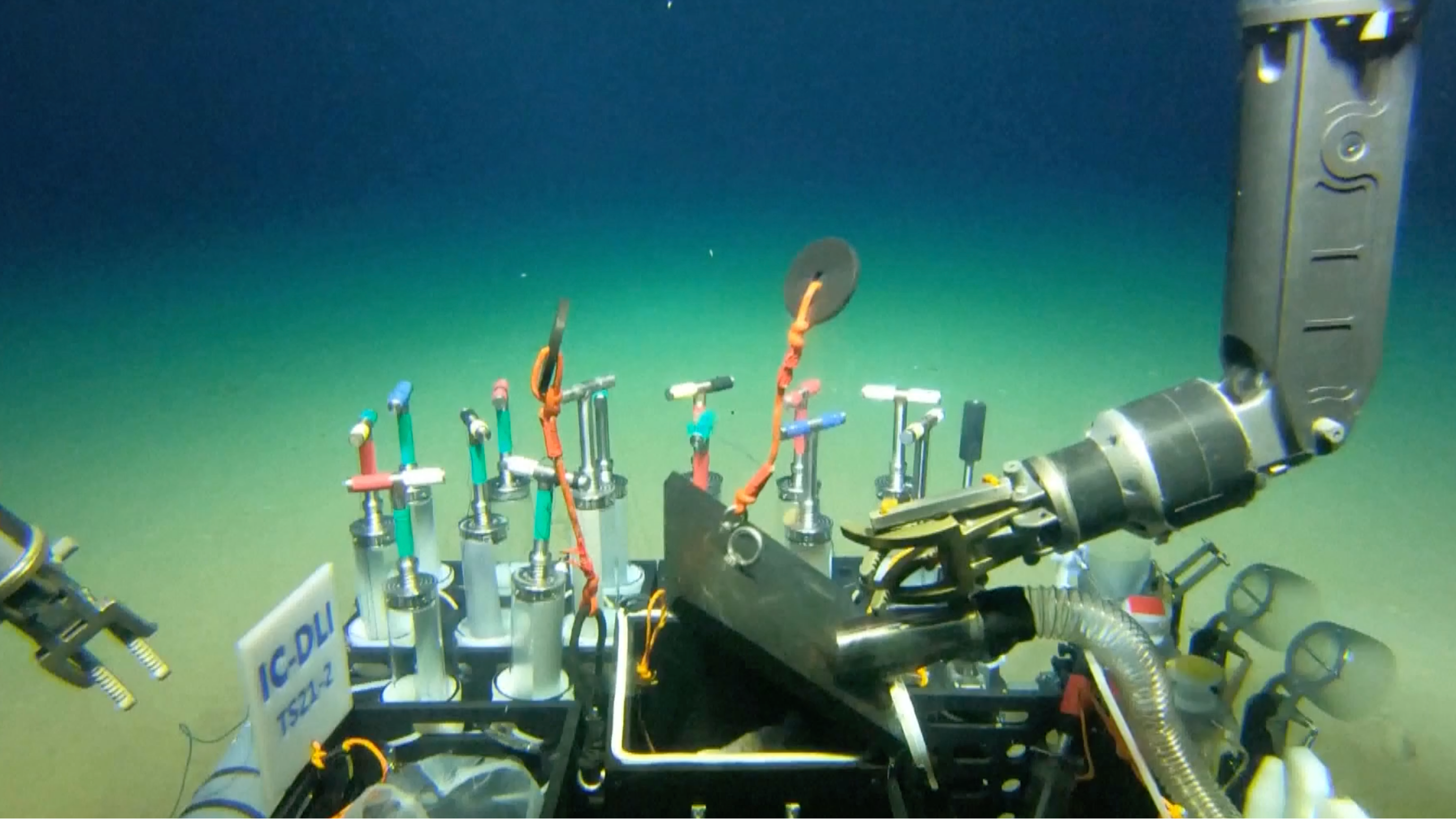
Chinese scientists initiated a consensus calling for a standardized system to enhance international cooperation for deep-sea expeditions during their latest expedition to the Mariana Trench.
China's scientific research ship Tansuo-1, which carries the deep-sea manned submersible Fendouzhe (Striver), returned to a port in the city of Sanya, in south China's Hainan Province, on Sunday, after completing a 53-day deep-ocean expedition to the Mariana Trench.
During the voyage, Chinese research teams jointly initiated the Mariana Consensus.
The consensus calls for the establishment of a standardized system for deep-sea expeditions to realize the long-term preservation and sharing of deep-ocean scientific samples and data, so as to achieve international cooperation on deep-sea expeditions.
"Since deep seas, especially those with a depth of over 10,000 meters, are mainly in international waters or some exclusive economic zones, they have become an important focus for our international peers. Therefore, we hope that our international counterparts can work with us together. I believe that through the Mariana Consensus, we will make more meaningful contributions to deep-ocean research," said Xiao Xiang, a professor at Shanghai Jiao Tong University.
The team also launched the Mariana Trench Environment and Ecology Research Project (MEER) during the expedition.
The project aims to invite more researchers from home and abroad to join in the MEER, so as to tackle major scientific issues together, such as the origins of life and environmental adaptation, biodiversity and climate change, among others.
"On the basis of such project, we are able to further digitalize the global biodiversity resources in the deep ocean and further explain scientific questions related to the origin of life and the adaptation techniques in extreme environments, which will also benefit the industrial application of these gene resources," said Xu Xun, scientist on the expedition team.
During the 53-day expedition, which started on October 14, the China-built Fendouzhe successfully completed 23 dives, six of which exceeded a depth of 10,000 meters.
The scientific researchers collected several large organisms, in-situ micro-organisms, sediments and rock samples, accumulating valuable data for use in genetic research on the area and understanding its geological structure.
(If you want to contribute and have specific expertise, please contact us at nature@cgtn.com.)
