- Home
- China
- World
- Asia-Pacific
- Americas
- Europe
- Middle-East and Africa
- Politics
- Business
- Opinions
- Tech & Sci
- Culture
- Sports
- Travel
- Nature
- Picture
- Video
- Live
- TV
- Specials
- Learn Chinese


Share







Copied
Getty
Editor's Note: Chen Jing is a policy analyst and adjunct research fellow at Shangdao Institute for Social Research, a Nanjing-based social think tank specializing in research on China's domestic and foreign policy. Chen's research interests include China-U.S. relations and women's development. The article reflects the author's opinions and not necessarily the views of CGTN.
Politicians in the U.S., the self-proclaimed "beacon of democracy," are committed to spreading their democratic practices to all corners of the world, and the holding of the so-called Summit for Democracy, which is partly claimed to outcompete China, is just one case in point. However, as U.S. President Joe Biden endeavors to "light up" the world, young Americans are shrouded in darkness.
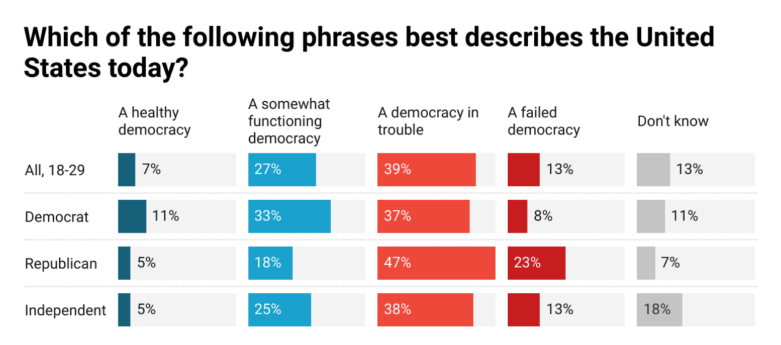
A screenshot of Harvard Institute of Politics Youth Poll on December 10 about U.S. people's attitude towards U.S. democracy. /Harvard Kennedy School Institute of Politics
According to a recent poll released by Harvard Kennedy School in December, 52 percent of young Americans believed that their country's democracy was either "in trouble" or "a failed democracy," with just 7 percent saying U.S. democracy is "healthy." One may wonder the reasons underlying the paradoxical phenomenon that why the younger generation in the country holds such a bleak view of its self-claimed best democracy in the world.
The first factor, as the poll suggests, is younger Americans' growing worries about climate change, an issue that the U.S. government fails to handle efficiently. Although Biden has pledged sharp cutbacks in carbon emissions and would seek to make the U.S. "reaching net zero emissions economy-wide by no later than 2050," the Democratic president's climate agenda is very likely to meet strong resistance from the Republicans given the increasingly intensified partisan conflicts and social cleavage. The Republicans sponsored by giant oil companies would be more than just reluctant to cooperate with Democrats on issues such as clean energy.
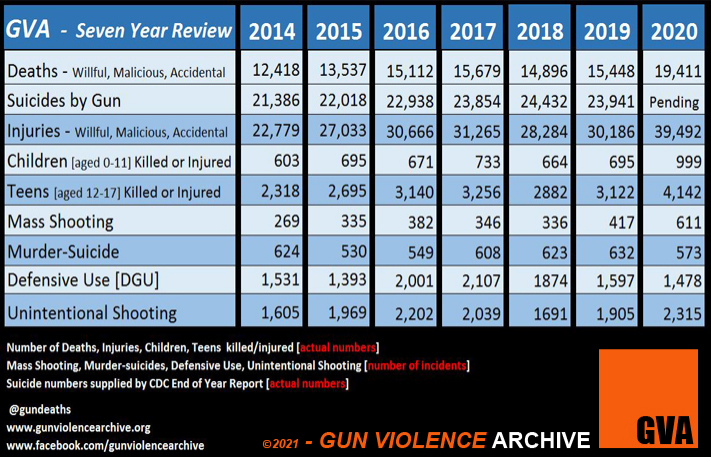
A screenshot of Gun Violence Archive on December 10 about U.S. gun violence. /Gun Violence Archive
Gun safety is another key factor at play. Gun Violence Archive, a website that tracks shooting in the U.S., reveals that there were 991 gun violence deaths among people aged 17 or younger in 2019. The number increased to 1,378 in 2020 and climbed to 1,429 in 2021 till December 9.
Even with such startling numbers, the National Rifle Association, one of the largest and most influential American interest groups, is still striving to push both the executive and legislative branches to block gun control policies and legislation. Although the Biden administration has introduced gun control plans, the opposition from Congress is evident. An expected gloomy result of the coming midterm elections for the Democrats will only make Biden's gun control agenda even harder to achieve.
Most importantly, the COVID-19 pandemic is an urgent issue troubling young people in America. As of December 2, over 7 million children have tested positive for the virus since the onset of the pandemic, according to data collected by the American Academy of Pediatrics and the Children's Hospital Association. To make the matter even worse, young Americans are more reluctant to be vaccinated due to their skepticism about the safety of the vaccine.
Apart from that, young Americans are suffering from an identity crisis. As the Biden administration emphasizes the importance of inclusiveness of different ethnic groups, the race problem still lingers as major trouble in America. For instance, Critical Race Theory, an education course aimed at informing young people that racism is embedded in the American legal system, also becomes a political target. Politicians are making full use of this issue to gain votes instead of deciding on what is beneficial to young people's development.
With that said, the aforementioned factors are ostensible reasons explaining American youth's frustration about their democracy. As partisan conflicts continue to intensify, both Democrats and Republicans are collecting selling points to cater to their voters, making young people feel their interests are largely ignored. They are experiencing a sense of betrayal when the U.S. government does not act on behalf of its people but of those interest groups.
In essence, young Americans are desperate with the decaying democratic institutions that are incapable of managing these tricky and pending issues. In another word, they are disillusioned with the country's political system and social governance capabilities.
Since the younger generation shapes the future, their viewpoints are of significance and should never be underestimated. For Biden, how to boost his people's confidence, young people in particular, is more important than just to organize the "Summit for Democracy" to show off U.S. democracy and to outcompete China. Favorable views of America by the country's younger generation should be the key yardstick to measure a genuine democracy.
(If you want to contribute and have specific expertise, please contact us at opinions@cgtn.com.)
