- Home
- China
- World
- Asia-Pacific
- Americas
- Europe
- Middle-East and Africa
- Politics
- Business
- Opinions
- Tech & Sci
- Culture
- Sports
- Travel
- Nature
- Picture
- Video
- Live
- TV
- Specials
- Learn Chinese


Share







Copied
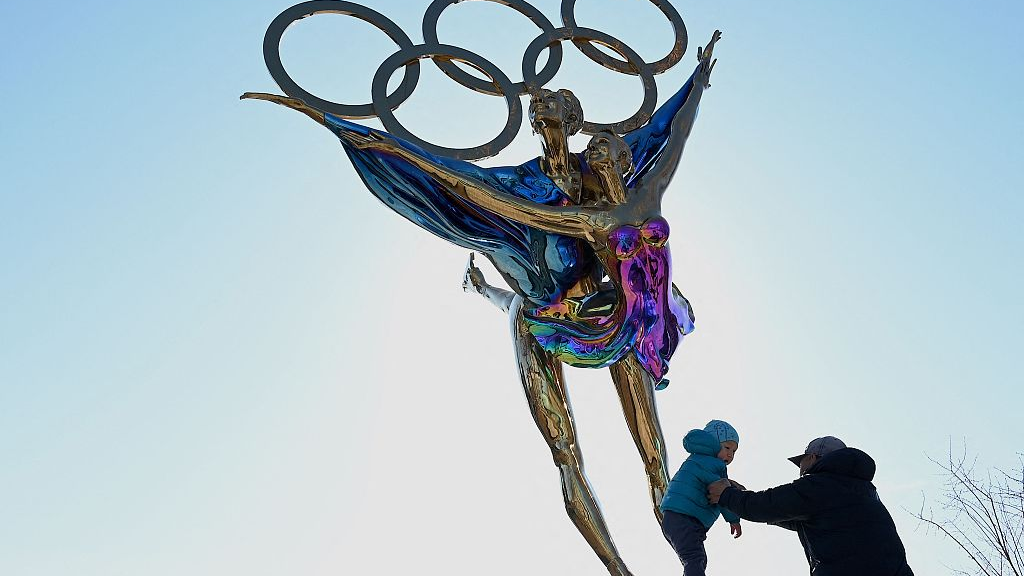
A child stands on a statue with the Olympic Rings titled "Dating With the Winter Olympics," near the headquarters of the Beijing Olympic Organizing Committee in Shougang Park, west Beijing, China, December 7, 2021. /VCG
Editor's note: Abu Naser Al Farabi is a Dhaka-based columnist and analyst focusing on international politics, especially Asian Affairs. The article reflects the author's opinions, and not necessarily those of CGTN.
Boycotting sports events for political reasons, mostly for the rivalry between or among the parties involved, is not quite unique in sports history, while boycott of such grand events as the World Cup or the Olympics could cause huge global repercussions.
The full-scale U.S. boycott of the Summer Moscow Olympics in 1980 and the subsequent Soviet boycott of 1984's Summer Olympics in Los Angeles are among the most significant. We have not seen a boycott of that scale since the end of the Cold War.
But politics is striking back again, given the U.S. decision to diplomatically boycott the Beijing Winter Olympics starting in February, and it seems that Generation Z is going to witness another cold-war analog in the field of sports.
Ostensibly, the Biden administration has decided to boycott the Beijing Olympics in response to the so-called human rights abuses and genocide in China's Xinjiang Uygur Autonomous Region. But beyond this background chorus, there lies a long-played geopolitical gambit on the part of the West – politicizing global platforms or inflating domestic issues to score geopolitical points.
To dig out what plays behind America's concern about Chinese "human rights abuse" in Xinjiang, we need to go deep down to the West's long history of deception and demonization regarding China.
In the early years of the People's Republic of China, the U.S. played the "Tibet Card" with its all intelligence and covert military apparatus to undermine China from within. But due to then-Chinese leader Mao Zedong's strong resolve to hold on to the nation's integrity and sovereignty, the U.S. and its allies drastically failed in their mission.
Simultaneously, it had used Taiwan region as a cold-war outpost to drive a wedge between China and the former Soviet Union. Those geostrategic cards, which remained relatively frozen for years after the rapprochement between two countries in the late 1970s, have started to reemerge.
But this time, the U.S. and its allies are apparently more willing to add the "Xinjiang Card" as another weapon to undermine China's rise.
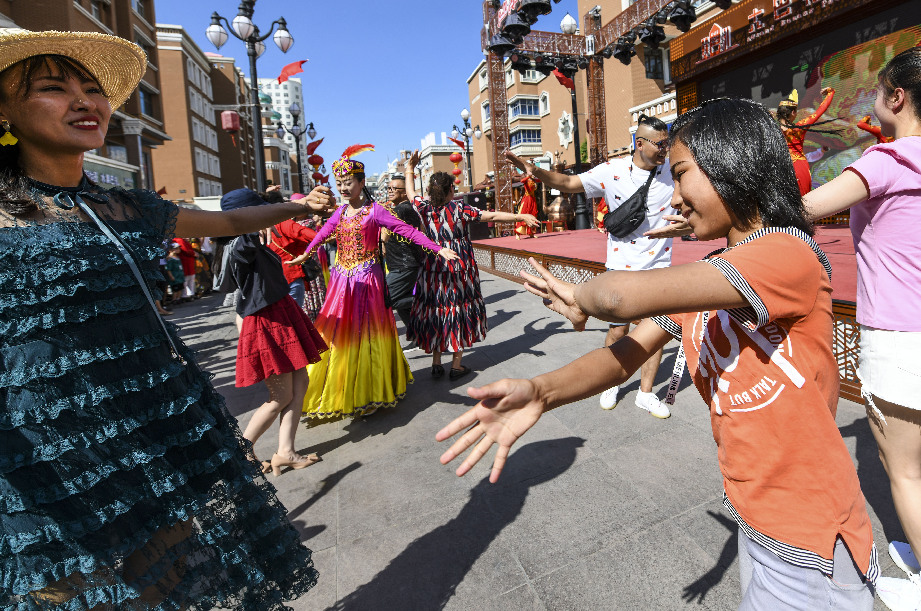
People dance in the streets at the International Grand Bazaar in Urumqi, northwest China's Xinjiang Uygur Autonomous Region, July 2, 2019. /Xinhua
But why has the U.S., along with its allies, so desperately pushed China's so-called human rights abuse and genocide in Xinjiang into international discourse while showing a brazen disregard for its own egregious human rights violations?
The timing around the resurgence of the Xinjiang issue and the U.S. desperation regarding missing out on its "hegemonic primacy" are two things that certainly hold the answer to that question.
It had all started during the Trump administration, with a war against Chinese exports to the U.S. But these impetuous trade policies started to backfire, making the administration desperate to devise out new weapons to demonize China.
With few strategic arrows in its toolbox, the Trump administration in its sunset years resurrected the Uygur issue as a part of its broad strategic assault against China. This autonomous region was known for separatist insurgency, partly fueled by external agents, but the Trump administration had, in turn, begun to paint it as a ground of ethnic cleansing.
First, the U.S. delisted the East Turkestan Islamic Movement, an insurgent group, active in and around Xinjiang, from an international terrorist list in November 2020, and at the same time embarked on an outrageous campaign with its media and intellectual mechanisms to manipulate global discourse, giving China's ethnic policy an egregious portrayal.
To the naked eye, it may seem an outpouring of empathy to Uygur Muslims, but at its core, it's a political hook and outright hypocrisy. It is not necessary to look too far back to history as the ongoing humanitarian catastrophe in Afghanistan, unfolding due to the U.S. withdrawal and financial squeeze, is testimony to sacrilegious Western sanctimony.
Having enjoyed absolute global primacy for more than two decades, the U.S. has been declining, particularly since the 2008 economic recession and mostly for its hubris-driven overstretching. Haunted by the phantom of supremacy, the more America is losing to China, the more desperate it is getting.
And out of desperation to salvage its increasingly fading sheen, the U.S. looks at everything, be it bilateral or global, through the cold-war lens. And its diplomatic boycott of the Beijing Winter Olympics is no exception to that.
Given the global struggle against common threats, like the pandemic and climate change, and the exigency of forging broader cooperation to combat them, polarizing decisions such as America's will further hamstring the already crippled collaboration on humanitarian objectives.
Grand sports events, like the Olympics, are supposed to be grand confluences of global political stakeholders, with a chance to narrow their gaps and contribute to "global good." But if the U.S. continues to stick to its boycott and rally support for the decision, it will just end up polarizing and fragmenting the world.
(If you want to contribute and have specific expertise, please contact us at opinions@cgtn.com.)
