- Home
- China
- World
- Asia-Pacific
- Americas
- Europe
- Middle-East and Africa
- Politics
- Business
- Opinions
- Tech & Sci
- Culture
- Sports
- Travel
- Nature
- Picture
- Video
- Live
- TV
- Specials
- Learn Chinese


Share







Copied
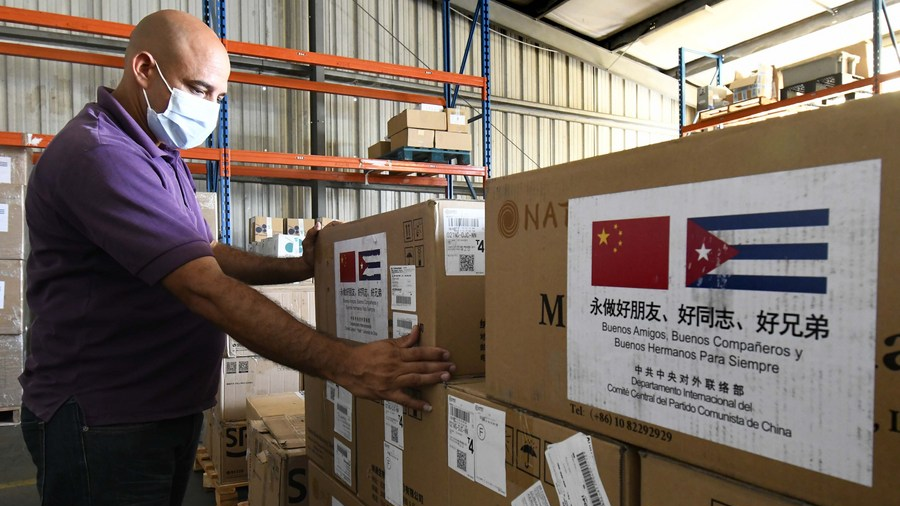
A staff member transports medical supplies donated by the International Department of the Communist Party of China Central Committee in Havana, Cuba, May 6, 2020. /Xinhua
Editor's note: Elias Jabbour is a professor in the Faculty of Economic Sciences at the State University of Rio de Janeiro. The article reflects the author's opinions and not necessarily the views of CGTN.
After two centuries of the great struggles that led Latin America to its first formal independence processes, the great question that surrounds the progressive circles of our region is when the so-called "second independence" will be conquered.
The most attentive are aware that Latin America is known as the "backyard" of the United States. That is, a natural area of influence and the region of the world where imperialism has always openly exercised its power, whether by force, directly organizing or overthrowing any government that affronts its interests, or by imposing boycotts that lead to the economic suffocation of a country. An exception is the brave Cuban people who, since 1959, have maintained their national dignity even in the face of the violent and, in the words of the American intellectual, Noam Chomsky, a sadistic economic blockade.
Venezuela lives a similar situation. The Bolivarian revolution is under the broadest economic and political blockade, but remains irreducible in the face of the external threat to its integrity and sovereignty. The combination of economic blockade, the Venezuelan government's dollar freeze abroad and the nation's withdrawal from the international payments system (SWIFT) is pushing the country into a major humanitarian crisis. This is the concept of human rights that the U.S. has to offer to those who reject the rules of its game of domination, whether in Latin America or in the world.
It is interesting to note that while Latin America is a "natural area of influence" for the U.S., this region also figures as the weak link in the imperialist chain. It was in Latin America that potential anti-hegemonic movements have emerged more recently. Evo Morales' Bolivia is an example in that not even a coup d'état was able to prevent his Movement for Socialism (MAS) from returning to government.
Another example comes from Peru, where a progressive government was consolidated. And in my country, Brazil, after the 2016 parliamentary coup, there is a real possibility of the return of progressive forces to the government. Not to say that Bolsonaro's defeat in the upcoming general elections would have a profound effect on all of Latin America. I have written and said that since the discovery of immense oil reserves in its territory, Brazil has become one of the epicenters of the great geopolitical game in the world. Lula da Silva's return to the presidency of the Republic would be a major setback for U.S. policy and a great milestone in the long-awaited "second independence of Latin America."
But as I mentioned before, there is a big geopolitical game going on. An interesting move was played by Nicaragua when the country broke with the Taiwan region and recognized the Beijing government as the only legitimate government representative of the Chinese people in the world. This is not a trivial fact.
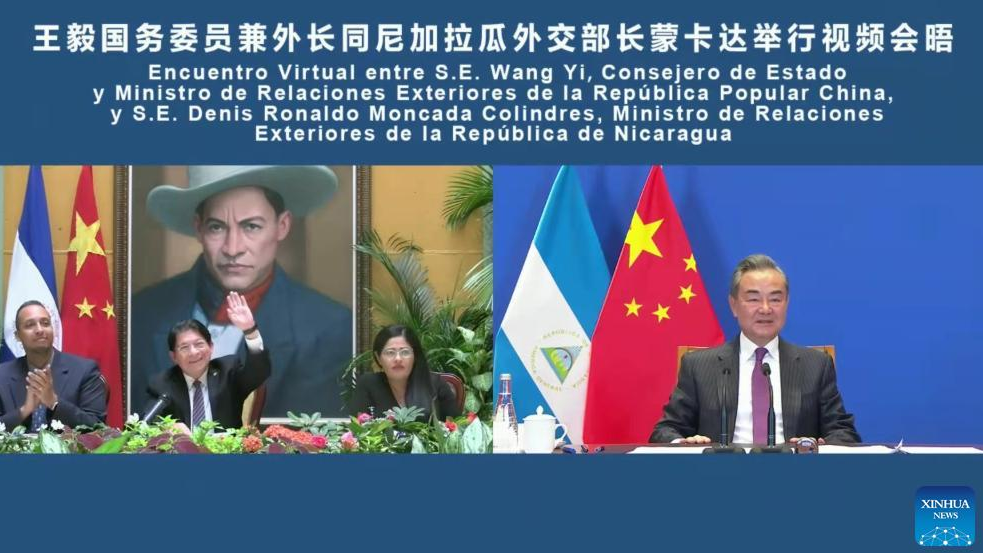
Chinese State Councilor and Foreign Minister Wang Yi meets with Nicaraguan Foreign Minister Denis Moncada via video link in Anji, east China's Zhejiang Province, December 10, 2021. /Xinhua
Imperialism has made extensive use of its military and propaganda capabilities to wage a semiotic war against China, with a view of shaping global public opinion against the country and, at the same time, raising the military capacity of puppet governments like Australia, Japan and authorities like Taiwan. In addition, of course, it sponsors widespread instability on the Korean peninsula and the South China Sea. It is no exaggeration to say that the U.S. is the greatest threat to global security in the world today.
On the other hand, Chinese state capacities in the areas of trade and exports of public goods have gradually become a powerful instrument of soft power. The Chinese are not interested in hegemony and the imposition of their model on the world. It is no exaggeration to say that – in addition to powerful mass internal political movements – China and its trade, investment and non-interference policy in other countries' internal affairs – became a fundamental geopolitical variable on the Latin American scene.
China is already the biggest trading partner of many Latin American countries and even the main source of foreign productive investment. Instead of promoting coups and exporting poverty to Latin America, China has shown great flexibility in dealing with different national demands.
It is not in China's interest that Latin American countries become impoverished, but it is up to the countries of the region to adopt a more strategic posture in view of the possibilities opened up by the Chinese. The struggle for our second independence necessarily involves our political choices, our ability to lead large progressive political majorities and to establish friendly relations with the U.S. but also to seize the great opportunities opened up by the transformation of China into an exporter of great public goods.
Apparently, Argentina, governed by Alberto Fernandez, understood this idea pretty well, as the great partnerships signed with the Chinese demonstrate. Nicaragua has its strategic project and it certainly counts on China. On Brazil, Deng Xiaoping was prophetic when he pointed out in 1988 in an article "Establishing a New International Order on the Five Principles of Peaceful Coexistence" that there will not be the Latin American century when there is no development for Brazil.
(If you want to contribute and have specific expertise, please contact us at opinions@cgtn.com.)
