- Home
- China
- World
- Asia-Pacific
- Americas
- Europe
- Middle-East and Africa
- Politics
- Business
- Opinions
- Tech & Sci
- Culture
- Sports
- Travel
- Nature
- Picture
- Video
- Live
- TV
- Radio
- Specials
- Learn Chinese


Share







Copied
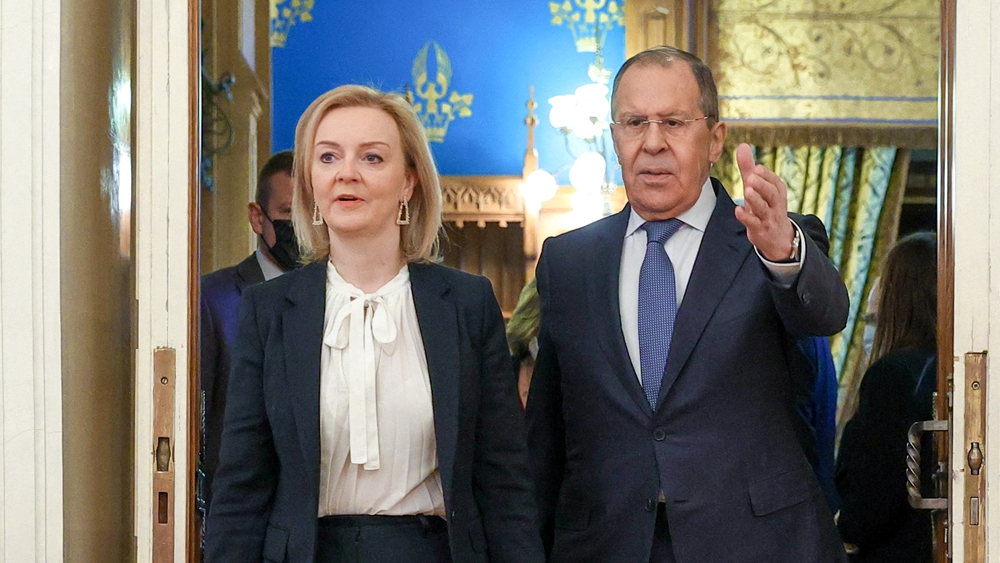
Russian Foreign Minister Sergei Lavrov (R) and British Foreign Secretary Liz Truss attend a meeting in Moscow, Russia, February 10, 2022. /Reuters
Editor's note: Abu Naser Al Farabi is a Dhaka-based columnist and analyst focusing on international politics, especially Asian Affairs. The article reflects the author's opinions, and not necessarily those of CGTN.
U.S. foreign policy, since America's emergence as a global power, has followed a typical order: fabricating an imaginary enemy, adopting incendiary schemes around it, eliciting reactionary bids from the opponent, and then, in response, venturing into the militaristic move maneuvered around dubious doctrines like the war on terror, protection of political sovereignty and responsibility to protect (R2P).
In this respect, the U.S. subtly camouflages its contriving actions that cause opponents, in its words – U.S. adversaries, to react and demonize the opponents' withstanding efforts in a diabolic fashion. In this effort, it uses its expansive media coverage simultaneously to dye its deeds as something rational and moral, on one hand, and to depict opponents as doing something devilish and destabilizing, on the other – thus manipulating global discourse in its favor.
The current escalating tensions between Ukraine and Russia are similar sorts of outcomes resulting from the longstanding U.S. policy trend that ranges from provoking tensions to invoking reaction, and then to inflaming eventual escalation. In both cases, its global media machinations are bombarding messages into the public domain absolutely on the current "tensions" rather than on "the provocations" that have long festered into the prevailing near-atrophic situation.
Concerning the current tensions between Ukraine and Russia, the Western strategic community seeks to communicate the crisis as something created out of a range of reasons – Russia's revisionist aggression and Putin's thrust for peer recognition and lust for personal legacy.
Even absurdly, some are trying to draw a parallel between the recent spike in oil prices and Russia's military maneuvers along the Ukraine-Russia border. But a look back into history would invalidate the very ground of these causations and lay bare America's long-standing behind-the-scenes menacing that has metamorphosed into the current crisis.
The greatest geopolitical catastrophe of the 20th century, the very dissolution of the Soviet Union, is where the seeds of this crisis were sown. The disintegration of the Soviet Union led to the creation of 15 independent countries, including Russia. But quite grotesquely and contrary to the West's long-preached principle of self-determination, the former administrative boundaries of the Soviet Union became the borders of newly created nation-states. As a result, more than 25 million ethnic Russians were dissected from mother Russia and became minorities in the new states, half of them in Ukraine.
The seeds of the crisis had grown into the saplings in 1999 when, having breached its earlier commitment not to expand NATO's claws into the former Soviet space, the U.S. allowed accession of multiple former Warsaw Pact countries into NATO. Russia's then geopolitical weakness and economic volatility at home were exploited to the enlargement of the alliance.
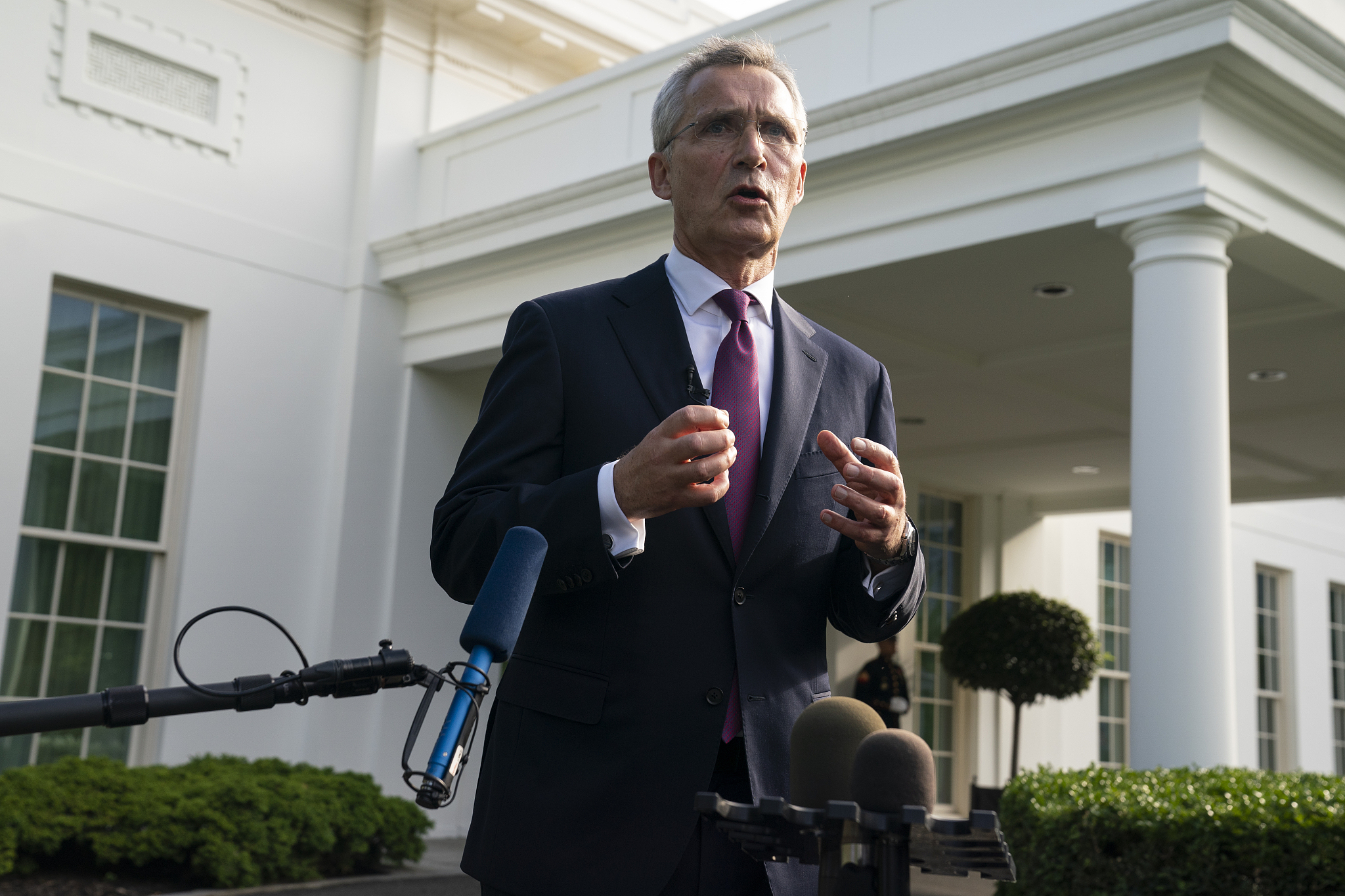
NATO Secretary General Jens Stoltenberg talks to reporters after meeting U.S. President Joe Biden at the White House, Washington, D.C., U.S., June 7, 2021. /VCG
Even after the fall of the Soviet Union along with the decimation of NATO's rival alliance, the Warsaw Pact, NATO continued its eastward expansion, with gradual divergence from its core mission of defense and drifted more toward offense that was first demonstrated in its aerial campaign during the Kosovo War in 1999.
A further ramification of its shadow on Russia's frontier, NATO allowed membership of seven East European countries including Estonia, Latvia and Lithuania. In a brazen show of U.S. "superpowerdom," this accession came at a time when Vladimir Putin had even shown the inclination to go for reconciliation with the West.
At the same time as the continued eastward expansion of NATO, the U.S. kept carrying out its cold-war contrivance – fomenting artificial rebellion across East and Central European countries in the name of "color revolutions," with the aim of toppling the regimes it deemed antagonistic to its interests and obstacles to the furtherance of its sphere of influence. The "Orange Revolution" in 2004 and the "Euromaidan" in 2014 in Ukraine are no exception to that end.
The ongoing crisis, from Russia's perspective, is less about Ukraine and more about the West's provocative policies across Europe. NATO's military posture built through successive rounds of expansion and no epilogue to its open-door policy at sight and Ukraine's renewed aspiration to join the alliance and the West's acquiescence to that end, have pushed Russia's fear of further encirclement by the West to an undeniable reality and put its security concern into inevitable jeopardy.
The current crisis between Russia and West-led Ukraine is not a sudden development, rather a long-brewing one that has reached its closest point of erupting. But the way the West is currently portraying the event subtly, and of course, deliberately, dodges the provocative developments that have led up to the current escalation. Delving deep into the long-played U.S. foreign policy trend, one could easily discern, beneath all sorts of "aggression" on the part of U.S. rivals, long-standing provocations from America and its so-called allies.
(If you want to contribute and have specific expertise, please contact us at opinions@cgtn.com.)
